From Pilot to Production: 7 Enterprise AI Problems and Our Solutions
Examining seven real enterprise challenges in moving agentic AI from pilots to production from the AWS Executives in Residence 2026 report Reimagine: Turning AI into Value, paired with ReadyForAI shipped capabilities and clear operational boundaries.
On this page (9)
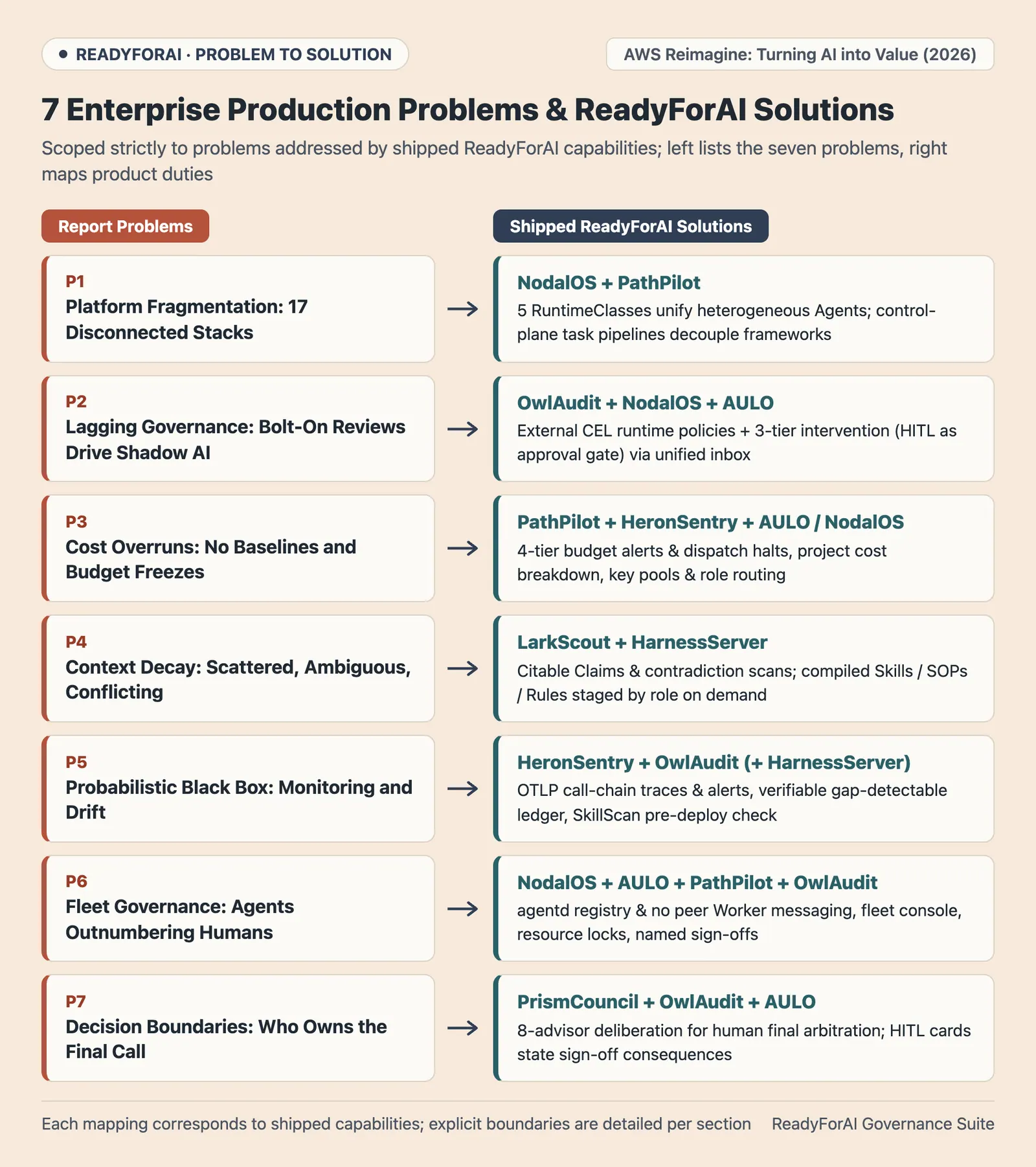
- 1. Platform Fragmentation: 17 Disconnected Stacks
- 2. Lagging Governance: Bolt-On Reviews Drive Shadow AI
- 3. Cost Overruns: No Baselines and Budget Freezes
- 4. Context Decay: Scattered, Ambiguous, Conflicting
- 5. Probabilistic Black Box: Monitoring and Drift
- 6. Fleet Governance: Agents Outnumbering Humans
- 7. Decision Boundaries: Who Owns the Final Call
- Closing: Start as a Full Deployment Project from Day One
- References
In 2026, the AWS Executives in Residence team published Reimagine: Turning AI into Value. Over nine months, they interviewed 154 executives representing 128 organizations across four continents and 23 industries—alongside more than 30 senior leaders inside Amazon and internal research spanning over 35,000 practitioners in 27 countries—to answer one question: why do most organizations stall in pilot mode while only a few turn AI into measurable business value?
Data cited in the report points to a clear gap: 84% of executives believe agentic AI will transform their business, yet only 6% trust it for core processes today, even as nearly 79% expect to increase agentic AI spend over the next year (from the AWS blog post Agentic AI: Bridging the Widening Gap Between Ambition and Execution, cited in the report). Meanwhile, Gartner forecasts that more than 40% of agentic AI projects will be canceled by the end of 2027 due to spiraling costs, insufficient governance, and unclear value.
The report states its overarching conclusion early: "organizations reporting they are getting the most value from AI are not the ones with the most AI. They are the ones who know what AI is for, and just as importantly, what it is not."
Rather than summarizing the entire report, this article takes a Problem → Solution → Boundary engineering approach. We selected seven real production problems from the report where ReadyForAI has shipped, verifiable capabilities, explaining which product handles what and where each solution stops.
1. Platform Fragmentation: 17 Disconnected Stacks
The Problem
Chapter 8 highlights a common failure pattern in enterprise infrastructure. Meghan Glabach, Vice President at Advocate Health, found that every prototype arrived with its own underlying stack; within two years, she counted 17 disconnected platforms—"each too small to govern but too different to consolidate."
The opposite mistake is just as damaging: attempting to build a single all-encompassing platform divorced from real use cases. That produces a rigid system where every team seeking a new data connection or workflow change must wait behind a central platform team, turning the platform into an engineering bottleneck.
The report's guidance is direct: staff the platform team as "an enabler, not a gatekeeper," and at the orchestration layer, "Buy the infrastructure and own the logic"—because agent frameworks evolve rapidly, and decoupling domain orchestration logic from any single framework protects enterprise workflow assets.
Our Solution
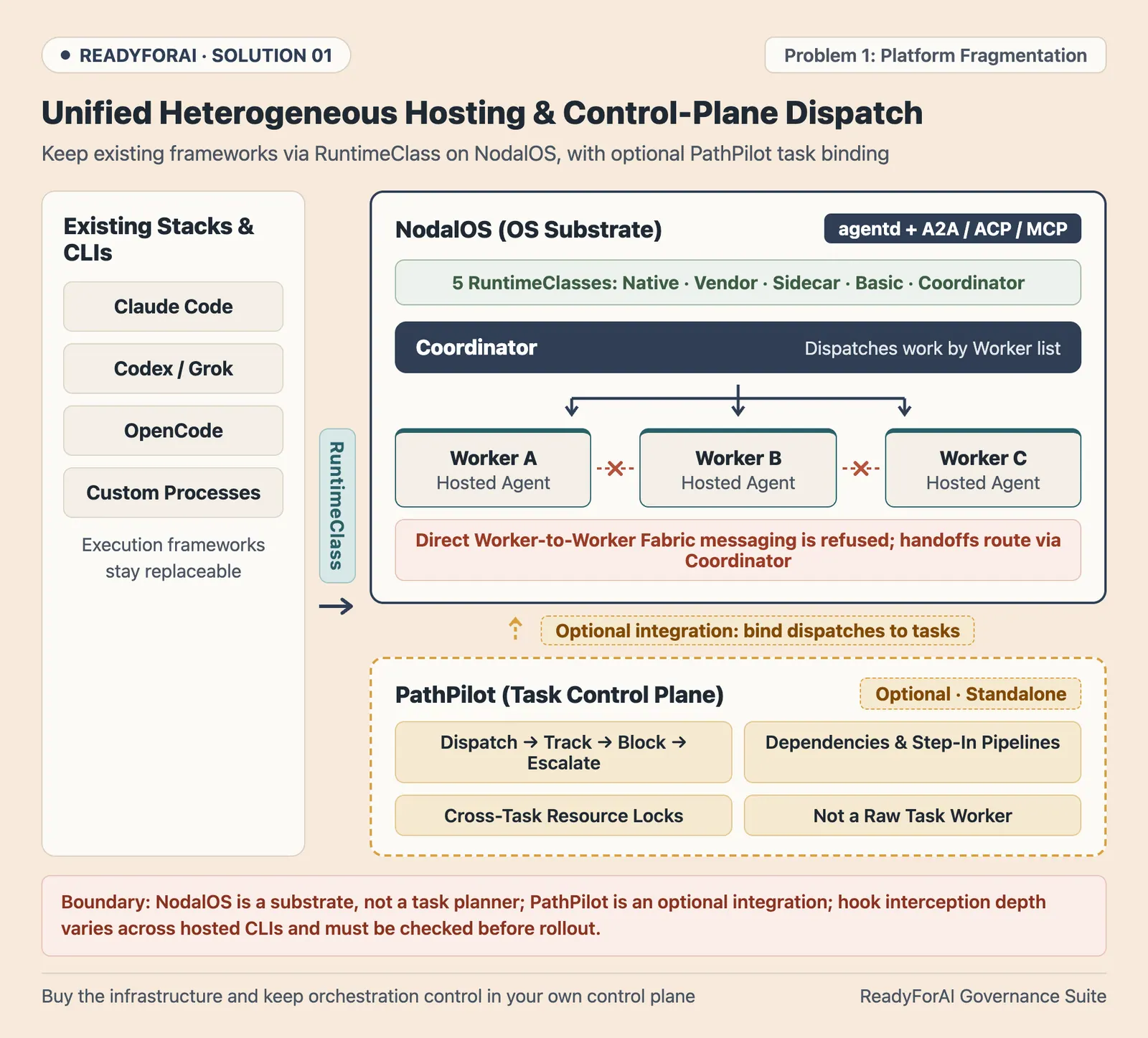
Following our architecture thesis in Build Your Own Control Plane and Beyond "Orchestration Theater", NodalOS (see nodalos.org) and PathPilot keep shifting agent frameworks replaceable on the execution plane while holding dispatch and governance control in your own substrate and control plane. NodalOS supervises existing coding CLIs or custom processes via agentd, five RuntimeClasses, and native protocol interoperability while blocking peer Worker messaging and routing handoffs through Coordinator dispatch; optionally connecting PathPilot binds dispatches to task lifecycles, dependencies, escalations, and cross-task resource locks. Teams keep existing Agents without rewriting them while retaining unified scheduling and replaceable frameworks.
Boundaries
NodalOS is a runtime hosting substrate, not a task planner; PathPilot is an optional integration and does not act as the raw task worker. In addition, hook interception depth varies across managed CLIs (some lack an "ask human" step, and provider-hosted tools bypass local hooks), so runtime support must be checked before deployment.
2. Lagging Governance: Bolt-On Reviews Drive Shadow AI
The Problem
Chapter 5 cites a 2025 AWS-commissioned European survey (Unlocking Europe's AI Potential): more than half of SMEs and large enterprises and three-quarters of startups already use AI, yet only 24% have a documented approach to responsible AI and only 10% have a data governance strategy. Organizations uncertain about regulatory obligations plan to invest up to 28% less in AI over the next year.
Approvals create an equally sharp conflict. Applying six-month IT review committees, legal sign-off forms, and blanket manual gates to prototypes built in days produces bolted-on governance that treats every use case as high-risk and pushes teams toward unmonitored "shadow AI"—as Boston University CIO Chris Sedore estimates in the report, roughly 40% to 50% of people on campus use AI weekly, some inside approved systems and some "going rogue."
The report recommends governance by design, risk tiering calibrated to the cost of being wrong, and "Approve patterns, not individual use cases," ending with a clear test: are controls outside the model in infrastructure, or inside a prompt hoping the model complies?
Our Solution
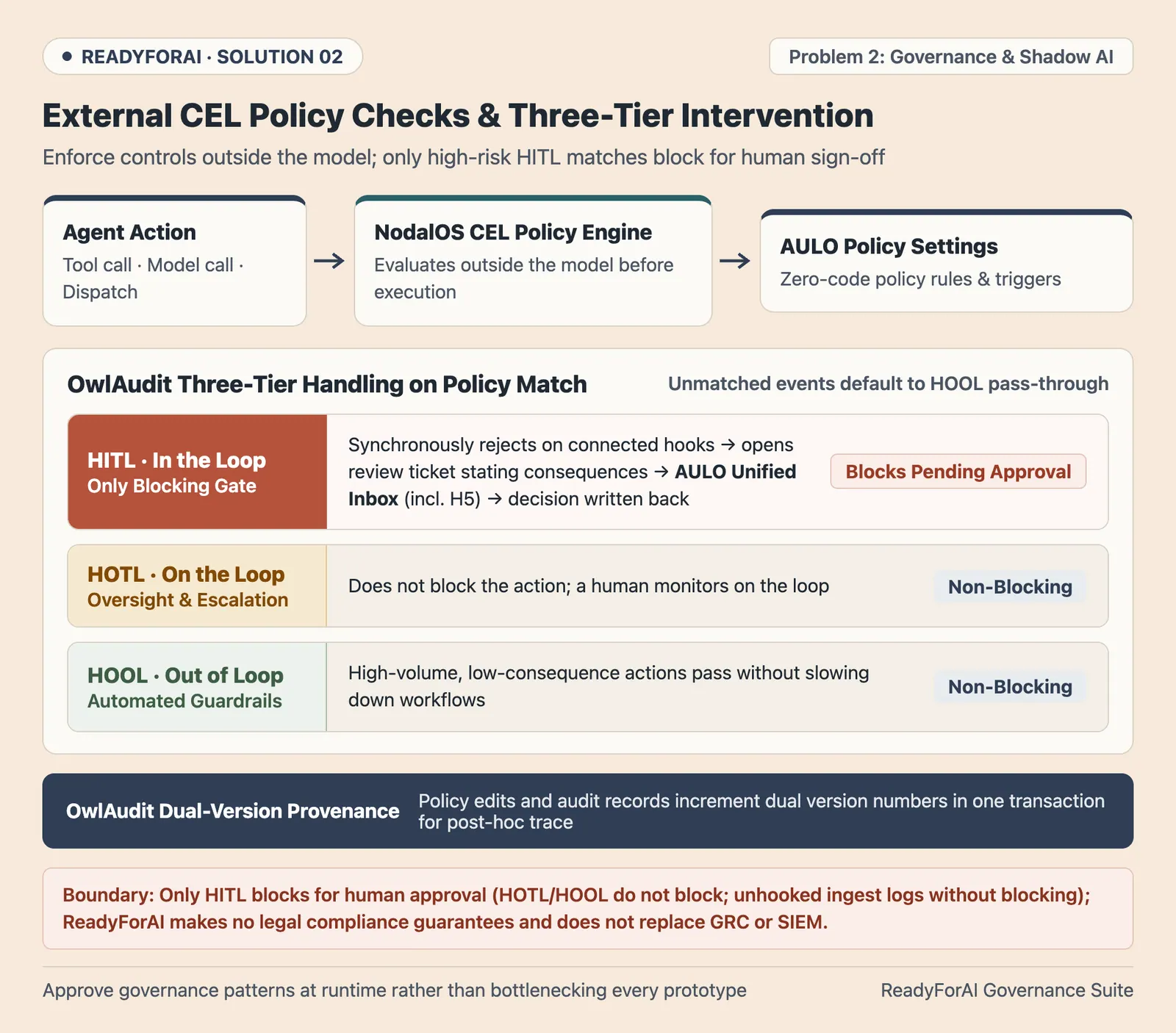
As argued in Production Does Not Trust Prompts, deterministic governance belongs outside the model rather than inside system prompts. ReadyForAI connects NodalOS, OwlAudit, and AULO to enforce tiered runtime guardrails: NodalOS evaluates CEL policies before tool calls, model calls, and dispatches, and invokes OwlAudit at hooked interception points to apply compliance policies across three tiers (HITL / HOTL / HOOL). Only HITL synchronously blocks an action and opens a review ticket in AULO's unified inbox (also accessible via mobile H5)—listing approval/rejection consequences and timeout paths—with decisions written back upstream; policy edits and audit records increment dual version numbers in one transaction, and admins manage rules in AULO without touching Agent code. Routine actions move smoothly while high-risk actions hit clear gates with policy-version provenance.
Boundaries
Among OwlAudit's three tiers, only HITL blocks an action pending human approval—HOTL and HOOL do not block, and unhooked generic ingest logs calls without blocking. ReadyForAI supplies runtime technical governance tools; it makes no legal compliance guarantees and does not replace legal counsel or existing GRC/SIEM platforms.
3. Cost Overruns: No Baselines and Budget Freezes
The Problem
Chapter 6 explains why traditional cloud FinOps cannot be copied straight onto AI. Cloud migration moved existing workloads with known transaction baselines, whereas AI creates new workloads that did not exist last quarter, leaving no historical baseline to extrapolate from.
Unit costs also swing sharply: summarizing a five-page contract costs cents, while a 200-page contract costs dollars, and automatic quality-check retries on stronger models multiply spend invisibly. Compounded by the Jevons paradox—Stanford AI Index and Menlo Ventures show GPT-3.5-level inference prices fell 280-fold in two years while enterprise generative AI spending tripled in 2025—and McKinsey's finding that 60% of an agentic task's cost goes to checking, repairing, and re-verifying answers, spend climbs unnoticed until a quarterly review triggers a blanket budget freeze.
The report advises tying spend directly to expected business return—noting AT&T linked over 2,000 use cases to return, delivering 5x in-year free cash flow—while building per-project/Agent cost attribution, routing requests via Best Buy CIO Neal Sample's "crossbar capabilities," and enforcing gateway policies.
Our Solution
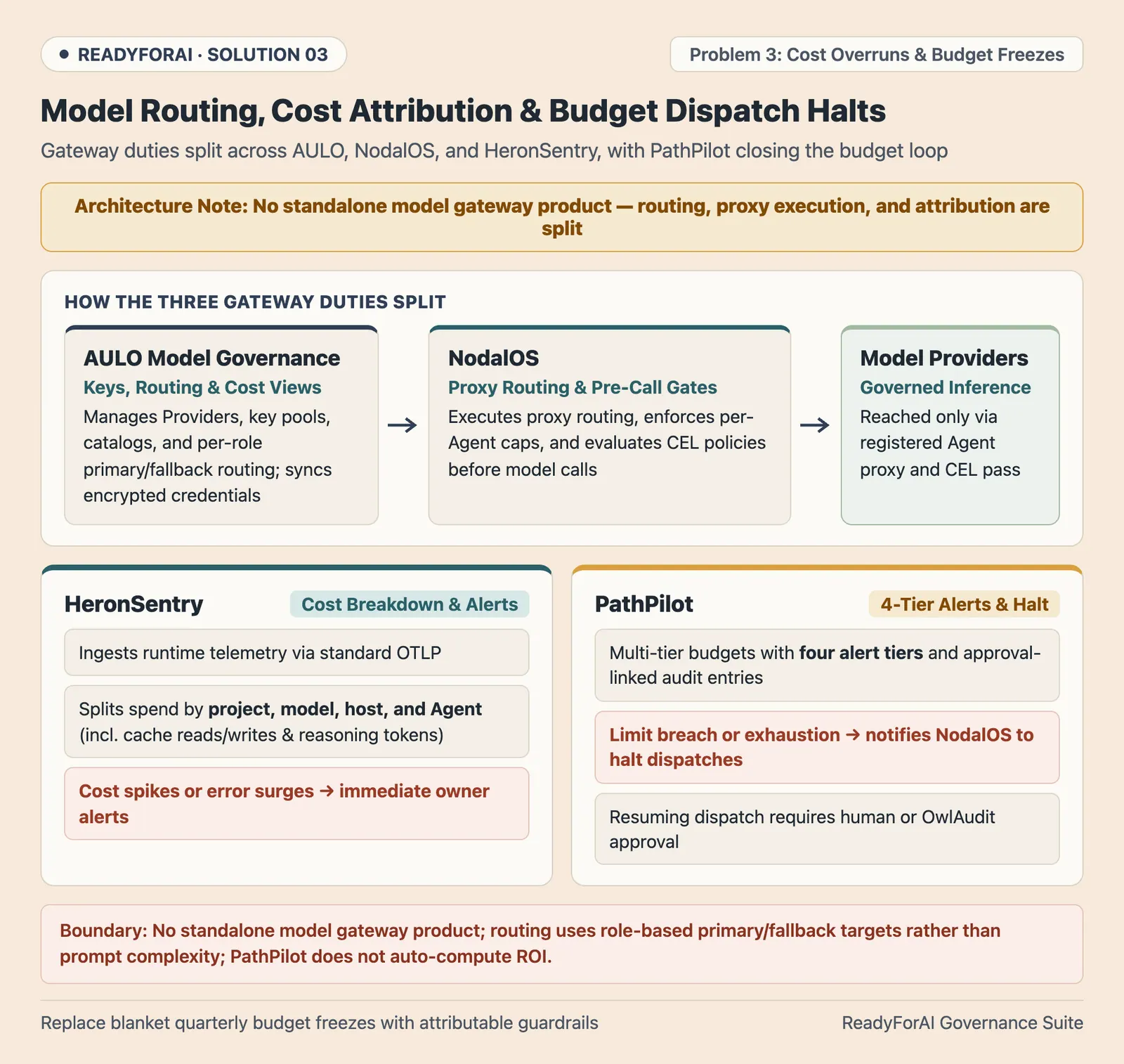
To fulfill the report's three gateway responsibilities and close the budget loop, AULO, NodalOS, HeronSentry, and PathPilot split the duties cleanly. AULO's Model Governance panel centralizes key pools, catalogs, role-based primary/fallback routing, and cost views, syncing encrypted credentials to NodalOS; NodalOS executes proxy routing, per-Agent usage caps, and pre-call CEL gates; HeronSentry breaks down OTLP token spend by project, model, host, and Agent with immediate spike alerts; and PathPilot enforces multi-tier budgets with four alert tiers, synchronously halting NodalOS dispatches on breach until approved for resumption. Teams gain clear attribution and progressive circuit breakers instead of blanket quarterly freezes.
Boundaries
ReadyForAI has no standalone model gateway product; those responsibilities are split across AULO, NodalOS, and HeronSentry. Routing uses admin-configured role-based primary/fallback targets and does not automatically pick models by prompt complexity, and PathPilot enforces budget halts without automatically computing ROI—return ownership stays with business teams.
4. Context Decay: Scattered, Ambiguous, Conflicting
The Problem
Chapter 7 argues that when every company can access the same foundation models, proprietary data and context decide outcomes. Enterprise data sits in two layers: the structured systems layer and the unstructured human layer / Institutional Context inside employees' heads, emails, chats, and meeting notes.
For decades, humans quietly absorbed semantic ambiguities that break agents at machine speed—such as a CRM field marked "do not contact" that account managers knew actually meant "contact only through the CFO's executive assistant." Horizontal initiatives trying to make "all data AI-ready" upfront virtually never succeeded in interviews; effective teams encode human semantics around active use cases.
Chapter 8 warns of three compounding hurdles for the context layer: building it first, keeping it current second (stale policy docs degraded accuracy enough within months to halt production deployments), and managing contradictions third when document stores inevitably conflict and agents cannot tell which source to trust.
Our Solution
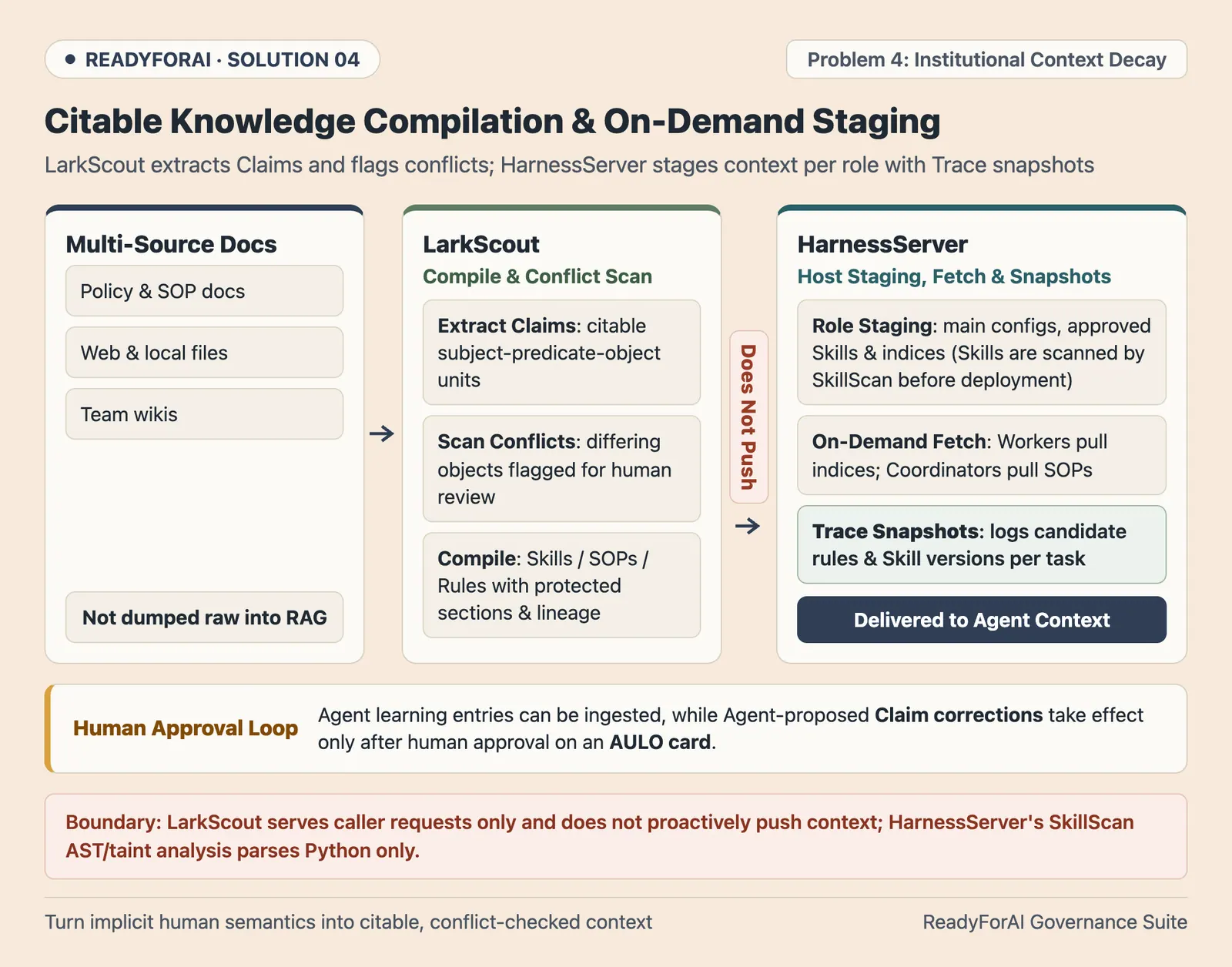
Building on the three hard gates in Production-Grade Agent Skills, LarkScout and HarnessServer work sequentially to compile and stage trustworthy context. Rather than dumping raw files into RAG, LarkScout extracts citable subject-predicate-object Claims from multi-source docs, scans for conflicting Claims (same subject and predicate, different object) for human review, and compiles agentskills.io-compatible Skills, SOPs, and Rules with protected sections and fork lineage (Agent-proposed Claim corrections take effect only after human approval in AULO); HarnessServer pre-stages workspaces by role on the host, serves context on demand to both Coordinators and Workers, and logs Trace-linked Task Context Snapshots. This keeps raw document noise out of prompts while preserving rule-version traceability.
Boundaries
LarkScout does not proactively push or inject context into Agents—it compiles knowledge and serves caller requests, leaving context selection to HarnessServer and NodalOS. Meanwhile, HarnessServer's SkillScan static analysis parses Python only (not shell or JS) and does not replace runtime sandboxes or human review.
5. Probabilistic Black Box: Monitoring and Drift
The Problem
Traditional software rests on deterministic testing where identical inputs yield identical outputs. AI agents are probabilistic—running the same task twice can follow completely different tool paths and reach different conclusions. The report therefore makes evaluation and observability infrastructure a core platform pillar to verify agent boundaries before and during production.
In the report, Motorola Solutions VP Jeremiah Nelson calls for visibility into what is occurring, how much is spent, what tools are used, and whether IP risk exists so teams can adjust in time. Chapter 8 stresses monitoring the transaction path: isolated steps may look valid while the end-to-end chain fails, requiring every model call, tool choice, and retrieval to be reviewable with live anomaly alerts. Before launch, teams such as Fortive also run agents in shadow mode alongside human workflows until consistency stabilizes above 95%, 98%, or 99%.
Our Solution
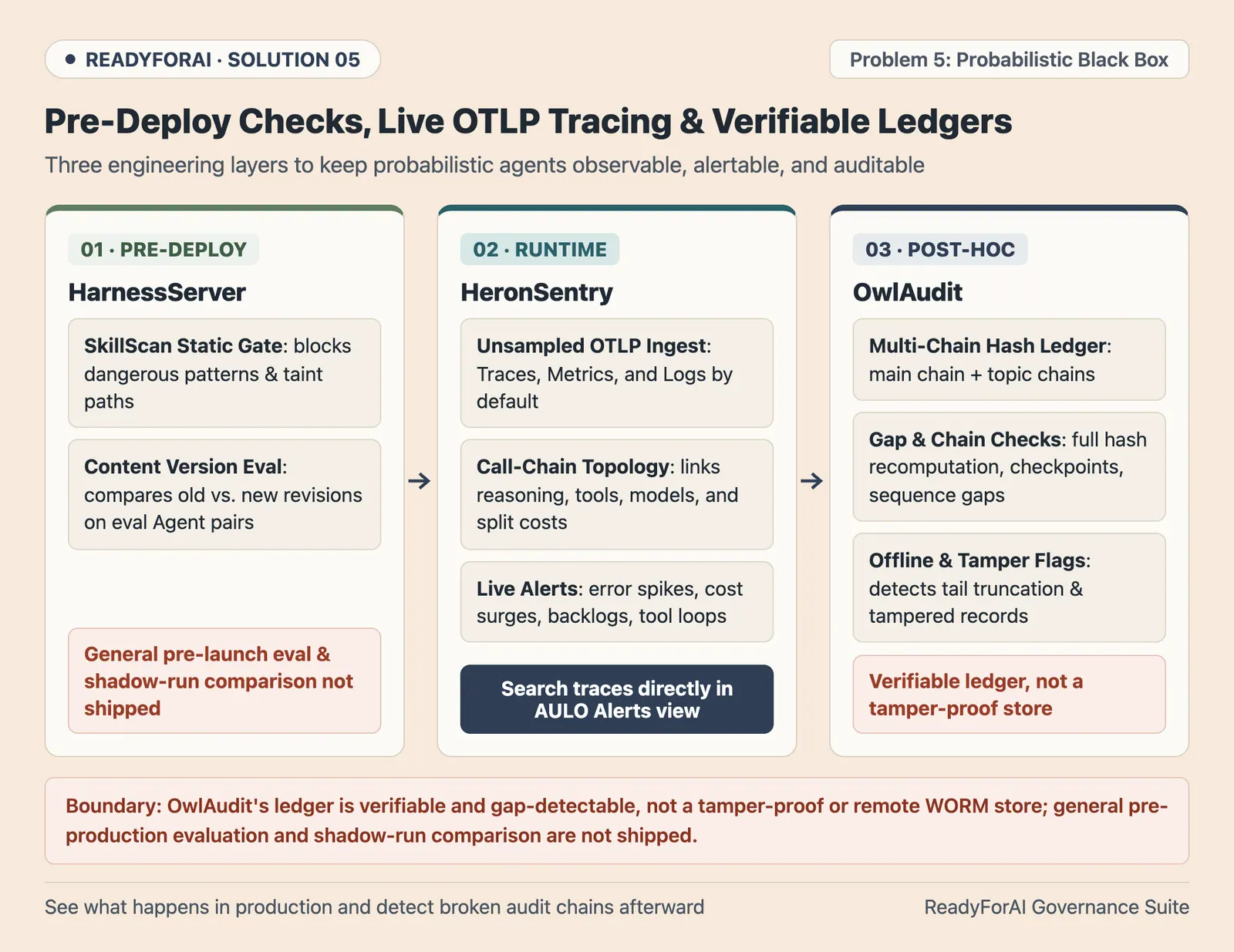
ReadyForAI covers pre-deploy checks, runtime visibility, and post-hoc verification across HarnessServer, HeronSentry, and OwlAudit. Before deployment, HarnessServer runs SkillScan static checks and compares revised content versions on configured evaluation Agent pairs; in production, standalone HeronSentry ingests unsampled OTLP telemetry by default to reconstruct call-chain topologies, split token costs, and trigger alerts searchable directly from AULO's Alerts view; afterward, OwlAudit maintains multi-chain Hash Chain ledgers supporting full hash recomputation, sequence gap detection, and offline tail-truncation checks against a separately saved chain tail. Together they keep probabilistic runs inspectable during incidents and verifiable afterward.
Boundaries
First, OwlAudit's audit ledger is verifiable and detects broken chains, not a tamper-proof store—it does not guarantee physical source veracity or replace remote WORM storage. Second, general pre-launch evaluation and live shadow-run comparison are not shipped—we do not provide Fortive-style production shadow comparisons or full production-trace replay evaluation for arbitrary Agents, so general regression validation still relies on your own test suites and staged rollouts.
6. Fleet Governance: Agents Outnumbering Humans
The Problem
Chapter 5 identifies the fleet governance challenge as the next major hurdle arriving faster than solutions. Governing one agent is manageable; governing hundreds or thousands operating concurrently at machine speed changes the nature of the problem:
- According to the report, Amazon director Amber Hanson notes her team of three is already supporting more than 300 agents, shifting governance toward managing a machine-speed digital workforce;
- At OLX Group, roughly 15 agents run behind each listing page, with over 4,200 agents making simultaneous decisions across the marketplace;
- Citibank's mandatory framework across 180,000 employees in 90 countries mandates an agent inventory and a named owner alongside observability, evaluation, and testing.
Closing the fleet governance gap requires agent registries, explicit inter-agent boundaries, fleet-wide anomaly monitoring, and human accountability end to end, tracing every action back to a specific named human rather than a vague committee.
Our Solution
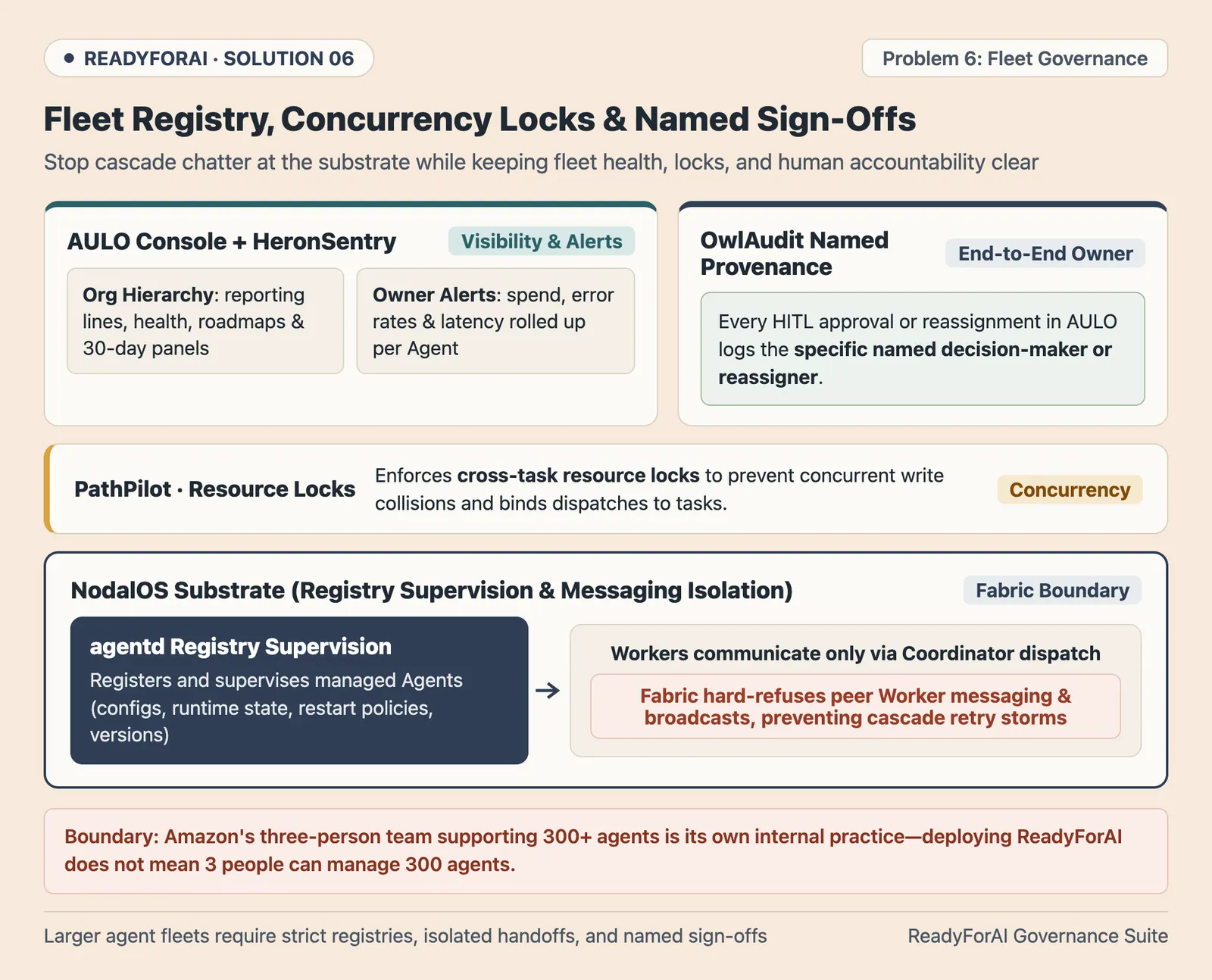
As fleets scale, NodalOS, AULO, HeronSentry, PathPilot, and OwlAudit preserve operational order. NodalOS registers and supervises managed Agents via agentd while hard-refusing peer Worker messaging and broadcasts so collaboration goes only through Coordinator dispatch; AULO and HeronSentry visualize Agent org hierarchy, health, and spend while routing anomaly alerts to owners; PathPilot enforces cross-task resource locks to prevent concurrent write collisions, and OwlAudit records who decided or reassigned each approval work item handled in AULO. This cuts off cascading peer-chat failures at the transport layer and ties every approval decision to a named person.
Boundaries
Amazon's "team of three supporting 300+ agents" is Amazon's own organizational and engineering practice—it does not mean deploying ReadyForAI enables three people to manage 300 agents. ReadyForAI delivers the registry, messaging isolation, resource locks, and named sign-off substrate; safe operator ratios still depend on risk profile and staffing.
7. Decision Boundaries: Who Owns the Final Call
The Problem
Chapter 10 confronts personal accountability anxiety: leaders know they remain the named person accountable ("I'll be the one accountable") if AI hallucinates, leaks data, or violates regulations, while legacy tools rebranded as "Agentic" force CIOs to act as "Chief Skeptic."
Equally urgent are decision rights: when teams can ship in a day, bad judgment scales faster than good judgment. Leaders cannot personally approve every minor action without recreating gatekeeper bottlenecks, nor cede judgment to probabilistic models. Organizations need clear boundaries separating fast experimentation from high-consequence choices requiring structured "creative abrasion" (Harvard professor Linda Hill) and explicit kill criteria—as Crypto.com's Jason Lau applies in the report: no owner, no metric, and no clear path to outcome means the initiative dies.
Our Solution
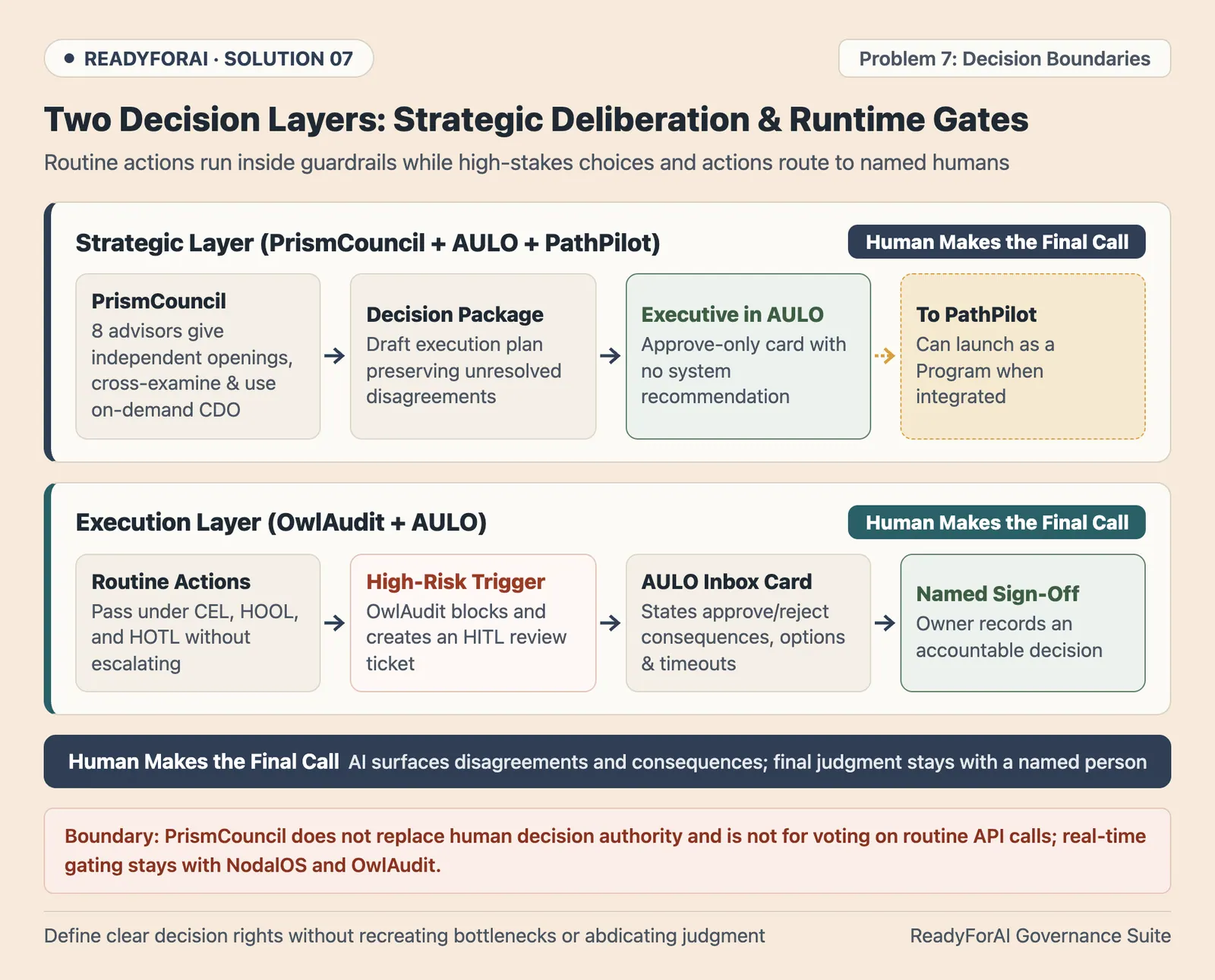
Extending the product design in From AI Council to Structured Deliberation, PrismCouncil, OwlAudit, and AULO split strategic investment decisions from runtime execution gates. For major initiatives, PrismCouncil convenes up to eight built-in advisors through independent parallel openings, cross-examination, and on-demand CDO data grounding into a Decision Package preserving open disagreements for executive approval in AULO (and optional PathPilot Program launch); at runtime, routine operations pass inside guardrails while high-risk actions matching HITL policies generate OwlAudit review tickets in AULO detailing approval/rejection consequences and timeout paths for named sign-off. Humans keep final authority on both tiers without bottlenecking daily engineering work.
Boundaries
PrismCouncil does not replace humans in making final strategic or business decisions—approval cards intentionally offer only an approve action without system recommendations, leaving rejections and closures to executives—nor is it meant to vote on routine runtime API calls, which remain governed by NodalOS and OwlAudit.
Closing: Start as a Full Deployment Project from Day One
The closing chapter, How to start, emphasizes an asymmetric cost of action versus delay: teams that experiment and fail lose weeks, whereas organizations that wait lose months of coordination.
Among its Do this Monday actions and closing principles, two stand out for engineering teams:
- Take Oxy CTO Patrick Bangert's rule: "You should start projects as full deployment projects": keep experiments small, but put monitoring, cost attribution, governance guardrails, and an operational owner in place on day one rather than building "party tricks and science experiments."
- Name the owner and explicit kill criteria before building: if nobody accepts production ownership, or an initiative lacks a named owner, a metric, and a clear path to business outcomes, stop it early.
In practice, that means hosting heterogeneous runtimes and task budgets cleanly via NodalOS and PathPilot, wiring OTLP tracing, HITL gates, and verifiable audit ledgers from day one with HeronSentry and OwlAudit, curating conflict-checked institutional context through LarkScout and HarnessServer, and keeping final human decision authority clear in AULO and PrismCouncil.
If your team is moving existing AI pilots safely into production, start with our AI Governance Diagnosis to inspect runtime, audit, and cost blind spots, or contact us to discuss deployment architecture.
References
- AWS Executives in Residence. Reimagine: Turning AI into Value. 2026. Official portal: AWS Executive Insights — Reimagine
- Werner, J. (2026). Agentic AI: Bridging the Widening Gap Between Ambition and Execution. AWS Executive in Residence Blog. Original post
- Gartner Inc. (2025-06-25). Gartner Predicts Over 40% of Agentic AI Projects Will Be Canceled by End of 2027. Press release