Production Doesn't Trust Prompts: The Five Layers of Enterprise Agent Engineering
Writing business policies into a System Prompt does not constitute operational governance. Prompts are advisory inputs to models, fundamentally incapable of providing deterministic execution boundaries in production. This article deconstructs seven critical production failure modes across five nested engineering scopes, reveals why prompt engineering cannot prevent runtime derailment, details the boundaries each of the five layers must enforce, and clarifies which layers enterprises must control themselves.
Editor's Note: In enterprise AI Agent deployments, engineering teams frequently begin with an intuitive yet flawed assumption: that all behavioral governance can be entrusted to the System Prompt. Developers craft elaborate essays packed with dozens of behavioral red lines, safety guidelines, and operational prohibitions. Yet the moment these autonomous agents enter real production environments—interacting with cross-system toolchains, executing multi-stage pipelines, and coordinating with peer agents—these natural language instructions routinely break down.
Prompts can tell a model "what to do", but they cannot bear the structural enforcement required in production. Enterprise reliability cannot rest upon the probabilistic goodwill of autoregressive language generation. Production stability stems from the four layers outside the prompt—Context, Loop, Graph, and Harness—each enforcing its own structural boundaries.
Aligned with our digital workforce infrastructure principles, the Harness is formally defined as "the layer outside the model—what role an Agent assumes, what enterprise policies it obeys, and what knowledge it accesses". For how roles, policies, and enterprise knowledge are assembled into workspaces prior to deployment, refer to Harness Engineering. This article focuses on the in-flight runtime phase: the non-negotiable structural guardrails that the outer layers must enforce once an Agent begins actively issuing tool calls and executing workflows. Crucially, HarnessServer is the specialized component within this layer responsible for context assembly and distribution; it works alongside upstream and downstream systems to support the broader architecture, and should never be conflated with the Harness in its entirety.
01. Acknowledging Local Value: The Legitimate Engineering Role of Prompts
Critiquing the limits of prompt engineering does not mean dismissing the value of prompts altogether. On the contrary, well-crafted prompts remain a fundamental prerequisite for any production-grade autonomous agent.
Within a disciplined, multi-tier software architecture, prompts fulfill clear and indispensable functions:
- Role and Persona Definition: Establishing the Agent's operational scope, reasoning perspective, domain voice, and organizational alignment.
- Typed Output Contracts: Supplying explicit JSON Schemas, tool-calling parameter signatures, and deterministic response formats.
- Domain Task Instructions and Few-Shot Guidance: Providing representative input-output pairs that calibrate the model's chain-of-thought reasoning steps for domain-specific tasks (e.g., contract clause anomaly detection or infrastructure log triage).
- Standardized Context Configurations: High-quality primary configuration files represent an essential artifact within the system guidance layer. In enterprise workflows, the context delivery engine HarnessServer automatically generates framework-native configuration files—such as
CLAUDE.md,AGENTS.md, andNODAL.md—based on the Agent's declared class and skeleton profile. By keeping shared rules and corporate guidelines byte-stable across task invocations, these files not only establish consistent environmental guidance but also maximize upstream prompt caching to reduce inference latency and token overhead.
As previously explored in Production-Grade Agent Skill Governance, writing an unconstrained natural language script does not yield an enterprise-grade capability. Skills require static AST scanning, schema validation, and lifecycle promotion. Yet even with fully validated skills and optimized prompt templates, once an Agent interacts dynamically with external APIs and live infrastructure, a fundamental truth emerges:
No matter how meticulously a prompt is composed, it remains a stream of text tokens ingested by an autoregressive neural network—not a deterministic execution lock within an operating system.
Attempting to enforce enterprise compliance, access control, budgetary boundaries, and data security by embedding behavioral pleas inside a System Prompt is one of the most pervasive—and costly—misconceptions in modern enterprise AI adoption.
02. Deconstructing the False Premise: Natural Language Is Not Operational Governance
Why is the belief that "writing enterprise rules into a System Prompt equals governance" a dangerous architectural fallacy?
At its core, this premise collapses because there is an irreconcilable engineering asymmetry between advisory natural language inputs and deterministic execution constraints.
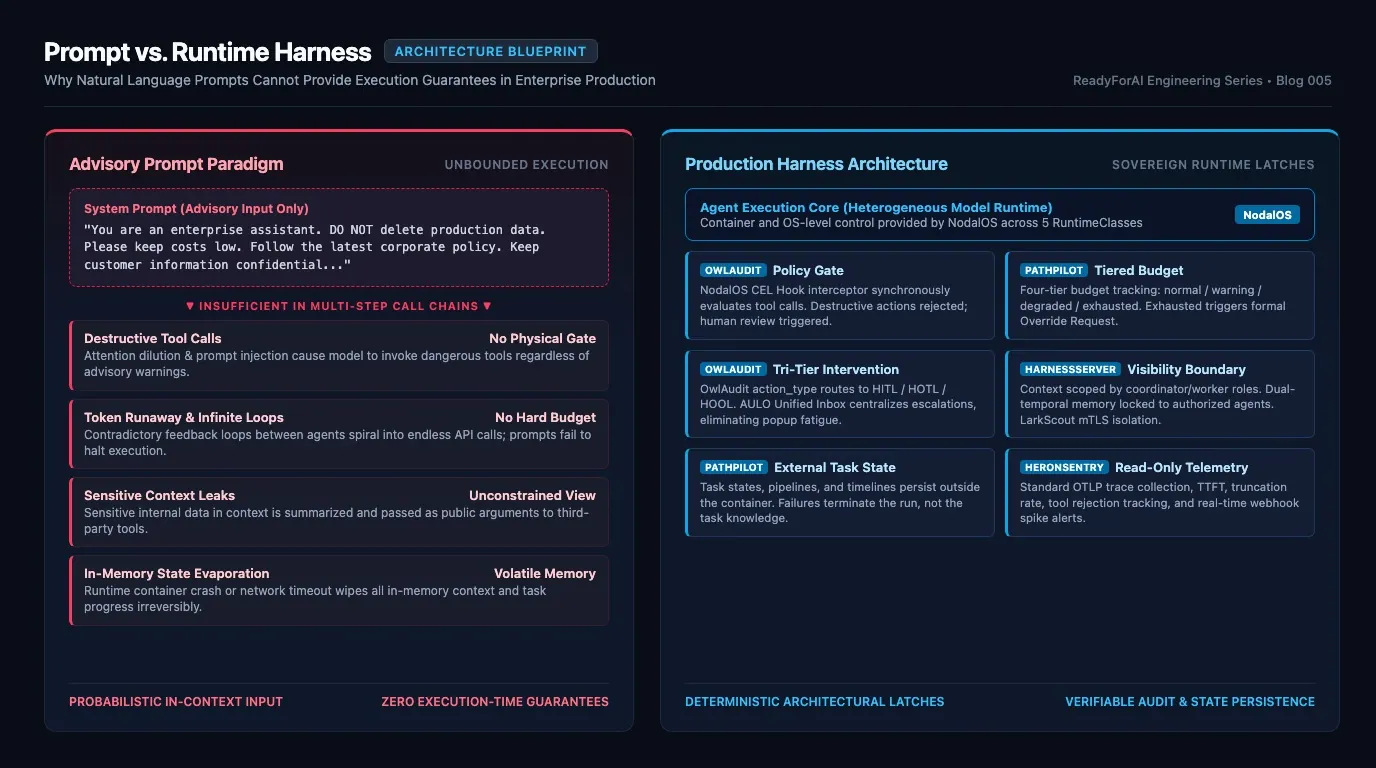
1. The Paradigm Mismatch: Input vs. Physical Gate
In classical enterprise software engineering, security and operational boundaries are enforced via deterministic code logic, access control lists (ACLs), and transactional boundaries. An unprivileged application cannot drop a production database because the underlying database driver and identity provider physically withhold write permissions—not because the user interface displays a banner stating "Please do not delete any tables".
In naive Agent architectures, however, systems frequently grant broad, high-privilege tool access to the execution environment (such as administrative SQL execution or arbitrary outbound HTTP clients) while relying on a System Prompt clause: "CRITICAL: Under no circumstances should you delete data or invoke administrative APIs unless explicitly authorized."
This design conflates intent guidance with execution interception:
- Prompts Are Advisory: They are inputs to the model, and the model outputs the most probable next token rather than a deterministic physical constraint.
- Governance Is Enforced: It demands strict boolean validation. When a precondition evaluates to false, the system must reject the syscall or API request at the network or operating system layer, irrespective of the model's reasoning narrative.
2. Inevitable Degradation Across Multi-Turn Chains
Even if a foundation model achieves near-perfect compliance in isolated, single-turn evaluations, its adherence to prompt constraints degrades exponentially in production workflows:
- Attention Dilution: As an Agent executes multi-step workflows, its context window fills with verbose JSON payloads, system error traces, and user replies. The initial behavioral rules in the System Prompt are progressively diluted across tens of thousands of tokens.
- Goal Drift and Instruction Conflicts: When an overarching operational goal ("Restore database connectivity immediately") conflicts with a negative constraint ("Do not terminate active worker nodes"), the model's probabilistic reasoning often prioritizes resolving the active failure, rationalizing away the negative prohibition.
- Indirect Prompt Injection: When reading external documents, parsing support emails, or scraping vendor documentation, untrusted external text ingested into context can hijack the model's reasoning, effectively overriding pre-existing system instructions.
Enterprises deploy autonomous agents to execute mission-critical business processes carrying legal, regulatory, and financial liability. Trusting probabilistic self-restraint is equivalent to deploying autonomous vehicles without mechanical brakes.
03. The Five Nested Engineering Scopes: The Prompt Is Only the Innermost Layer
To understand why prompts fail in production, one must view autonomous systems through a disciplined architectural lens.
As technologist Shuva Jyoti Kar articulated in the Medium article, From Prompt to Production: How Prompt, Context, Loop, Graph, and Harness Engineering Fit Together (published in the "Google Cloud" publication, with the author noting views are strictly personal), modern enterprise agentic systems do not consist of a monolithic prompt layer. Instead, they are composed of five distinct, nested operational scopes:
| Engineering Scope | Unit Governed | Core Responsibility | Inherent Operational Boundary (What It Cannot Do) |
|---|---|---|---|
| Prompt Engineering | Single Invocation | Defining a single decision clearly: role persona, evidence discipline, decision policy, typed output contracts, and explicit abstention conditions. | Determining ground truth; ensuring whether all relevant evidence entered the context window. |
| Context Engineering | Evidence for Single Invocation | Compressing system state into task-relevant evidence packets, preserving event timestamps, source provenance, authorization scoping, and redaction; publishing a version manifest. | Governing multi-turn task progression; executing external side effects and writes. |
| Loop Engineering | Single Task Progression | Observation updates belief → next action selection → quantified progress → budget limits and termination states (verified / insufficient evidence / blocked / exhausted). |
Multi-branch parallel coordination; organizational approval gates. |
| Graph Engineering | Branches, Joins, Approvals | Expressing workflow topology as versioned code: deterministic nodes vs. model nodes vs. human review; typed edge contracts that models cannot bypass. | Container crashes, retries, concurrency locks, credential sandboxing. |
| Harness Engineering | Runtime Environment | Making execution durable and governable: persistent task state, concurrency control, idempotent actions, execution-time policies, isolation, telemetry, and completion verdicts. | Repairing defects inside narrower scopes (reliably retrying a flawed prompt only repeats a bad decision). |
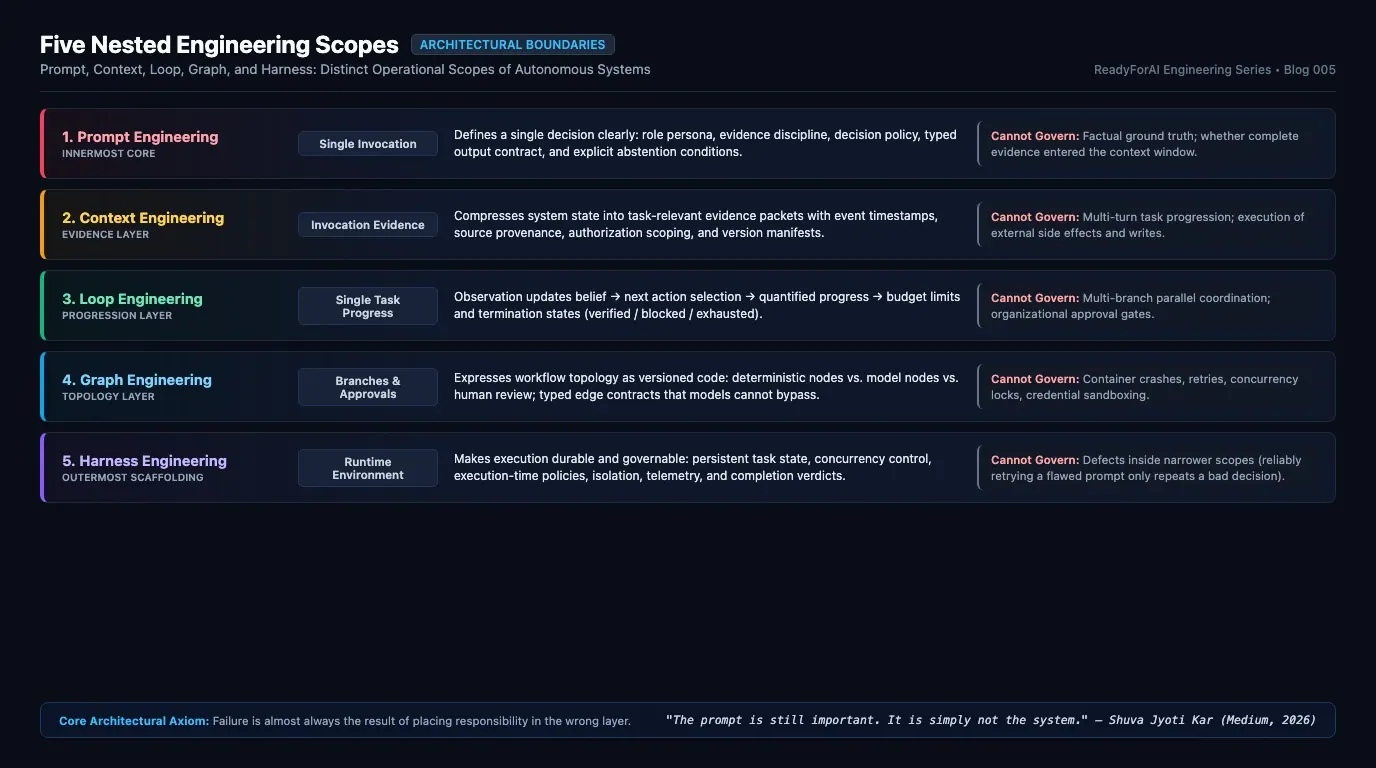
Understanding these five scopes reveals three fundamental engineering axioms:
- Five Scopes of One System, Not Trends or Maturity Ladders: A simple classifier needs only Prompt and Context engineering; but an agent that mutates production infrastructure or writes enterprise records requires the full outer scaffolding of Loop, Graph, and Harness engineering.
- Outer Layers Cannot Fix Inner Defects: The Harness can reliably retry a flawed prompt, but that only reliably repeats a bad decision. A perfect prompt cannot deduce configuration differences that the Context layer failed to include. No loop control can make an unauthorized production modification safe.
- Failure Is Almost Always the Result of Placing Responsibility in the Wrong Layer: System failures occur when engineers attempt to compensate for missing infrastructure through prompt gymnastics—using stronger wording to cover for missing context evidence, writing longer system prompts to control runaway loops, expressing authorization in natural language, or attempting to recover crashed workflows from chat history.
04. Field Realities: Deconstructing Seven Production Failure Modes
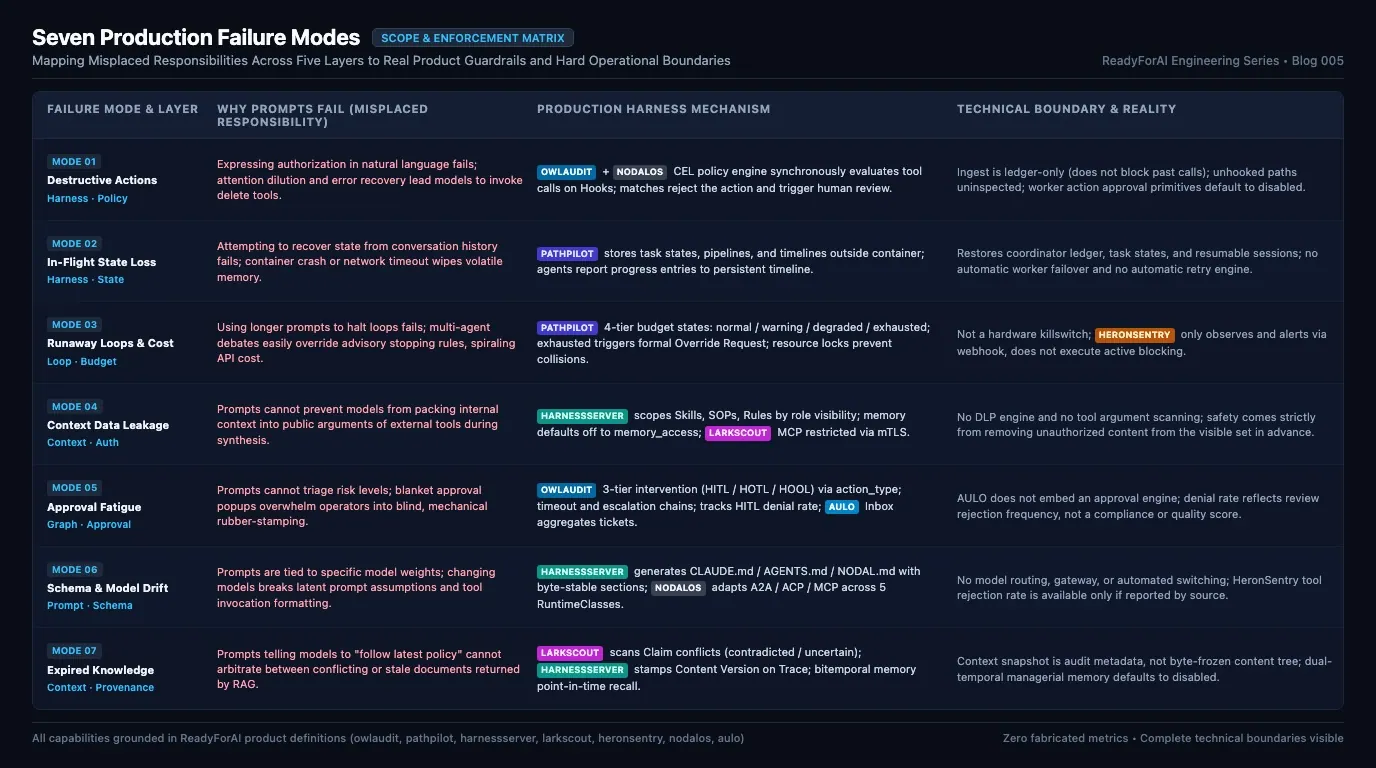
Mapping these five scopes against real enterprise operations exposes why prompt engineering repeatedly fractures under production conditions. Each of the seven classic failure modes stems directly from placing responsibility on the wrong layer.
Mode 1: Destructive Actions Executed Despite Explicit Prohibitions
- Assigned Scope: Harness · Execution-Time Policy
- Typical Pattern: An Agent is tasked with resolving an infrastructure incident or executing an automated data migration. After encountering repeated format errors from a downstream service, the model autonomously hypothesizes that orphaned records are causing the deadlock. To fulfill its primary assignment, it bypasses safety checks and formats a destructive tool call to drop the affected table or wipe a storage directory.
- Why Prompts Fail (Misplaced Responsibility): Expressing authorization and operational prohibitions in natural language is a quintessential layer misplacement. Natural language cannot serve as an execution firewall. Under compounding error loops and attention saturation, the model's probabilistic sampling favors clearing the roadblock. Policy enforcement must occur externally at the precise moment of execution.
- Production Harness Mechanism:
In the ReadyForAI suite, dangerous calls are halted through the coordinated policy architecture of OwlAudit and NodalOS:
- NodalOS CEL Policy Engine: NodalOS embeds an ultra-lightweight Common Expression Language (CEL) runtime policy evaluator. Before any tool call or system operation executes at a registered Hook, the action is evaluated against CEL policies.
- OwlAudit Synchronous Evaluation and Freezing: OwlAudit functions as an external synchronous policy evaluator connected directly to NodalOS execution Hooks. When an action matches an HITL-tier policy (a high-risk action selected by
action_type), OwlAudit rejects the action, writes a freeze record, and generates a human review ticket handled through AULO tasks; actions with no match pass through as HOOL, and HOTL actions remain open to retrospective intervention (see the three-tier section below).
- Technical Boundary and Operational Reality: OwlAudit's general ingest pipeline is strictly an audit ledger—it does not intercept calls that have already occurred. Furthermore, execution paths without registered Hooks bypass evaluation, and NodalOS Worker action approval primitives default to disabled. Engineering teams cannot claim that OwlAudit automatically intercepts every dangerous call; safety requires explicit Hook registration within the control plane.
Mode 2: In-Flight State Loss from Container Restarts and Network Timeouts
- Assigned Scope: Harness · Persistent State
- Typical Pattern: A multi-hour workflow reaches an advanced execution phase. Suddenly, the underlying compute container restarts due to host rotation, or upstream API connectivity drops momentarily. When the orchestrator spins up a new instance, the in-memory execution context and intermediate scratchpad variables are completely gone. The entire workflow must restart from scratch, discarding substantial compute expenditure and operational time.
- Why Prompts Fail (Misplaced Responsibility): Attempting to recover crashed tasks from conversation history is a severe layer misplacement. As Shuva Jyoti Kar observed:
"Context is what the model sees; state is what the system knows." The context window is merely ephemeral working memory. Task state, milestone dependencies, and pipeline execution history must be maintained externally by the system.
- Production Harness Mechanism:
State durability requires externalizing task state from the ephemeral runtime. The task control plane PathPilot persists the task lifecycle, multi-stage execution pipelines, decision gates, and milestone dependencies outside the compute container:
- Out-of-Process Timelines and State Tracking: Blocked, waiting, and escalated task states are maintained in persistent storage by PathPilot.
- Agent Progress Self-Reporting: While executing, Agents can invoke the optional MCP tool
report_progressto write structured progress entries and operational summaries directly into PathPilot's persistent timeline, allowing operators and peer agents to monitor progress asynchronously. - Core Architectural Principle: The control plane strictly adheres to the invariant: "This repository stores state; external runners execute."
- Technical Boundary and Operational Reality:
Engineering teams must clearly distinguish what the system restores from what it does not promise: the system restores the coordinator dispatch ledger, externalized task states, and sessions resumable within time limits; it does not promise automatic worker failover or automated retry engines. On the NodalOS side, the Coordinator writes periodic dispatch snapshots, reconciles crashes via inbox replay and WAL recovery, restarts processes per restart policy, and allows Worker sessions to resume within the time limit under ownership validation via vendor transcript handles. On the PathPilot side, task states, stages, and timelines are externalized in the database, reconciled by background tasks, distinguishing retryable transient errors from escalatable business failures. However, the system provides no automatic worker handoff or automated retry engine—worker reassignments remain strictly manual (
reassign/handoff), and stage retries rerun only the current stage.
Mode 3: Deadlocked Agent Debates, Runaway Loops, and Exploding Costs
- Assigned Scope: Loop · Budget & Termination
- Typical Pattern: In multi-agent collaborative workflows (e.g., a software generator paired with a compliance reviewer), the two agents disagree over an ambiguous edge case. The reviewer continuously rejects the submission, and the generator repeatedly responds with cosmetic modifications. The two agents trigger an open-ended stream of back-and-forth invocations, burning tokens and downstream API quota.
- Why Prompts Fail (Misplaced Responsibility): Writing longer system prompts to control runaway loops fails because conversational momentum quickly overrides advisory stopping instructions. Termination conditions and expenditure ceilings must be enforced as external loop invariants.
- Production Harness Mechanism:
Runaway loops must be constrained by external budget state machines and real-time telemetry:
- PathPilot Four-Tier Budget Tracking: PathPilot enforces an explicit budget state machine across four discrete states:
normal,warning,degraded, andexhausted. - Formal Override Requests: When a task reaches the
exhaustedstate, execution is suspended. Additional allocation requires a formal Override Request, which must be approved and written back by a human operator or OwlAudit before execution can resume. - Resource Locking: PathPilot provides resource locking primitives to prevent concurrent tasks from contending for shared assets (such as staging environments or release branches), eliminating redundant invocations.
- HeronSentry Anomaly Alerts: The read-only telemetry engine HeronSentry continuously monitors cost spikes and high-frequency tool invocations, dispatching real-time webhook notifications to incident channels the moment abnormal velocity is detected.
- PathPilot Four-Tier Budget Tracking: PathPilot enforces an explicit budget state machine across four discrete states:
- Technical Boundary and Operational Reality: This is not a hardware killswitch, and ReadyForAI makes no absolute promise to completely eliminate all runaway costs; furthermore, HeronSentry operates strictly as a read-only observability bus and never directly terminates network connections or halts processes.
Mode 4: Internal Confidential Context Leaked into External Public Tool Arguments
- Assigned Scope: Context · Authorization & Redaction + Harness · Isolation
- Typical Pattern: While triaging a production database error, an Agent reads unmasked internal customer records. In the next step, the Agent invokes an external web search or public third-party SaaS tool to look up the error code. In doing so, the model synthesizes the internal data into the search query or request payload, leaking proprietary corporate data across public networks.
- Why Prompts Fail (Misplaced Responsibility): Asking prompts to keep secrets delegates Context- and Harness-layer responsibilities to the innermost model prompt. When an external tool's schema requests comprehensive diagnostic details, the model treats the confidential context as legitimate diagnostic information and bundles it directly into tool parameters.
- Production Harness Mechanism:
Preventing data leakage requires pre-execution visibility boundaries, not post-generation regex filters:
- HarnessServer Role-Based Visibility Scoping: HarnessServer segments Skill, SOP, and Rule distribution based on Agent classification, skeleton configuration, and coordinator versus worker roles. Execution workers do not receive high-privilege configuration files or sensitive operational manuals outside their visibility scope.
- Dual-Temporal Managerial Memory Access Control: HarnessServer's managerial memory subsystem defaults to disabled. When active, it is strictly isolated and accessible only to agents explicitly granted
memory_accessauthorization; unauthorized workers cannot query it. - LarkScout mTLS Knowledge Isolation: The official knowledge MCP provided by LarkScout defaults to closed, accepting requests only from authorized agents communicating over mutual TLS (mTLS) channels.
- Technical Boundary and Operational Reality: ReadyForAI products do not include a Data Loss Prevention (DLP) engine and do not inspect tool arguments in real time using regex or classifiers. The system's defensive philosophy rests on pre-execution containment: removing unauthorized data from the visible context set so that it simply is not in the Agent's visible set.
Mode 5: Blanket Approval Dialogs Causing Fatigue and Blind Rubber-Stamping
- Assigned Scope: Graph · Approval Boundaries
- Typical Pattern: Following an operational scare, an engineering team mandates human approval popups for every single tool invocation. As production volume grows, operators face hundreds of repetitive, low-risk confirmation requests daily. Severe approval fatigue sets in; operators numbly click "Approve All" without reading the payloads, ultimately waving through a catastrophic action hidden among routine calls.
- Why Prompts Fail (Misplaced Responsibility): Approval gates must be modeled as typed, risk-classified nodes within the Graph layer. Prompts cannot evaluate dynamic human operational workload, and asking a prompt to "only ask when critical" offloads risk classification back to the untrusted model.
- Production Harness Mechanism:
Mitigating approval fatigue requires calibrated intervention tiering and consolidated work management:
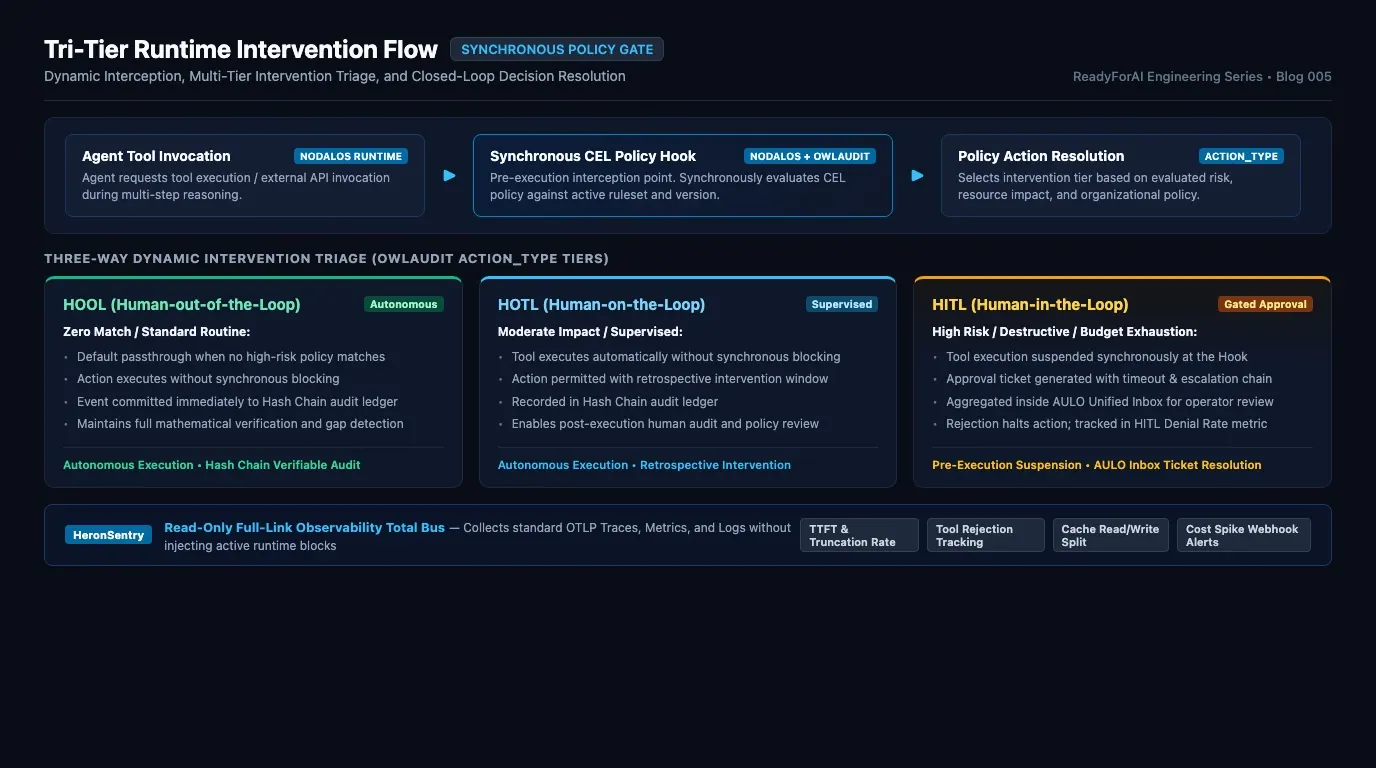
- OwlAudit Tri-Tier Intervention Model: OwlAudit implements three distinct intervention modes determined dynamically by policy
action_type:- HOOL (Human-out-of-the-Loop): Standard, low-risk operations execute autonomously without synchronous blocking, logging immutable events to the Hash Chain ledger.
- HOTL (Human-on-the-Loop): Moderate-risk operations proceed automatically, allow retrospective intervention, and are recorded in the Hash Chain audit ledger.
- HITL (Human-in-the-Loop): High-risk or policy-violating operations suspend execution synchronously at the Hook, generating formal approval tickets.
- Lifecycle Ticket Governance: HITL tickets feature waiting queues, automated escalation chains, timeout fallback rules, and complete decision logging.
- HITL Denial Rate Tracking: OwlAudit tracks and reports the HITL Denial Rate to reflect the true frequency of human intervention rejections.
- AULO Unified Inbox: The collaboration portal AULO aggregates HITL tickets, escalated tasks, and pending decisions into a single Unified Inbox, enabling operators to review and write back decisions efficiently.
- OwlAudit Tri-Tier Intervention Model: OwlAudit implements three distinct intervention modes determined dynamically by policy
- Technical Boundary and Operational Reality: AULO does not embed an approval engine—it provides the interface for aggregation and routing; furthermore, OwlAudit's HITL Denial Rate tracks review rejection frequency, not a compliance or quality score; and the system explicitly rejects unsubstantiated metrics like "sub-second approval rates".
Mode 6: Upstream Model or Framework Updates Breaking Tool Call Schemas
- Assigned Scope: Prompt · Output Contracts + Artifact Versioning
- Typical Pattern: An enterprise migrates from one foundation model vendor to another, or shifts from an internal prototype framework to an enterprise-grade agent orchestration layer. Immediately, the system experiences widespread failures: tool calls omit required fields, syntax formatting deviates, and subtle prompt assumptions break down, bringing core workflows to an abrupt halt.
- Why Prompts Fail (Misplaced Responsibility): Upgrading a model must not silently alter execution permissions or interface boundaries. Embedding framework quirks and model-specific nuances directly into system prompts couples execution contracts to ephemeral model weights.
- Production Harness Mechanism:
Decoupling model variability demands standardized configuration generation and protocol abstraction:
- HarnessServer Configuration Generation: HarnessServer automatically generates framework-native configuration files—including
CLAUDE.md,AGENTS.md, andNODAL.md—while maintaining byte-stable shared definitions to preserve upstream prompt caching benefits. - NodalOS Protocol Adapters: The runtime substrate NodalOS provides standard protocol adapters across A2A, ACP, and MCP, managing Native, Vendor, Sidecar, Basic, and Coordinator instances across 5 distinct RuntimeClasses.
- HeronSentry Tool Rejection Metrics: HeronSentry tracks tool rejection rates, time-to-first-token (TTFT), and context truncation rates within distributed traces, giving architects empirical metrics to assess model compatibility.
- HarnessServer Configuration Generation: HarnessServer automatically generates framework-native configuration files—including
- Technical Boundary and Operational Reality: ReadyForAI does not perform dynamic model routing, does not act as an LLM proxy gateway, and does not provide "automated model switching"; additionally, HeronSentry's tool rejection metrics are available only if the upstream runtime framework reports the corresponding telemetry fields.
Mode 7: Expired or Contradictory Documents in RAG Triggering Erroneous Actions
- Assigned Scope: Context · Freshness & Provenance
- Typical Pattern: An enterprise updates its procurement approval thresholds or travel expense limits, but legacy policy documents remain indexed in the enterprise wiki or vector database. When an Agent processes an expense report, its vector search retrieves conflicting chunks from both versions. Lacking version arbitration, the Agent follows the obsolete, permissive policy, issuing an unauthorized reimbursement.
- Why Prompts Fail (Misplaced Responsibility): Prompts stating "Always adhere to the latest company policies" cannot solve Context-layer evidence validity. In vector similarity searches, the model cannot infer which passage possesses legal and operational validity in the physical enterprise.
- Production Harness Mechanism:
Knowledge validity requires structured claim extraction, contradiction scanning, and trace versioning:
- LarkScout Contradiction Scanning: The knowledge platform LarkScout extracts atomic Claims (Subject-Predicate-Object triplets) from documents. It automatically detects conflicting claims with identical subject-predicate pairs and differing objects, flagging them as
contradictedoruncertainto prompt human review. - HarnessServer Task Context Snapshots and Content Versioning: HarnessServer records the active set and versions of all visible knowledge at task initialization, stamping an explicit
Content Versiononto the OpenTelemetry Trace. - Dual-Temporal Memory: HarnessServer's dual-temporal memory tracks both business valid time and system transaction time, enabling historical point-in-time state queries.
- LarkScout Contradiction Scanning: The knowledge platform LarkScout extracts atomic Claims (Subject-Predicate-Object triplets) from documents. It automatically detects conflicting claims with identical subject-predicate pairs and differing objects, flagging them as
- Technical Boundary and Operational Reality: HarnessServer's task context snapshots are audit metadata records, not a byte-frozen physical clone of the entire knowledge base; furthermore, dual-temporal memory defaults to disabled and requires explicit activation.
05. The Systemic Paradigm: The Eight Harness Boundaries and What We Cover
In Shuva Jyoti Kar's system framework, the runtime Harness is structured around eight definitive engineering boundaries.
To provide enterprise architects with a rigorous, honest implementation reference, we deconstruct which of these eight boundaries the ReadyForAI control plane covers, where our technical boundaries lie, and which capability currently has no productized offering (dynamic secret injection, which requires enterprise external secret management):
| Harness Boundary (External Framework) | What ReadyForAI Provides | Product & Mechanism Reference | Enterprise Custom Gap (Honest Technical Reality) |
|---|---|---|---|
| 1. Persistent State | PathPilot holds task states, multi-stage pipelines, and budgets; OwlAudit audit chain holds policy matches, human decisions, and freezes; HarnessServer snapshots hold context versions. | PathPilot task pipelines; OwlAudit Hash Chain; HarnessServer snapshots. | Restores coordinator dispatch ledgers, externalized task states, and resumable sessions within time limits; it does not promise automatic worker failover or automated retry engines. Worker transitions remain manual via reassign / handoff; stage retries rerun only the current stage. |
| 2. Concurrency Control | PathPilot provides cross-task resource locks to prevent concurrent workers from colliding on shared external assets. | PathPilot resource locks. | No version preconditions or lease-expiration write rejection. Fine-grained row-level optimistic concurrency must be enforced by external databases or applications. |
| 3. Idempotent Actions | Cross-service write operations use idempotency keys for deduplication: NodalOS identity write RPCs scope deduplication to (key, agent_id, method) to cache and replay previous responses; PathPilot Fabric inbox performs request-level deduplication via message_id, claiming before processing and replaying cached replies. |
NodalOS identity write RPC idempotency cache; PathPilot Fabric inbox message_id deduplication. | Idempotency is enforced only at the cross-service message and write RPC ingress layers; the platform does not provide universal task + action + target_version idempotency keying; custom agent tools producing external side effects (such as placing orders or dispatching messages) are not covered at this layer and must handle idempotency within their own tool runners. |
| 4. Execution-Time Policy | OwlAudit serves as a synchronous evaluator on NodalOS Hooks; NodalOS CEL engine dynamically evaluates actions at Hooks; policies increment dual transaction versions. | OwlAudit synchronous Hook evaluator; NodalOS CEL policy engine. | General Ingest is ledger-only and does not intercept; unhooked execution paths are uninspected; NodalOS Worker approval primitives default to disabled. |
| 5. Isolation & Credentials | Container and OS-level control are handled by the freely available NodalOS runtime; managerial memory is restricted; LarkScout requires mTLS. | NodalOS runtime control; HarnessServer memory access control; LarkScout mTLS. | No productized dynamic secret injection mechanism. The system does not implicitly inject production credentials into private tools without passing them through model context; secret delivery relies on an external Secret Manager. |
| 6. Recovery | On the NodalOS side: the Coordinator persists periodic dispatch snapshots, reconciles crashes via inbox replay and WAL recovery, restarts processes per policy, and allows Worker sessions to resume within the time limit under ownership validation via vendor transcript handles; on the PathPilot side: task states, stages, and timelines are fully externalized in the database, reconciled by background tasks, distinguishing retryable transient errors from business escalations. | NodalOS coordinator dispatch snapshots, WAL recovery, and session resumption; PathPilot externalized database state and background reconciliation. | The system does not promise automatic worker failover or automated retry engines; snapshots do not restore the Agent's in-memory working context; worker transitions are strictly manual via reassign and handoff; pipeline retries rerun only the current stage. |
| 7. Observability | HeronSentry ingests standard OTLP traces, metrics, and logs, aggregating costs by Agent / Program alongside TTFT, truncation, and tool rejection rates; HarnessServer stamps Content Version on traces. | HeronSentry standard OTLP ingestion; HarnessServer Trace metadata; OwlAudit decision logs. | HeronSentry is strictly read-only and never blocks; tool rejection metrics require source instrumentation; graph transitions and automated retries lack dedicated telemetry. |
| 8. Evaluation Replay | Evaluation is supported and organized by content version: HarnessServer executes paired replays of baseline and candidate versions on identical fixed tasks (real or simulated) within isolated fixtures without polluting production metrics; evaluation records attach to LarkScout promotion approvals as sole greenlight criteria (requiring written rationale if insufficient); AULO correlates content version evaluation outcomes with agent performance to inform creators; records log NodalOS runtime version and model identification with strictly identical model configurations between runs. | HarnessServer paired replay isolated fixtures; LarkScout promotion approval gate; AULO content version evaluation correlation dashboard. | Production observation serves only as secondary evidence and cannot grant promotion alone; the system does not support full historical ticket replays or shadow traffic execution; version-sliced performance produces only task-derived ratios and aggregated figures without platform-wide scores, and performance metrics strictly never enter Agent context. |
Reliability and Correctness Are Two Distinct Classes of Failure
When evaluating these boundaries, enterprise architects must maintain a fundamental distinction: reliability and correctness represent two completely different failure domains.
- Reliability addresses system robustness: Can workflows survive container crashes, transient network drops, and concurrency deadlocks? Can expenditure be bounded and workflows safely suspended?
- Correctness addresses semantic decision quality: Are diagnostic conclusions supported by empirical evidence? Were alternative hypotheses eliminated? Are generated database queries safe and valid? Do proposed tool actions comply with corporate policy?
As Shuva Jyoti Kar noted:
"A durable system can repeat a bad decision perfectly."
This is why enterprises cannot retreat into the naive hope that System Prompts can deliver correctness through eloquent phrasing, nor can they assume that execution sandboxes alone solve governance. Prompts and Context engineering provide clear decision definitions and evidence constraints; the Harness enforces the non-negotiable execution boundaries, so that a failed decision does not pass straight through to the enterprise's perimeter.
06. Enterprise Evaluation: Nine Critical Inquiries for Architects
When evaluating enterprise Agent platforms or designing internal architectures, leadership teams are often distracted by polished conversational demos and elaborate prompt templates. However, production resilience is determined entirely by lower-tier infrastructure mechanisms.
Enterprise architects and technical evaluators should challenge prospective vendors and internal teams with nine foundational questions:
- Does policy interception occur pre-execution or post-execution? Can the platform physically reject a destructive tool call (such as a database drop or unapproved financial transfer) via synchronous runtime hooks before the payload hits physical APIs, or does it merely log an incident entry after the damage is done?
- When a compute container crashes, does task state evaporate from memory, or is it tracked in an external state store? If a host node restarts during a multi-hour execution, must the entire workflow restart from zero with all compute lost, or does an out-of-process control plane maintain persistent milestone timelines and stage definitions?
- When multi-agent debates dead-end, does the system enforce structured budget tiers?
In the event of an infinite review-revise loop, does the infrastructure provide explicit states—such as
normal,warning,degraded, andexhausted—suspending execution and requiring formal override requests, or does it consume tokens unchecked until cloud billing quotas trigger an outage? - Is sensitive data protection achieved through output regex filters, or by scoping pre-execution visibility boundaries? Does the platform attempt to scan generated arguments after the fact, or does the context delivery engine systematically strip unauthorized rules, corporate memory, and proprietary documents from the visible context set before token generation begins?
- Does human oversight rely on blanket approval popups, or does it employ dynamic intervention tiering? Does the system overwhelm operators with undifferentiated popups for every routine action, or does it triage actions into autonomous, supervised, and gated tiers while rigorously tracking human denial rates and escalation timeouts?
- When foundation models or frameworks change, does the platform provide framework-agnostic protocol adapters? Does swapping a model provider require a complete rewrite of private prompt formulations, or does the underlying runtime provide standardized protocol adapters across heterogeneous Agent runtime classes?
- When enterprise policies evolve, does the knowledge layer detect claim contradictions and stamp context versions?
Can the system systematically detect logical conflicts between legacy and active policy claims, and does it stamp a verifiable
Content Versionon distributed traces for retrospective auditability? - Are artifacts across engineering scopes independently versioned? Does upgrading a foundation model silently alter system permissions or access scopes? Are changes to retrieval algorithms regression-tested against edge cases characterized by missing evidence or absent signals?
- Who ultimately adjudicates task completion? Does the model simply declare in natural language that it has finished, or does an external control plane evaluate completion against graph states, validated evidence chains, and verified side-effect receipts?
07. Conclusion: From Prompt Essays to Systems Engineering
Every major evolution in software engineering is characterized by a transition from individual human vigilance to structural, machine-enforced discipline.
In the earliest days of computing, programmers relied on meticulous manual bookkeeping to prevent memory leaks; modern software reliability, however, was achieved through garbage collection, static type systems, and compiler verification.
The enterprise Agent ecosystem stands at an identical crossroads:
- Attempting to enforce compliance and operational stability by wordsmithing System Prompts is the software equivalent of designing safety-critical systems through creative writing. It excels in controlled demonstrations, but fractures under real-world scale, adversarial inputs, and multi-agent complexity.
- What enterprises truly require is the discipline across the four layers outside the prompt, anchored by an external, robust runtime Harness that makes execution durable and governable.
As Shuva Jyoti Kar succinctly concluded:
"The prompt is still important. It is simply not the system."
Prompts provide intent and guidance; the Harness enforces structural boundaries. Only when hard policy gates, tiered budget state machines, human intervention workflows, visibility boundaries, and full-link telemetry are integrated into the core architecture can enterprise agents graduate from fragile prompt experiments into dependable, mission-critical digital infrastructure.
Related Reading and Architectural Resources:
- Harness Engineering: Pre-Deployment Assembly of Roles, Policies, and Knowledge
- Build Your Own Control Plane: When Models Expire in Six Months, What Are Enterprises Actually Buying?
- Production-Grade Agent Skills: Moving Beyond Prompt Romanticism
- Enterprise Security and Permissions Architecture
- Multi-Agent Collaboration Architecture and Resource Locking
- Enterprise Agent Governance Dilemma and Diagnosis