Build Your Own Control Plane: When Models Expire in Six Months, What Are Enterprises Actually Buying?
Frontier foundation models and Agent frameworks iterate on six-month cycles. Locking business rules, security policies, and organizational knowledge into a proprietary vendor's walled garden forces technical capabilities to reset with every upgrade. This article deconstructs the decoupled architecture of enterprise digital workforce infrastructure—high-frequency execution plane versus sovereign control plane—and its five core governance pillars.
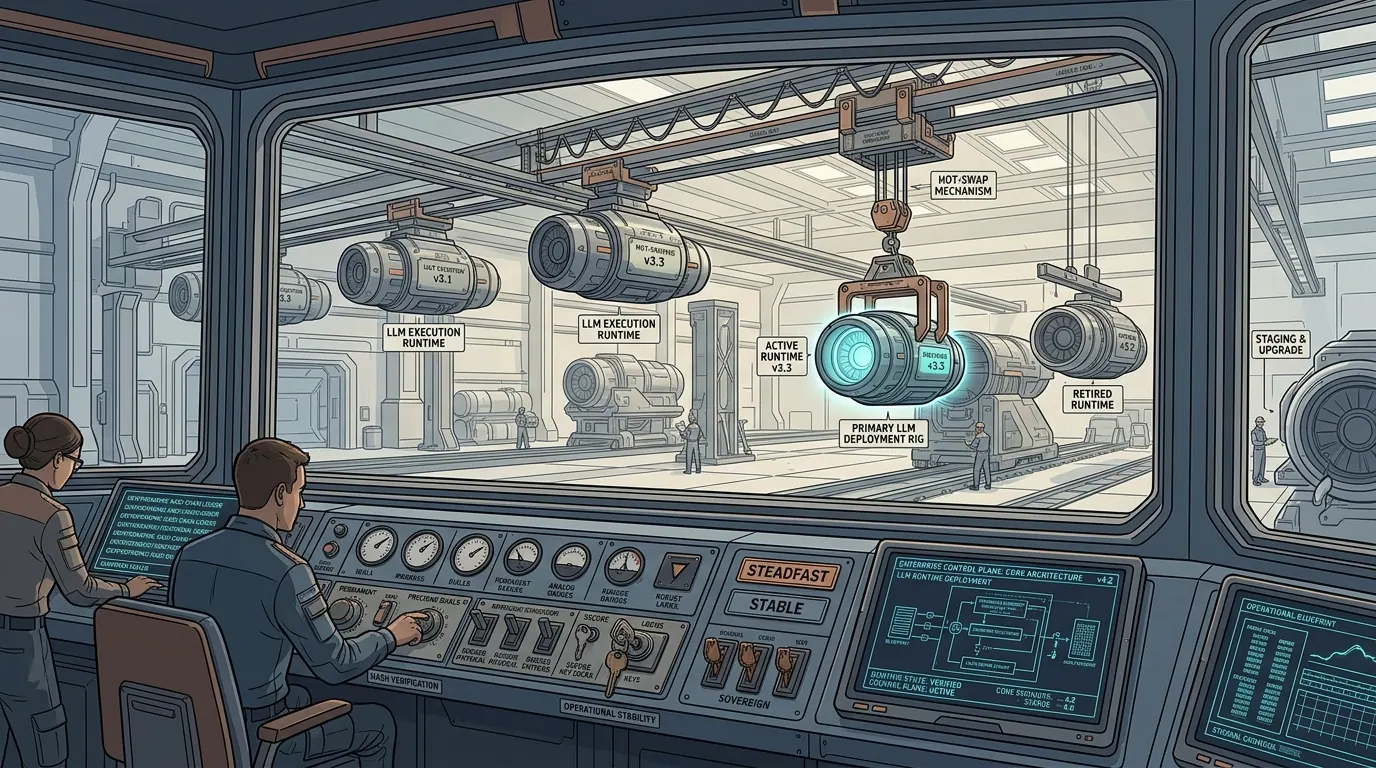
Editor's Note: In production enterprise AI deployments, foundation models and front-end interaction frameworks are iterating on six-month lifecycles. When an enterprise binds its core business logic, security policies, data pipelines, and audit logs inside a single model vendor's closed-source proprietary suite, every model deprecation, pricing restructure, or paradigm shift forces organizational coordination and digital assets to reset to ground zero.
This article presents a foundational architectural principle for enterprise digital workforce infrastructure: decouple the high-frequency execution plane, retain sovereign ownership of the control plane. By running heterogeneous Agent environments on the free-to-use, lightweight host foundation NodalOS, enterprises can construct a sovereign control plane anchored by human collaboration hub AULO, task planning and tiered budget governance PathPilot, policy gateway and verifiable audit engine OwlAudit, context delivery and bitemporal memory subsystem HarnessServer, knowledge extraction and experience reflection pipeline LarkScout, full-link read-only telemetry HeronSentry, and strategic human ruling board PrismCouncil. What enterprises truly need to acquire and cultivate is not the ephemeral usage rights to any individual model, but an independent control plane capable of outlasting model lifecycles and compounding long-term organizational assets.
From 2024 through 2026, enterprise digital transformation has been subjected to relentless technical turbulence:
From initial dense text models to multimodal foundation systems, open-weight reasoning models, and modern tool-using Agent frameworks, the effective half-life of a foundation model has collapsed to under six months. A commercial model that dominated benchmark leaderboards two quarters ago is frequently eclipsed by newly released open-weight architectures or specialized inference engines that offer superior throughput, larger context windows, or drastically lower cost per token. Proprietary wrapper code written just a year ago turns into legacy technical debt the moment upstream API protocols shift.
Confronted with this velocity, engineering leaders and enterprise CIOs face a classic procurement dilemma:
- The Closed-Suite Trap: Purchasing an end-to-end proprietary bundle from a hyperscaler or foundation model vendor—encompassing chat interfaces, RAG retrieval, fine-tuning, and application hosting—delivers the fastest initial time-to-demo. Yet business rules, access policies, and organizational data become permanently entangled in proprietary formats. When the enterprise wishes to introduce higher-efficiency models or migrate workloads back to private data centers to satisfy private deployment and data boundary requirements, migration friction proves prohibitive, resulting in severe vendor lock-in.
- The Monolithic In-House Trap: Attempting to build an entire Agent framework, orchestration runtime, and private model serving stack entirely from scratch frequently underestimates the engineering complexity of multi-agent distributed deadlocks, cascading token consumption, and verifiable compliance auditing. Massive capital expenditures yield fragile, non-standard architectures that struggle to track external open-source innovations.
What should enterprises buy, and what should they build?
The answer lies in one of the most durable laws of software engineering: strictly decouple system tiers that evolve at different rates. In the era of the autonomous enterprise workforce, this principle dictates a clean, architectural separation between the Control Plane and the Execution Plane.
01. The Two-Plane Decoupling: High-Frequency Execution vs. Sovereign Control
In classic distributed systems—ranging from Kubernetes cluster architectures and network switches to enterprise database proxies—the control plane orchestrates policies, routing topologies, quotas, and persistent state, while the data/execution plane handles high-throughput packet forwarding and computation. The control plane demands strong consistency, fault tolerance, and institutional sovereignty; the execution plane optimizes for raw throughput, concurrency, and flexible scheduling.
Applying this distributed systems discipline to enterprise Agent infrastructure reveals two distinct operating planes:
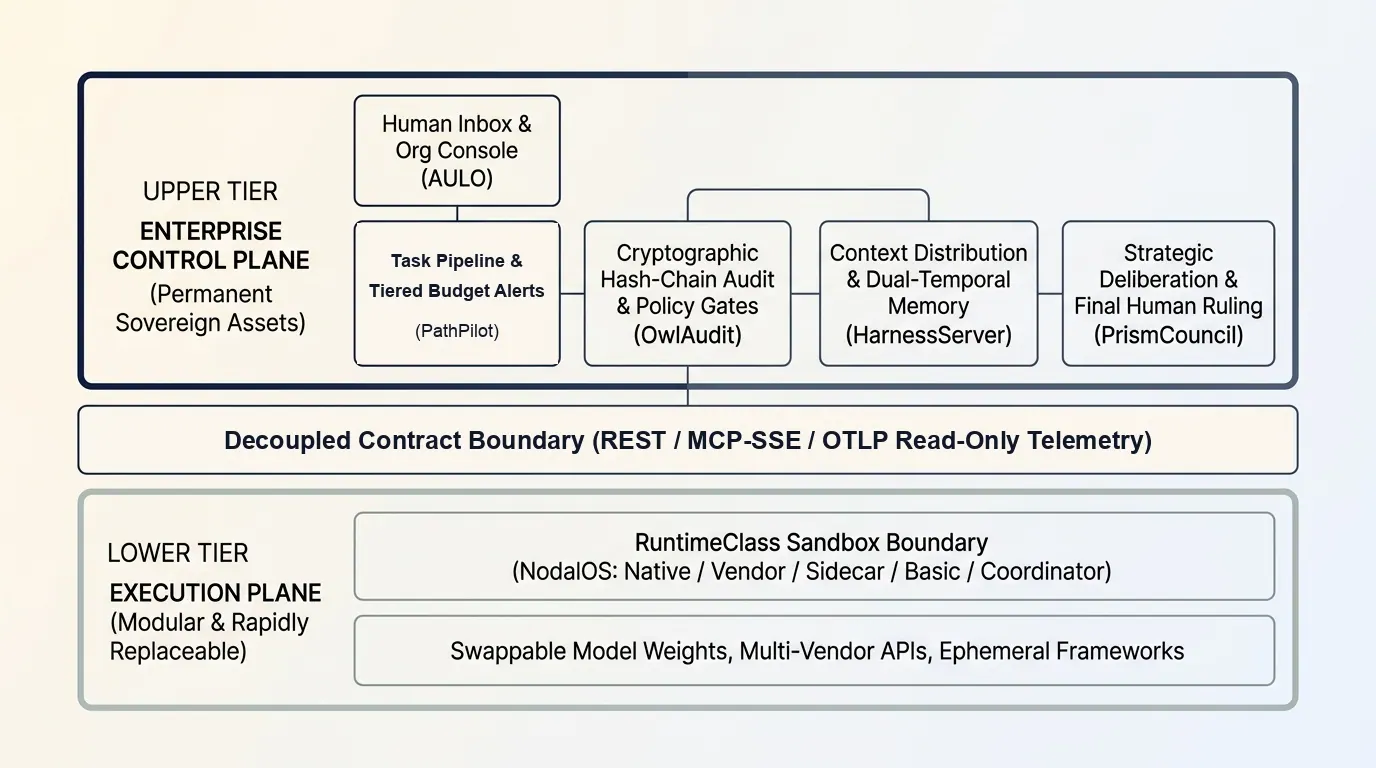
1. The Execution Plane: Rapid Arbitrage and Modularity
The execution plane comprises two elements: Agent runtime instances and the underlying foundation models or external tool services.
- Intrinsic Nature: The execution plane is an ephemeral, stateless, or weakly-stateful compute medium. Instances spawn upon task assignment and tear down upon task delivery.
- Business Imperative: Maximum compute cost-efficiency and task delivery fidelity. Enterprises must retain the agility to dynamically route distinct workloads—such as high-level planning, high-volume data sanitization, or multi-language code review—across open-weight local engines (e.g., Llama, DeepSeek), proprietary commercial models (e.g., Claude, GPT), and diverse tool APIs, capturing price-performance arbitrage in real time.
- Architectural Rule: Never hardcode enterprise institutional rules, compliance logic, or proprietary data schemas into the execution plane. The execution plane must remain lightweight, modular, and permanently expendable.
2. The Control Plane: Institutional Capital and Sovereign Ownership
The control plane represents the central nervous system and policy perimeter of the enterprise digital workforce. It safeguards non-negotiable institutional capital:
- Identity and Authorization: Which Agent represents which organizational entity? What credentials does it hold, and what resources may it view?
- Task Pipelines and Spending Limits: Who triggers execution? What is the spending ceiling, and what mechanism intercepts runaway recursive loops?
- Policies and Verifiable Audit Trails: Does execution comply with internal governance standards? Is there an immutable, mathematically verifiable causal log?
- Context Delivery and Institutional Memory: Where are historical standard operating procedures (SOPs), business rules, and operational learnings preserved?
- Human Final Authority: For decisions involving material commercial exposure or capital commitments, who holds the final sign-off authority?
3. The Unacceptable Cost of Outsourcing the Control Plane
Surrendering control-plane sovereignty to an external SaaS or model vendor exacts three irreversible penalties:
- Organizational Capabilities Reset with Every Model Upgrade: If your guardrails rely on hand-tuned prompt engineering inside a vendor's console, your enterprise knowledge is dumped into an opaque proprietary vector database, and your human-in-the-loop approvals are locked in a vendor-specific form, switching to an alternative model that offers an order-of-magnitude cost reduction breaks your entire governance layer. Everything must be re-engineered from zero.
- Commercial Contracts and Audit Defensibility Compromised: Enterprises pushing agentic adoption hit another layer of friction: some vendors introduce contractual restrictions within terms of service that restrict autonomous third-party agents from calling private APIs, or impose recurring "agent governance seat licenses." Without an independent control plane, enterprises cannot independently substantiate actions during regulatory audits or enforce uniform security and permissions across hybrid environments.
- Implicit Exfiltration of Institutional Knowledge: Over months of handling edge cases, correcting model mistakes, and adapting to organizational realities, the institutional expertise shared by enterprise staff is absorbed into a vendor's opaque parameters, leaving the enterprise with nothing more than an invoice for token usage.
Pioneering engineering teams across the industry have already shifted focus toward this control-plane reality. In May 2026, cloud data leader Snowflake announced its intent to acquire Natoma, a startup specializing in enterprise governance for the Model Context Protocol (MCP), specifically to construct a centralized enterprise control plane that enforces identity, access policy, and audit trails at the individual tool-call level. In the open-source infrastructure domain, Alibaba Cloud released ANOLISA (Agentic Nexus Operating Layer & Interface System Architecture), embedding security sandboxing (AgentSecCore), eBPF-based invocation observability (AgentSight), and persistent sandboxed memory directly into the operating system rather than treating them as ephemeral application-layer add-ons. Across both enterprise data clouds and foundational operating systems, a definitive industry consensus has crystallized: foundational model weights will continue to churn and commoditize at high velocity, but the control plane—governing tool access, authorization boundaries, cryptographic auditing, and persistent state—must remain an uncompromised, sovereign asset owned directly by the enterprise.
02. Architectural Boundaries: Sandboxing Agent Runtimes Is Not "Model Gateway Routing"
In discussions surrounding control plane architecture, engineering teams frequently encounter a fundamental misconception: confusing the sandboxing of Agent runtimes with building a model gateway or model router.
To be unequivocally clear: ReadyForAI's infrastructure manages the Agent runtime environment, not the underlying model itself.
Enterprise Control Plane — AULO (coordination) · PathPilot (budget) · OwlAudit (audit) · HarnessServer (context) · LarkScout (knowledge assets)
↓ Standard contracts (REST / MCP / OTLP)
Free-to-use base: NodalOS — RuntimeClass scheduling: Native / Vendor / Sidecar / Basic / Coordinator
↓ Process sandbox / workspace isolation / env injection
Heterogeneous Agent runtimes — Python / Node / containers calling remote or local LLMs
1. NodalOS: Engineering Purpose and Clear Boundaries
Serving as the free-to-use, lightweight host foundation of enterprise digital workforce infrastructure, NodalOS (documented at nodalos.org) focuses strictly on a single systems-level challenge: providing host sandboxing, system-call containment, and workspace lifecycle management for heterogeneous Agent runtimes.
NodalOS manages five RuntimeClasses — Native / Vendor / Sidecar / Basic / Coordinator — each implementing the same adapter interface, so which class a workload runs under does not change how the control plane governs it.
NodalOS equips these runtimes with isolated virtual filesystems, environment variable injection, and lifecycle liveness probes. Critically, NodalOS maintains rigorous architectural boundaries:
- It does not manage human interaction or inbox triage: Human-facing coordination is orchestrated entirely by AULO;
- It does not manage task decomposition or budget ceilings: Long-running workflow state and financial budgets are governed by PathPilot;
- It does not enforce compliance logic or tamper-proof logging: Verification gates and cryptographic audit trails are handled by OwlAudit;
- It does not distribute business context: Skill packages, SOPs, and rules are delivered per role by HarnessServer; Claim extraction and knowledge-view compilation happen upstream in LarkScout.
2. Observability Without Gateway Intrusion
How do Agent processes communicate with underlying models in this decoupled paradigm? Each Agent process connects directly to its designated model endpoints—whether enterprise cloud APIs (e.g., Claude, GPT) or internal private inference clusters running open-weight models (e.g., vLLM, Ollama)—using its own configured network transports.
Throughout this lifecycle:
- ReadyForAI does not act as a centralized model gateway, nor does it perform dynamic model routing: It introduces zero network hops or latency overhead into raw model inference calls;
- HeronSentry ingests operational metrics via standard OpenTelemetry (OTLP) collectors, capturing call chains, token utilization, and latency percentiles, aggregating cost telemetry across individual Agents and higher-level Programs;
- HeronSentry adheres strictly to a read-only observability and alerting boundary: It never injects active network resets, synthetic blocks, or payload manipulations into the data stream. Active gating and enforcement remain the sole responsibility of the policy engine.
The architectural outcome is profound: the rapid evolution of foundation models is completely decoupled from the enterprise control plane. When an enterprise swaps a reasoning model, upgrades an inference framework, or renegotiates API contracts, it simply updates runtime environment variables within NodalOS. The higher-level task orchestration, human approval queues, corporate knowledge base, and compliance audit chains remain entirely untouched. The control plane stands firm while execution evolves at market speed.
03. The Five Pillars of the Sovereign Control Plane
If the foundation model is treated as swappable compute, what constitutes the permanent control plane that an enterprise must own and cultivate?
ReadyForAI formalizes the production-grade control plane into five interconnected governance pillars, each resolving a core engineering failure mode in digital workforce scaling:
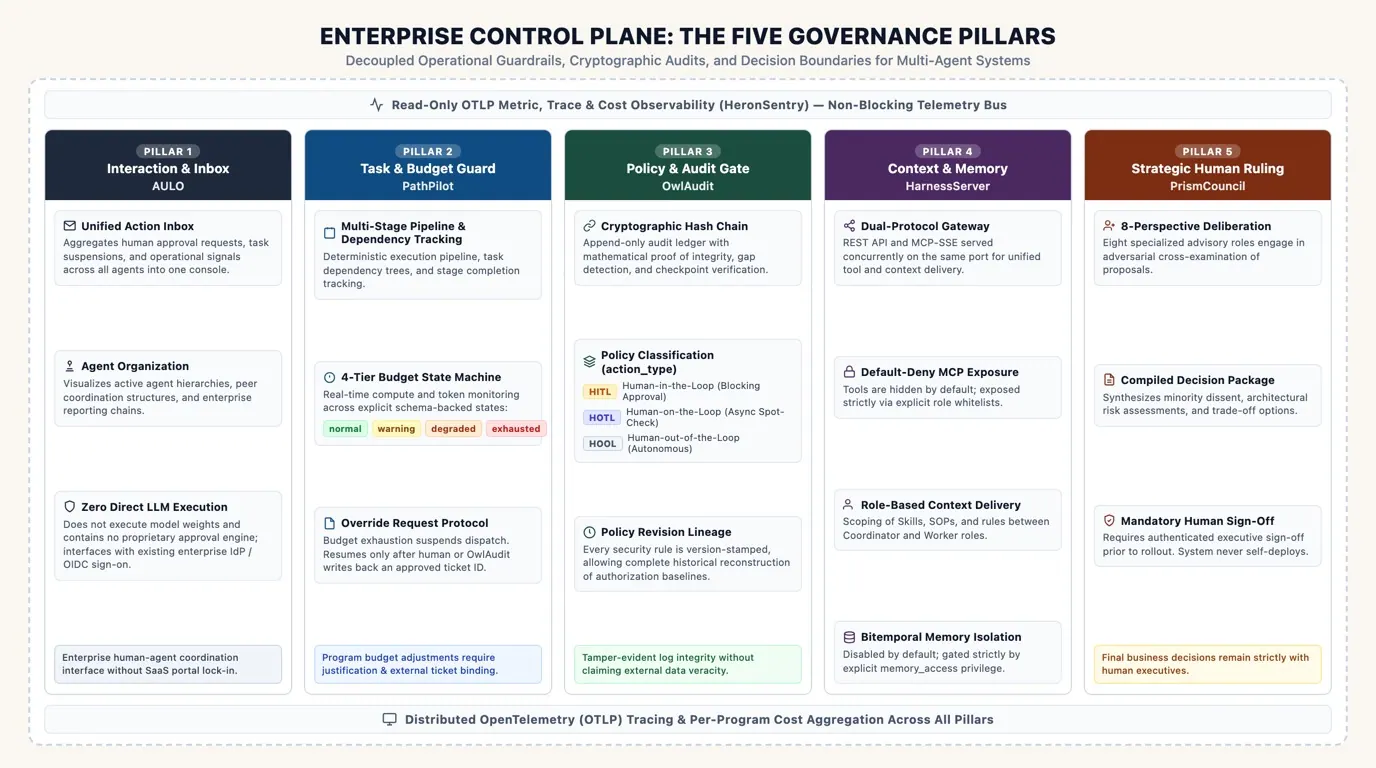
Pillar 1: Human Coordination and Unified Inbox (AULO) — Eliminating the "Human Router"
When an enterprise employs two or three autonomous agents for code review or document translation, simple web chat interfaces suffice. But when dozens of digital workers process expense claims, verify vendor contracts, monitor production alerts, and reconcile ledger entries, conversation-centric UI paradigms rapidly collapse.
Without a centralized coordination plane, enterprise teams face a recurring failure mode:
Agent A drafts a complex procurement discrepancy report and sends it to operations specialist B via enterprise chat. Specialist B cannot verify the underlying audit evidence inside the chat thread, so B copies numbers across windows to query Agent C for secondary verification, before manually pasting the final summary into an internal approval workflow. Human employees are not elevated into strategic supervisors; instead, they are degraded into mechanical "Human Routers" shuttling data between fragmented chat windows.
AULO resolves this by delivering an enterprise Agent organizational console coupled with a Unified Inbox:
Essential Product Facts:
- AULO executes zero foundation models internally: It operates strictly as a high-cohesion coordination, Agent organization, and notification layer, avoiding bloated LLM execution footprints;
- AULO embeds zero proprietary approval engines: Rather than attempting to replace existing corporate ticketing or approval workflows, AULO normalizes pending approval requests, confirmation signals, and task receipts from all active agents into a unified Inbox queue for structured human triage.
Through AULO, operational supervisors gain real-time visibility into Agent organization, task assignments, exception flags, and delivery receipts across the organization.
Pillar 2: Task Orchestration and Tiered Budget Governance (PathPilot) — Halting Cascade Explosions
In autonomous multi-agent systems, the primary danger is rarely an individual inference error; it is cascading recursion loops (Cascade Explosions) across collaborating agents.
Generic Failure Scenario: In an autonomous multi-agent workflow, a coordinator agent tasks a worker agent with reconciling anomalous ledger records. Due to an unhandled edge case in a bank statement, the worker returns ambiguous output. The coordinator interprets this as a formatting error and issues a retry directive. The worker executes another tool call, gets confused, and returns another variant. Trapped in an unbounded retry loop, the two agents exchange dozens of calls within sixty seconds, triggering catastrophic token cost spikes and polluting internal staging tables with duplicate writes.
Relying on natural-language prompt instructions like "Please terminate after three attempts" provides zero mathematical certainty in production. PathPilot enforces deterministic task planning, dependency tracking, and rigorous Four-Tier Budget State Governance:
- Four-Tier Budget State Governance (
normal/warning/degraded/exhausted): For individual tasks and long-running Programs, PathPilot actively tracks compute and token consumption across four explicit schema-backed states—normal,warning,degraded, andexhausted—alerting operators before resource thresholds are breached; - Audited Budget Reallocations: At the Program level, every budget expansion or reallocation is logged with causal justification and must reference an external corporate approval ticket identifier, maintaining complete financial defensibility;
- Override Request Protocol for Budget Exhaustion: When an essential business workflow encounters legitimate complexity that reaches the
exhaustedstate, the algorithm cannot self-grant additional budget. The workflow enters an automatic suspended state and issues a formal Override Request. Execution can only resume after an authorized human manager or policy engine (OwlAudit) writes back an approved ticket identifier.
Pillar 3: Policy Gates and Cryptographic Auditing (OwlAudit) — Moving Beyond Verbal Guardrails
Many organizations still attempt to govern autonomous agents by appending extensive "negative instructions" and "security guidelines" to System Prompts. Against complex multi-turn context dilution, prompt injection vectors, and nested tool calls, prompt-only guardrails provide negligible defense.
Real security requires deterministic code-level inspection and an immutable audit trail. OwlAudit provides this technical governance foundation:
- Cryptographic Hash-Chain Audit Logging: Every tool execution, environment state modification, parameter update, and human sign-off event is cryptographically linked in an append-only Hash Chain. This structure enables mathematical proof of log integrity, detection of omitted entries (Gap Detection), and periodic checkpointing across distributed nodes.
(Architectural Truth: OwlAudit's cryptographic hash chain mathematically ensures that recorded entries cannot be silently modified or deleted after creation; however, it does not certify the objective veracity of raw external inputs, nor does it replace specialized write-once-read-many (WORM) hardware storage arrays.) - Explicit Intervention Classification (
action_type): Prior to dispatching sensitive commands, the policy engine categorizes actions into three distinct operational modes:- HITL (Human-in-the-Loop): High-risk actions (such as capital transfers or schema migrations) are blocked until explicitly confirmed by an authenticated human operator via the UI;
- HOTL (Human-on-the-Loop): Medium-risk actions proceed automatically if initial policy constraints pass, but generate priority audit cards for asynchronous spot-checking by compliance officers within defined SLAs;
- HOOL (Human-out-of-the-Loop): Validated, read-only, idempotent tasks flow autonomously without manual friction.
- Full Policy Lineage Tracking: Every active policy rule is version-stamped, allowing organizations to reconstruct exactly which policy revision authorized an autonomous action at any given point in history.
Pillar 4: Context Delivery and Bitemporal Memory Isolation (HarnessServer) — Protecting Data Boundaries
A critical vulnerability in enterprise agent adoption is credential sprawl and cross-tenant data leakage. Teams frequently inject high-privilege administrative tokens into agent environments or allow unconstrained vector search over unrestricted internal data stores.
HarnessServer functions as the context distribution and capability delivery plane for agent workspaces, enforcing strict boundary isolation:
- Role-Based Provisioning and Default-Deny MCP Exposure: HarnessServer strictly separates context visibility between Coordinator (orchestration) and Worker (execution) personas. For Model Context Protocol (MCP) server endpoints, it enforces a default-deny security posture: tools are hidden from all agent roles unless explicitly granted in configuration. In standalone deployment, HarnessServer serves both REST management endpoints and MCP-SSE transport streams from a unified HTTP port;
- Task Context Snapshot: Upon task instantiation, HarnessServer captures a lightweight cryptographic snapshot of the exact versions of all Skills, SOPs, and knowledge claims mounted to the workspace. This snapshot serves as deterministic audit metadata rather than a bloated, byte-level disk image, enabling exact post-incident reconstruction without storage exhaustion;
- Bitemporal Managed Memory (Bitemporal Architecture):
- Disabled by Default: To prevent uncontrolled memory corruption and cross-session hallucination loops, memory persistence is disabled by default;
- Explicit Authorization: Memory access is strictly gated; only agents explicitly provisioned with
memory_accessprivileges may read or query historical state; - Dual-Temporal Indexing: Memory entries record both Valid Time (when the business fact was true in the real world) and Transaction Time (when the system recorded the entry). This enables compliance teams to answer precise retrospective inquiries: "What exact historical context did the agent possess on March 14th when it approved that transaction?"—overcoming the opaque volatility of unversioned vector embeddings.
Pillar 5: Strategic Human Ruling and Closed-Loop Decisions (PrismCouncil) — Preserving Human Sovereignty
For complex strategic initiatives, capital allocations, and cross-functional risk evaluations, organizations cannot rely on a single conversational bot generating unilateral advice. High-stakes governance requires structured, multi-perspective debate.
PrismCouncil orchestrates this strategic deliberation:
- Eight specialized advisor personas—spanning Corporate Strategy, Finance, Legal Risk, Operations, and Compliance—conduct structured multi-round debates, explicitly surfacing divergence points and evidentiary gaps to formulate a comprehensive Decision Package;
- Mandatory Human Sign-off: The synthesized Decision Package serves solely as a strategic advisory artifact. It cannot be promoted into active execution or spawned into PathPilot tasks without formal human executive approval. PrismCouncil adheres to the non-negotiable rule: the system never usurps human authority over final business decisions.
04. The "Knowledge Retention" Litmus Test: Where Does Operational Learning Settle?
When evaluating enterprise AI platforms, procurement teams frequently obsess over model benchmarks, context window sizes, and generation latency. However, forward-looking CIOs, enterprise architects, and general counsels must demand answers to a far more consequential question:
"Over the next twelve months, as this digital system processes edge cases, resolves exceptions, and incorporates human corrections from our senior specialists, where does that acquired institutional knowledge actually reside?"
If the vendor's answer is "it is absorbed into our proprietary model weights through reinforcement learning" or "it lives in our managed cloud session stores," the enterprise is exposing itself to massive intellectual property extraction. The moment subscription terms expire or the vendor deprecates that model generation, the operational wisdom distilled by your senior human specialists disappears with it.
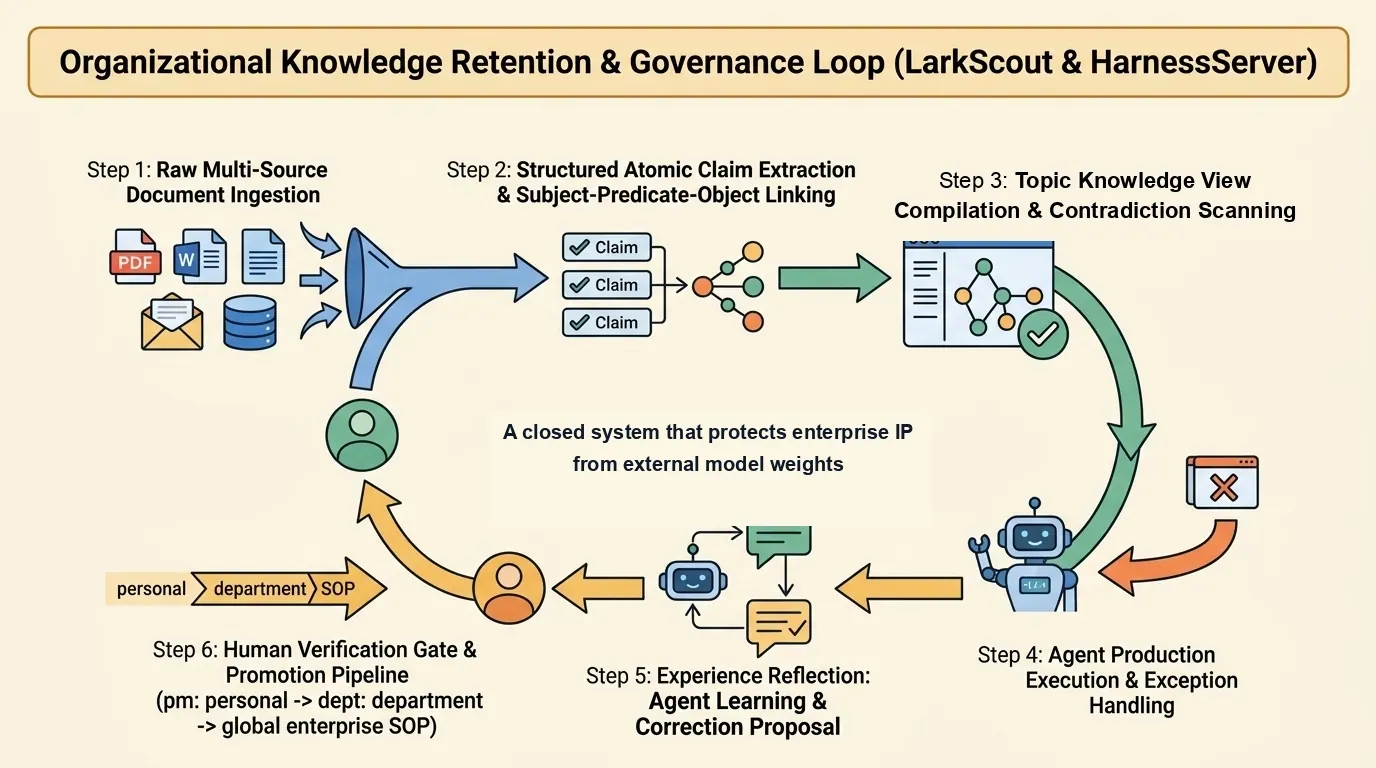
1. Atomic Claim Extraction and Knowledge View Compilation
True enterprise knowledge assets cannot consist of hundreds of thousands of raw, unstructured text chunks dumped into a generic vector index. Real business operations demand verifiable, cross-referenced facts.
Inside ReadyForAI's knowledge compiler, LarkScout:
- Complex corporate documents, contracts, and policy manuals are decomposed into atomic, structured Claims (Subject-Predicate-Object triplets) linked to verified entities;
- Across disparate data silos, related claims are compiled into thematic, fully cited Knowledge Views;
- Contradiction Scanning: LarkScout continuously evaluates claims across different sources that share identical subjects and predicates but present contradictory objects. Conflicting assertions are flagged as Contradicted or Uncertain, prompting human specialists to resolve discrepancies before corrupted instructions can mislead downstream agents.
2. Experience Reflection and Promotion Governance
Crucially, LarkScout establishes an engineered pathway for digital workers to learn from operational friction without corrupting baseline standards:
- When an autonomous worker encounters an unprecedented operational anomaly that is subsequently remediated by a human specialist, LarkScout's Experience Reflection pipeline abstracts the remediation trace into a structured Correction Proposal;
- Zero Automated Direct Commit: Correction proposals never alter production rules automatically. They are routed into a governed review queue for verification by authorized subject matter experts (SMEs);
- A Governed Three-Tier Scope Promotion Hierarchy:
- Personal Scope (
pm:): Experimental drafts and localized corrections confined to an individual engineer's testing workspace; - Department Scope (
dept:): Validated SOPs approved by team leads and synchronized across departmental agent instances; - Global Scope (
global): Institutional policies promoted only after a promotion request is reviewed and approved by an administrator, serving as universal baselines for all digital workers across the enterprise.
- Personal Scope (
This closed-loop governance ensures that institutional problem-solving transforms into version-controlled, human-auditable, plain-text software artifacts. These assets reside entirely within the enterprise's private data tier, ready to be dispatched by HarnessServer to whatever foundation model is in service today—or whatever superior model supersedes it tomorrow.
05. The Enterprise Architect's Evaluation Checklist
To prevent strategic lock-in and ensure long-term digital workforce sovereignty, enterprise architecture teams can evaluate existing vendor proposals and internal initiatives against four architectural criteria (for detailed comparisons, see ReadyForAI's comparison overview, self-built architecture comparison, and cloud vendor platform analysis):
- Decoupled runtimes and model agnosticism: Does the system run on a lightweight host sandbox (e.g. NodalOS) that allows seamless substitution of underlying models and frameworks without altering business workflows?
- Role-based context and default-deny tool boundaries: Are MCP endpoints and internal APIs restricted via default-deny policies per role? Is cross-agent data contamination prevented?
- Deterministic tiered budget governance and cryptographic audits: When multi-agent loops encounter state divergence, are there four-tier budget states with override approval (like PathPilot)? Are audit logs protected by tamper-evident hash chains?
- Sovereign knowledge assets and bitemporal memory: Are operational rules and SOP improvements preserved as structured, versioned artifacts (e.g. LarkScout / HarnessServer) under enterprise ownership, rather than opaque vendor weights?
Conclusion
Foundation models are the electricity, the specialized turbine, the high-octane fuel of modern AI; the control plane is the sovereign power grid, the flight deck, and the structural chassis that keeps the enterprise in flight.
In an era of hyper-accelerated AI competition, attempting to forecast which commercial model or proprietary platform will lead the market twelve months from now is a fool's errand. Do not wager your enterprise roadmap on technological shifts you cannot control; invest in the institutional control plane you must permanently own.
Confine execution to modular, sandboxed runtimes that capture every price and performance advance in the global market. Anchor governance, access control, financial budgets, and institutional knowledge inside a sovereign enterprise control plane. That is the only durable architectural strategy for the age of autonomous digital labor.