Beyond "Orchestration Theater": Building Production-Grade Digital Workforce Infrastructure
As multi-agent systems evolve beyond 'orchestration theater' and free-form chat, enterprise production demands deterministic control. Drawing from Claude Code Desktop and Meta FAIR / Harvard's ScaleMAS, this article presents a substrate-centric paradigm built on NodalOS and seven governance products.
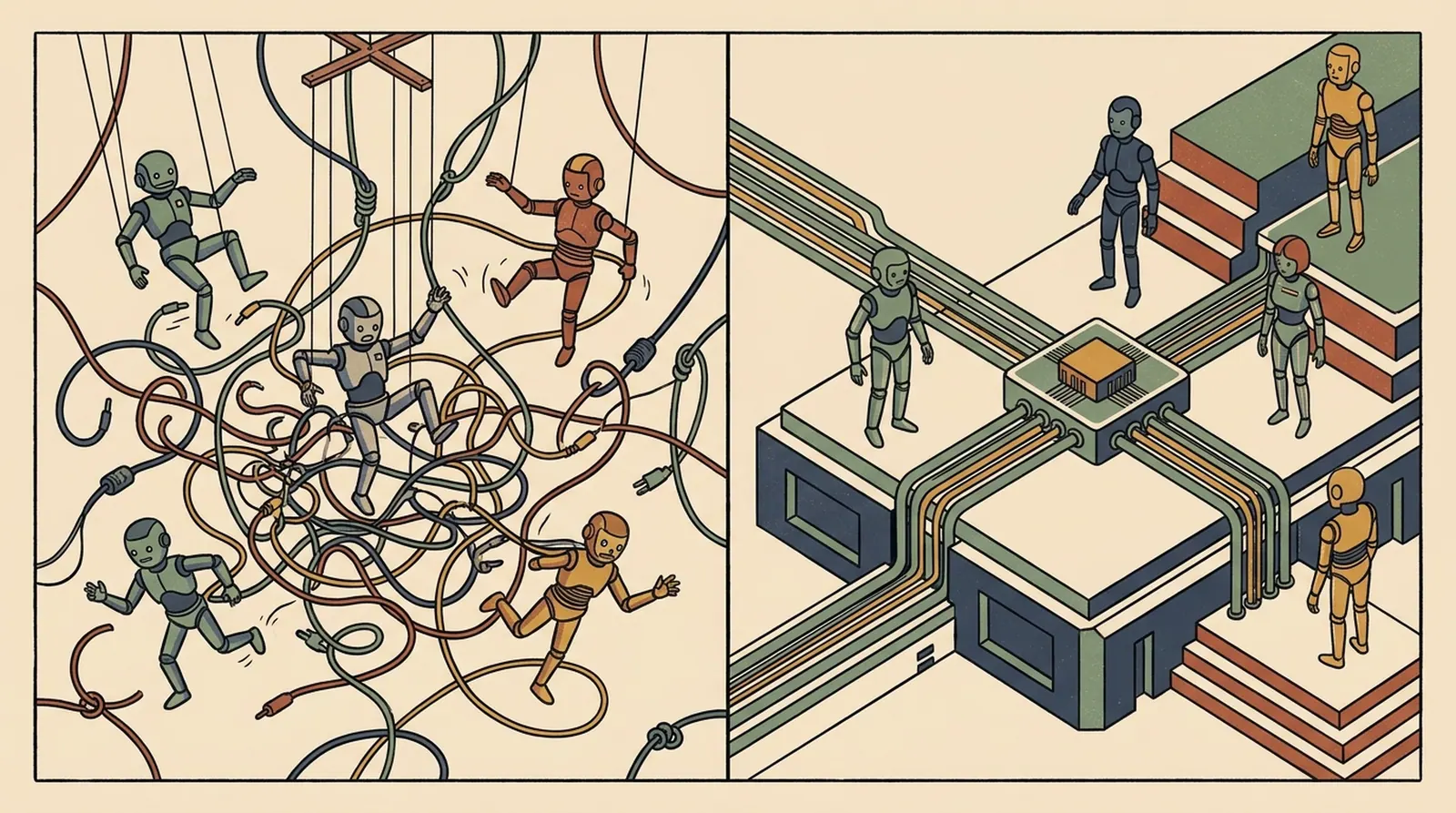
Over the past two years, Multi-Agent Systems (MAS) have undergone a profound transition from conceptual hype to engineering reality. Social media was once saturated with demos of autonomous swarms—agents chatting freely and holding virtual meetings. In serious enterprise production environments, however, these designs quickly hit severe engineering bottlenecks: cascading failures, excessive coordination tax, context window explosions, and uncontrollable safety risks.
Recently, industry and academia have sent a remarkably aligned signal. First, Anthropic released the Claude Code Desktop multi-session update, demonstrating an engineering interaction paradigm based on nested sessions, physical workspace isolation, and human-in-the-loop workflows. Second, researchers from Meta FAIR and Harvard University published ScaleMAS (Scaling Multi-Agent Intelligence with Substrate-Centric Coordination), showing through experiments that substrate-centric coordination achieves superior scalability.
This article outlines ReadyForAI's multi-agent architectural philosophy: why enterprises do not need superficial "orchestration theater," but rather a production-grade digital workforce infrastructure underpinned by a robust operating system substrate (NodalOS) and seven governance products.
1. Industry Disillusionment and Engineering Awakening: Four Reality Pitfalls
In the initial rush to deploy Large Language Models (LLMs), many teams attempted to tackle complex problems simply by adding more agents. In real business workflows, however, they quickly collided with an "engineering brick wall."
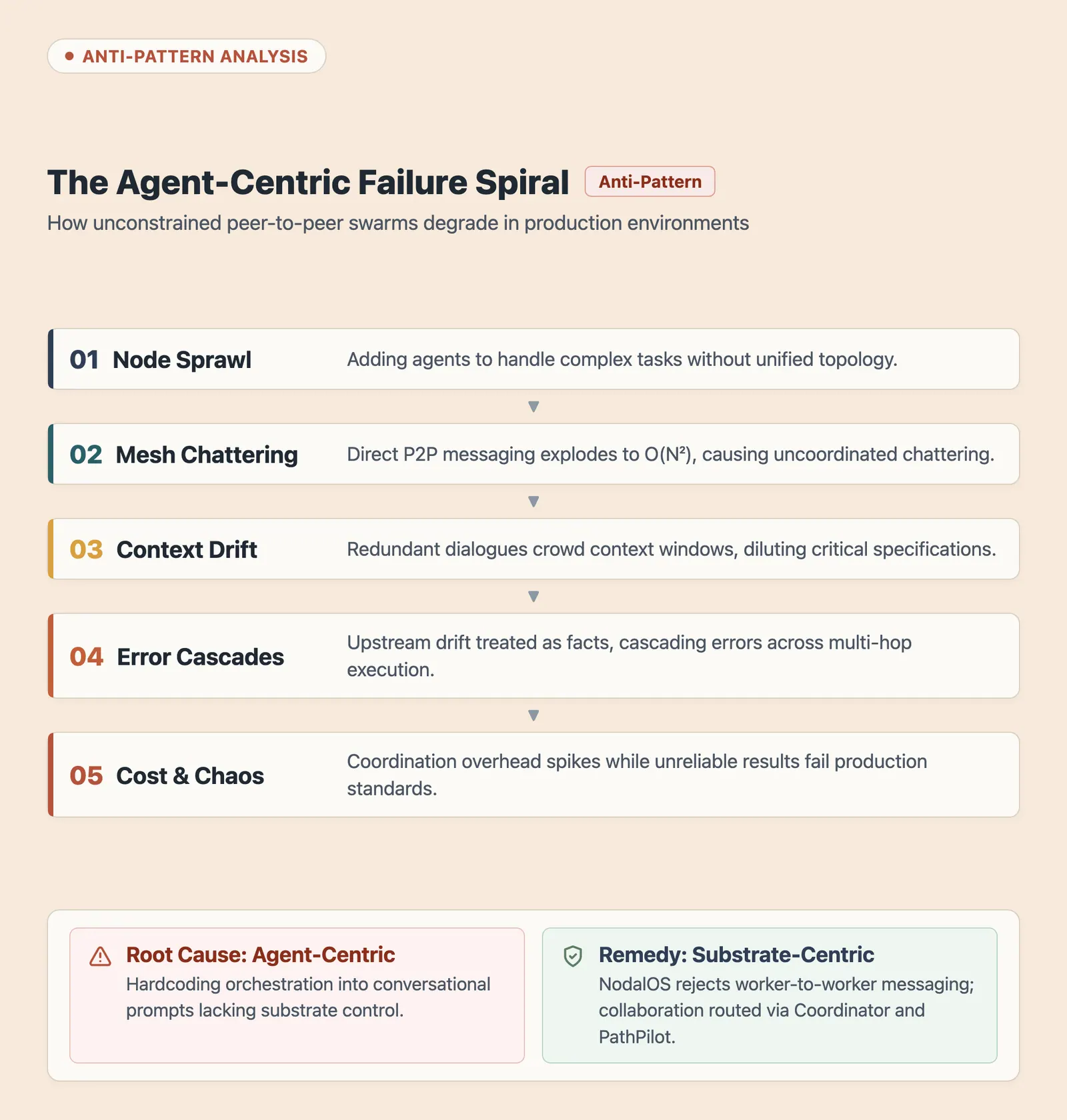
Engineering teams on the front lines have identified four core pitfalls:
- Cascading Failures: LLMs are fundamentally probabilistic. When agents are permitted to chat freely with one another, a subtle upstream hallucination is treated by downstream nodes as established fact, compounding erroneous assumptions throughout the workflow and multiplying the overall failure rate.
- Coordination Tax and Hidden Costs: Agent-to-agent pleasantries, parameter negotiation, circular back-and-forth inquiries, and retry loops drive token consumption sharply upward. In tasks that could be handled in a single deterministic step, splitting work across multiple conversational agents can multiply execution latency and token burn several times over—raising coordination overhead without improving output quality.
- Context Explosion and Attention Decay: Over long-horizon workflows, accumulating conversation logs and intermediate state in a single context window triggers severe "needle-in-a-haystack" degradation. Agents lose focus and drift away from original corporate standards and business objectives.
- Fragile Prompt-Based Guardrails: Relying solely on system prompts like "You do not have financial approval authority" or "Never delete data" offers no deterministic guarantees against prompt injection or privilege escalation (see Production Doesn't Trust Prompts: The Five Layers of Enterprise Agent Engineering).
Our engineering stance is unambiguous:
If a problem can be solved with a single prompt combined with deterministic engineering logic, never introduce multi-agent complexity.
When business complexity genuinely requires multi-role collaboration, coordination logic must never depend on free-form dialogue between agents; it must sink into the substrate and external control planes.
2. Technical Validation from Industry Milestones
Multi-agent design is leaving chaotic "free-form swarms" behind and converging on rigorous engineering patterns. Recent breakthroughs in both industry and academia validate this evolution:
2.1 Industry Practice: Claude Code Desktop's Multi-Session and Isolation Architecture
In Anthropic's Claude Code Desktop technical update, the team showcased an engineering control and interaction model built for production-grade software development:
- Hierarchical Topologies (Nested Sessions): "When you ask Claude to run tasks in parallel, it starts a nested session for each one. Each reports its result back into your main session when it's done, so the main thread stays readable."
- Physical Workspaces and Environments: "You can also save a setup as an environment, like a few folders, an SSH host or the cloud, and start sessions there, with the option of a worktree per folder"—reducing interference between concurrent changes.
- Non-blocking Interaction and Proactive Spawning: "You can also use
/btw, so side questions open in their own tab while the main session keeps going." Furthermore, "Claude also proactively suggests follow-up work as it's working, and you can run that as its own session with just one click." - Human-in-the-Loop (HITL) Sidebar Control Plane: "The sidebar makes it easy to see which sessions are working and which ones need you. Inside a session, a live to-do list follows Claude's plan as it goes, a recap card sums up the turn when Claude needs you, and the side rail shows where it runs, its context and its changes."
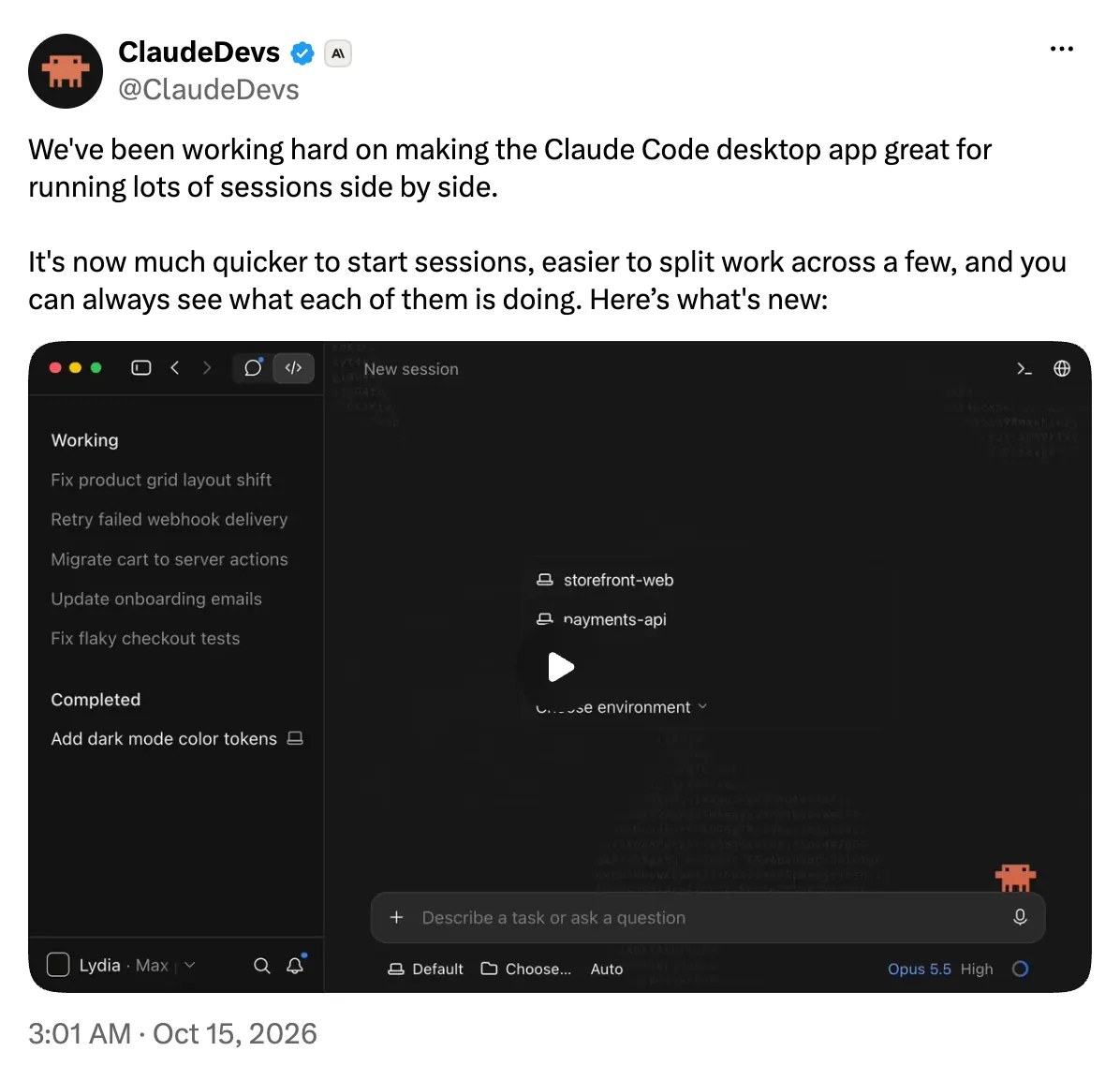
ClaudeDevs on X announcing the Claude Code Desktop multi-session update (Oct 15, 2026). View the original post
This design clearly demonstrates that effective agent collaboration does not rely on opaque peer-to-peer chitchat. It depends on structured hierarchical topologies, physical workspace isolation, and actionable human-in-the-loop interfaces.
2.2 Academic Frontier: The Substrate-Centric Paradigm Proposed by Meta FAIR and Harvard in ScaleMAS
In Scaling Multi-Agent Intelligence with Substrate-Centric Coordination (ScaleMAS), researchers from Meta FAIR and Harvard University expose the foundational flaw of conventional multi-agent systems: hardcoding collaboration logic directly into the agents themselves (Agent-Centric). In the ScaleMAS architecture, all agents operate under the exact same harness and identical prompt, holding no specialized roles and engaging in zero peer-to-peer messaging or task assignment.
Drawing inspiration from the architecture of the World Wide Web, the authors propose a Substrate-Centric coordination model:
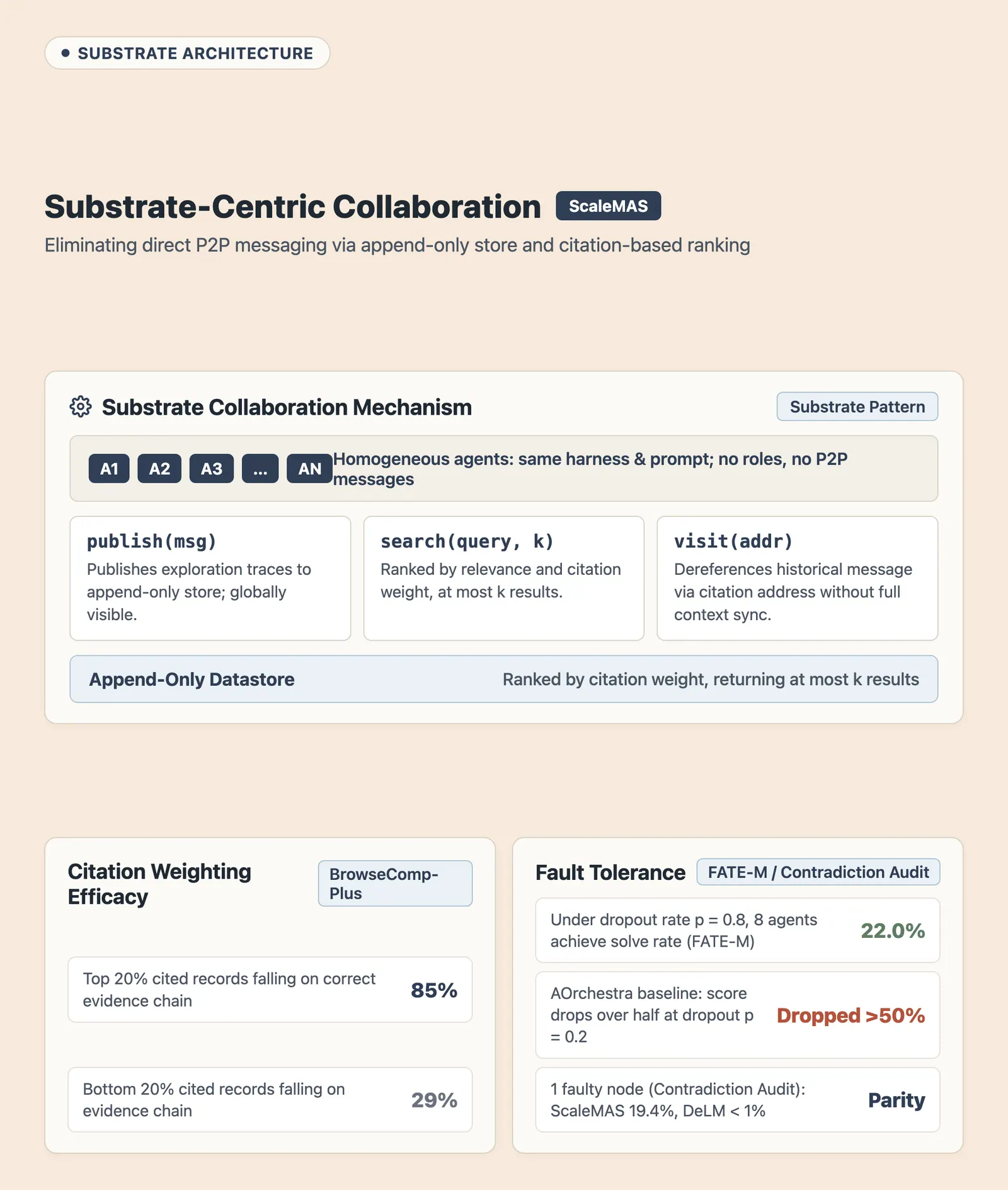
- Append-Only Datastore: All knowledge and findings are published to a datastore that supports only appends—records are never modified or deleted. Any agent can trace and visit evidence by address.
- Bounded Reads: Each agent retrieval is strictly capped at returning at most k records. Regardless of how large the agent collective grows, the read volume of an individual agent does not scale with collective size.
- Peer Citation Weighting: Rather than relying on a centralized judge, the system adapts a PageRank-style citation mechanism from the Web, dynamically boosting the authority of claims as subsequent agents cite them. In all BrowseComp-Plus benchmark runs, 85% of records in the top quintile of cited items were on the ground-truth chain of reasoning, compared to only 29% in the bottom quintile (with the paper noting that citation metrics reflect both connectivity and relevance).
- Empirically Proven Fault Tolerance and Scaling: The system scaled cleanly to 128 agents. On the FATE-M benchmark, even under an extreme step failure rate of p = 0.8 (where agents miss an average of 4 out of every 5 steps), an 8-agent ScaleMAS achieved a 22.0% success rate, whereas the centralized coordinator AOrchestra suffered more than a 50% performance drop at p = 0.2. On Contradiction Audit, when introducing an agent node that consistently failed at every step, ScaleMAS maintained performance parity with an all-healthy configuration (19.4% with 7 healthy nodes in both cases), whereas the baseline DeLM (blackboard-style shared context) collapsed to under 1%.
3. ReadyForAI Design Philosophy: Building Digital Workforce Infrastructure
Synthesizing cutting-edge engineering practices with academic insights, ReadyForAI adheres to four foundational design principles when engineering enterprise digital workforce systems:
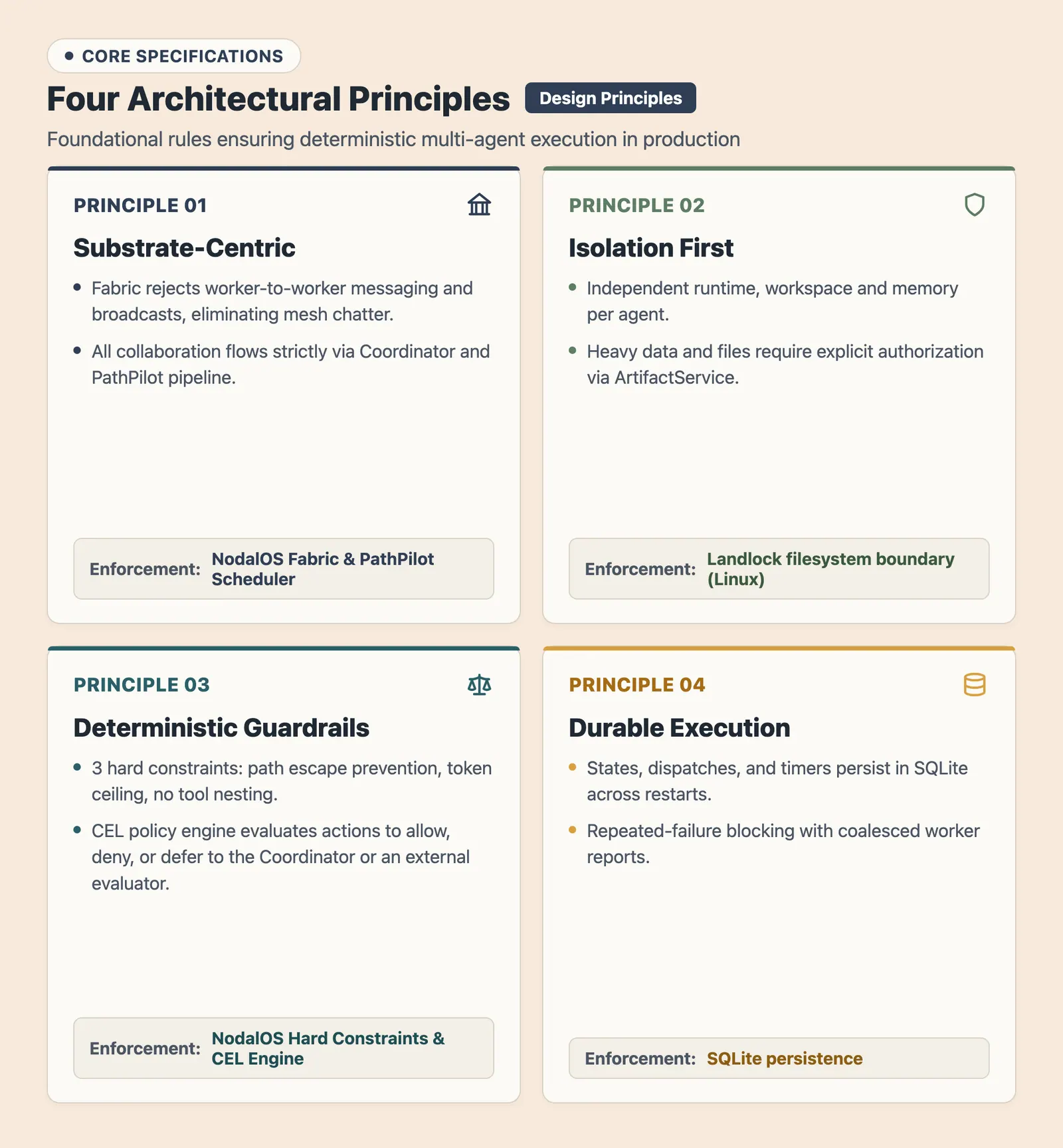
- Substrate-Centric over Swarms
Worker-to-Worker direct messaging is strictly rejected. NodalOS hard-enforces this on the message bus (Fabric), rejecting direct worker-to-worker messages and worker channel broadcasts. All task collaboration must be routed through Coordinator orchestration and PathPilot pipeline scheduling. By sinking communication and coordination into the substrate, system topology remains explicit and deterministic. - Isolation First, Explicit Sharing
Implicit shared memory is eliminated. Each agent possesses an independent runtime, workspace, and memory scope. On Linux, Landlock filesystem boundaries are applied by default to child processes spawned by agentd, restricting writes to the active workspace,shared/directory, private temporary directories, and CLI state directories (in-process Basic, Native, and Coordinator runtimes are unaffected; macOS is not currently bounded). Large data and file transfers must be explicitly authorized via ArtifactService grants, preventing out-of-band context pollution. - Deterministic Guardrails over System Prompts
Enterprise security is never delegated to fragile system prompts. The underlying execution bus enforces structural hard constraints: path traversal prevention, hard per-task token ceilings, and prohibition of agent tool nesting. Furthermore, the Policy Hook Bus evaluates Google CEL expressions at critical interception points before tool execution, coordinator dispatch, and model invocation—allowing operations to be synchronously permitted, denied, or deferred to the Coordinator or external evaluators. - Durable Execution & Atomic State Machine
Real-world enterprise tasks span hours or days. Individual worker processes are designed to allow crashes and restarts, with operational state, dispatch records, and pending timers transactionally persisted in an embedded SQLite database, ensuring breakpoint recovery at any point in time.
4. Layered Architecture: NodalOS Substrate and Closed-Loop Governance
ReadyForAI structures the entire digital workforce architecture into two clear tiers: the underlying single-node agent operating system (NodalOS) and the upper-layer enterprise governance suite.
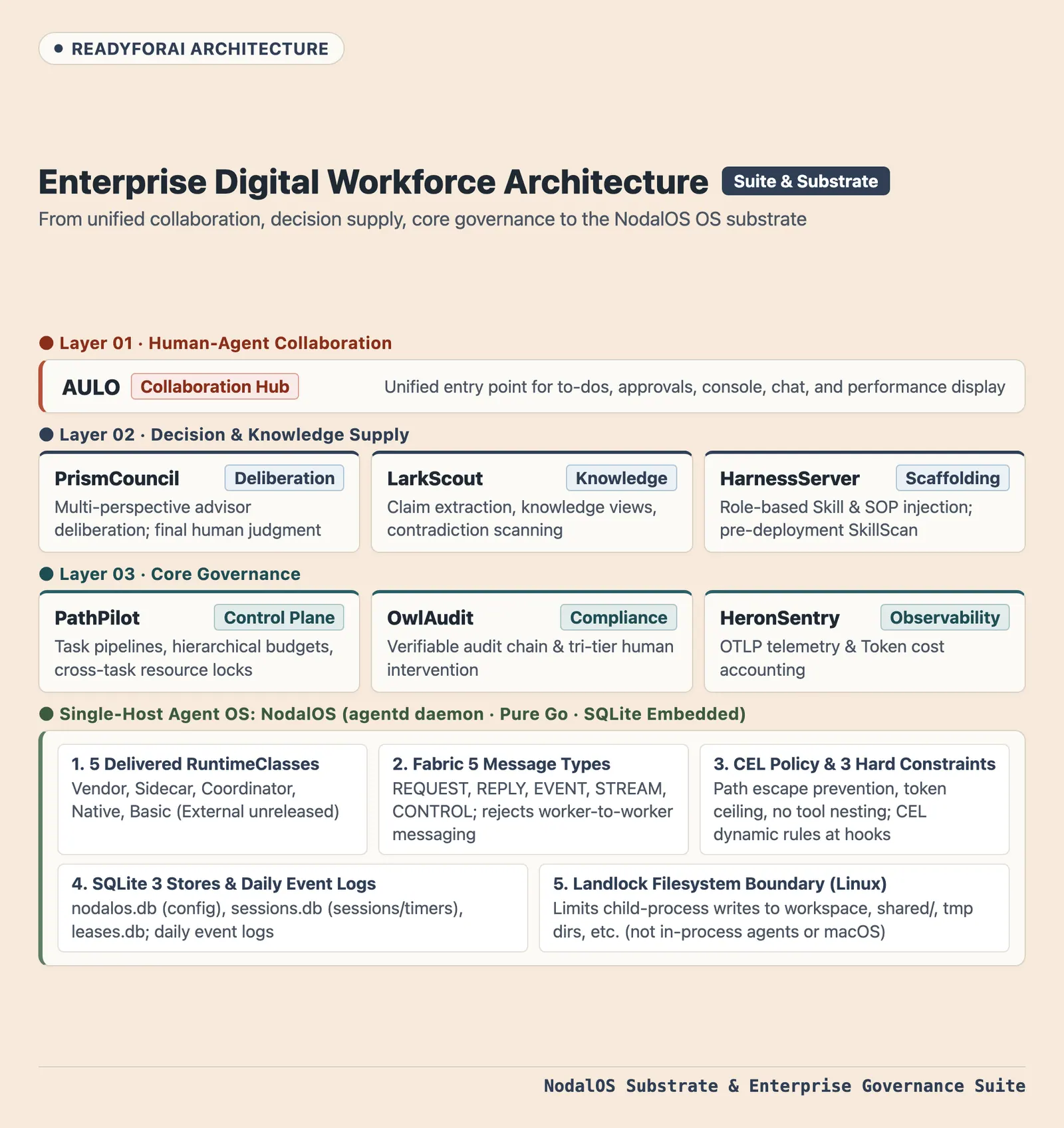
4.1 Operating System Substrate: NodalOS (Robust, Self-Contained, Lightweight)
NodalOS is an on-premises runtime and management substrate for heterogeneous agents. Built as a single daemon (agentd) paired with a management CLI (nodalctl), it is implemented in pure Go with zero CGO dependencies. With an embedded SQLite engine, it requires no external databases or message brokers:
- Five Shipped RuntimeClasses:
Vendor: Directly hosts official CLI agents including Claude Code, Codex, Grok, OpenCode, and generic CLI tools, as well as custom applications built on the OpenAI Agents SDK and Claude Agent SDK;Sidecar: Integrates external agent runtimes via HTTP (A2A profile, hosting frameworks such as Google ADK), stdio (custom JSONL protocol), or ACP (Agent Client Protocol);Coordinator: A model-driven resident orchestration runtime responsible for dispatching tasks to workers;Native: Native in-process agents implemented with the NodalOS Go SDK;Basic: A lightweight linear-loop agent adhering to internal complexity soft guardrails to preserve simplicity. (The planned External multi-node distributed runtime class is deferred to v1.1 and returns Unimplemented upon invocation.)
- Coordinator Durable Execution Primitives: Features resident Working Set context injection, durable timers persisted to SQLite that automatically fire after restarts, a pre-dispatch write-ahead log (Dispatch WAL), repetitive failure fingerprint blocking (preventing runaway failure loops), watchdog timeout monitoring, a fixed Steer coalescing window (throttling high-frequency burst reports), and session checkpoint/resume mechanisms.
- Policy Hook Bus:
- Inherent Hard Constraints: Enforces path traversal prevention, single-task hard token limits, and agent tool nesting prevention directly within the engine;
- Dynamic CEL Evaluation: Evaluates Google CEL rules at pre-execution hooks (
before_tool_invoke,before_coordinator_dispatch,before_model_invoke), supporting synchronous allow, deny, or deferral actions (defer_to_coordinator/defer_to_external).
- Tri-Database SQLite and Event Streaming Architecture:
nodalos.db: Low-frequency metadata and system configuration history;sessions.db: Medium-frequency session state, tiered runtime memory (working, short-term, long-term), and timers;leases.db: High-frequency lease acquisition and transient quota tracking;event-log/YYYY-MM-DD.log: Daily rotated, append-only immutable event streams;- The Fabric message bus defines a closed set of five message types (
REQUEST,REPLY,EVENT,STREAM,CONTROL), strictly governing process communication paths.
4.2 Explicit System Boundaries (The "What We Do Not Do" List)
NodalOS's public specifications strictly define its architectural boundaries, keeping the substrate focused and minimal:
- ❌ No built-in business human-agent interaction UI: Human-agent workflows, pending approvals, interaction cards, and global consoles are handled entirely by AULO;
- ❌ No compliance ticketing or audit ledger storage: High-order human review tickets, audit chains, and compliance reporting are managed by OwlAudit;
- ❌ No business performance analytics: Business KPI tracking and cross-role productivity analysis are aggregated and visualized by AULO;
- ❌ No task topology services or budgeting subsystems: Task topology graphs are maintained by AULO, while multi-stage task pipelines and hierarchical budget management belong to PathPilot (NodalOS solely dispatches tasks according to configuration and meters usage).
4.3 Enterprise Governance Suite: Seven Digital Workforce Management Products
Operating on top of NodalOS, ReadyForAI delivers a comprehensive enterprise governance matrix:
- AULO (Unified Human-Agent Workspace): Unifies to-do queues, approval flows, operational consoles, chat, and performance analytics into a single interface. Enables project-level interaction with Coordinators and distills critical decisions from multi-agent discussions.
- PathPilot (Execution Control Plane): Manages multi-stage task pipelines, milestone tracking, hierarchical budgets, and cross-task resource locks, bringing deterministic execution to complex business operations.
- OwlAudit (Compliance Audit and Gateways): Connects to NodalOS external governance hooks, maintaining a verifiable, break-detectable Hash Chain audit ledger, and providing three tiers of human intervention (with HITL functioning as an active approval gate).
- LarkScout (Knowledge Compilation Platform): Parses enterprise documentation into provenance-backed atomic Claim units, compiles them into curated knowledge views, and regularly scans and flags knowledge contradictions for human review.
- HarnessServer (Context and Capability Assembler): Injects role-specific Skills and SOPs into agent workspaces, running pre-deployment static scans on Skills via SkillScan (enabled by default, can be toggled off).
- HeronSentry (End-to-End Observability Plane): Ingests telemetry via standard OpenTelemetry (OTLP), reconstructs distributed execution topologies, and delivers granular token cost accounting broken down by prompt, cache read/write, and output.
- PrismCouncil (Strategic Deliberation Sandbox): Deploys eight specialized perspective advisors orchestrated by a Councilor in group or solo deliberation, synthesizing structured Decision Packages while upholding the principle of human final authority.
5. Enterprise Digital Workforce Adoption Roadmap
Deploying a digital workforce does not require purchasing a massive monolithic system on day one. ReadyForAI advocates an agile, phased adoption strategy:
| Phase | Enabled Products | Core Objectives & Deliverables |
|---|---|---|
| Phase 01: Host & Govern | NodalOS, PathPilot, AULO | Safely host existing agent teams, establish controllable task pipelines, and provide humans with an intuitive, centralized management console. |
| Phase 02: Enhance & Evolve | LarkScout, HarnessServer | Capture proprietary enterprise knowledge, distribute role-based SOPs, statically scan Skill safety risks before deployment, and initiate the continuous feedback flywheel. |
| Phase 03: Observe & Deliberate | HeronSentry, OwlAudit, PrismCouncil | Connect full-stack OTLP distributed observability, establish verifiable audit chains, and introduce multi-perspective deliberation for strategic business decisions. |
| Phase 04: Scale & Replicate | All 8 Products in Closed-Loop Synergy | Achieve unified governance across all 7 governance products and the NodalOS substrate, replicating across R&D, QA, compliance, finance, and marketing with decreasing marginal deployment costs. |
6. Conclusion: Anchoring Determinism in the Substrate and Control Plane
In an era of rapid generative AI evolution, underlying foundation models are being superseded on six-month cycles. A model that appears revolutionary today can become an interchangeable commodity tomorrow.
If an enterprise hardcodes its collaboration workflows into black-box prompts or unconstrained agent swarms, it faces vendor lock-in and fails to build its digital workforce into an enduring institutional asset.
As we analyzed in Build Your Own Control Plane: When Models Expire in Six Months, What Are Enterprises Actually Buying?: foundation models are depreciating probabilistic compute, whereas enterprise business rules, permission boundaries, audit trails, and deterministic governance capabilities anchored in the substrate and control plane represent lasting, compounding value.
The second half of the multi-agent era is no longer about "who writes the cleverest prompt." It is about "whose substrate is most resilient, whose control plane is most deterministic, and whose compliance audit chain is most complete." Leaving the theater of orchestration behind and grounding workflows in solid substrate and governance architecture is how enterprises build a true production-grade digital workforce.
References & Further Reading
- Anthropic Claude Code Desktop Multi-Session Announcement
ClaudeDevs on X: "We've been working hard on making the Claude Code desktop app great for running lots of sessions side by side..." - Meta FAIR and Harvard University ScaleMAS Research Paper
Scaling Multi-Agent Intelligence with Substrate-Centric Coordination (arXiv:2610.16120v1) - ReadyForAI Product Suite
ReadyForAI Products & Enterprise Governance Solutions - Related Deep Dives