From Tobi Lütke's AI Council to Enterprise Deliberation
Reflecting on Shopify CEO Tobi Lütke's AI council, explore how enterprise strategic decisions move from ad-hoc Q&A to structured, auditable deliberation.
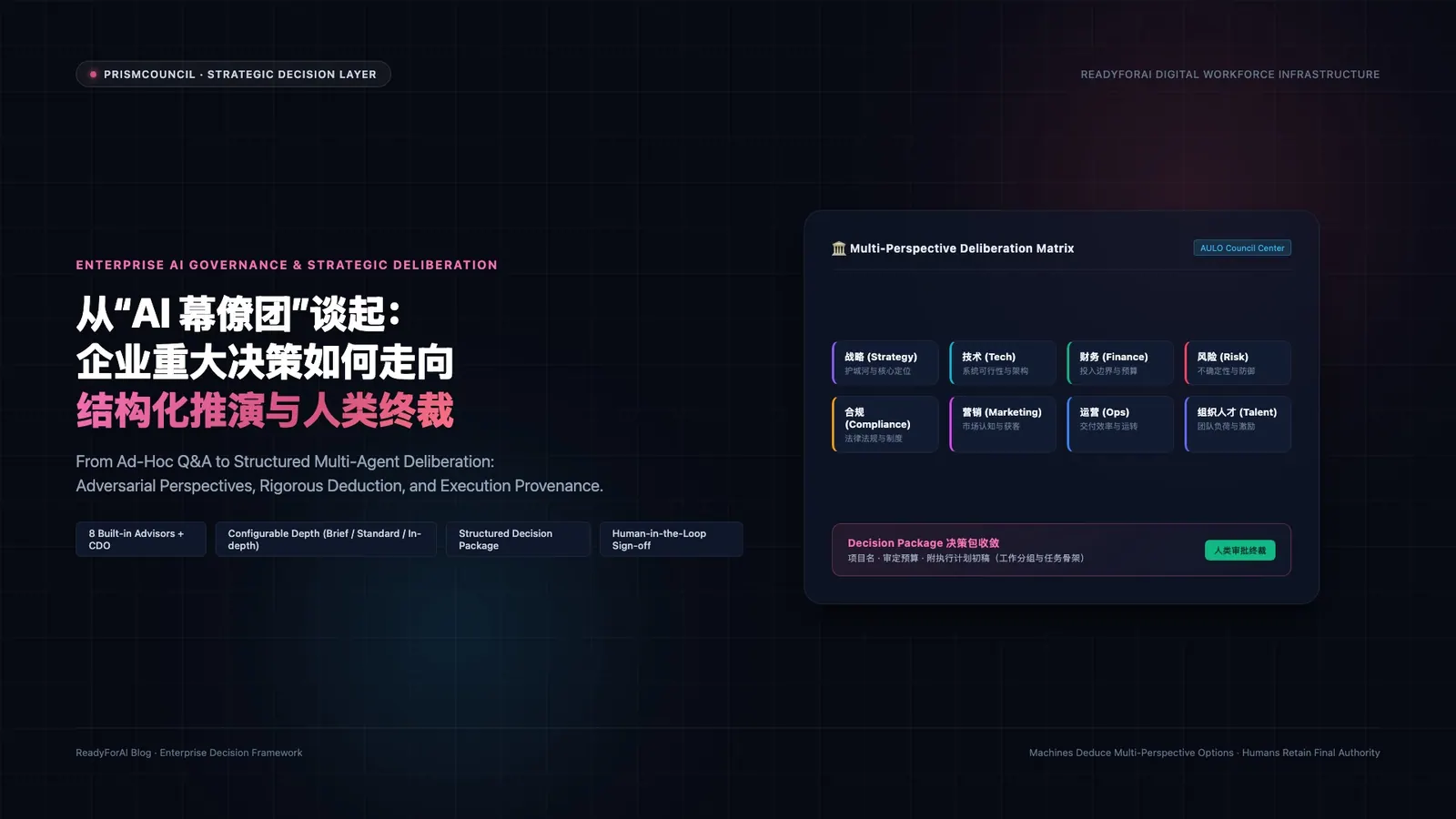
Executive Summary:
In September 2026, Shopify founder and CEO Tobi Lütke appeared on the business podcast The Knowledge Project (official episode page on Farnam Street), sharing how he uses a personal "AI Chief of Staff" alongside a multi-model "AI Council" to help work through complex enterprise dilemmas.The episode sparked substantial discussion across tech and leadership circles. Yet for the vast majority of enterprise leaders, manually orchestrating complex multi-agent scripts in a private personal environment is neither scalable nor necessary.
The cognitive challenges and deliberative needs Tobi faced are precisely what PrismCouncil addresses in enterprise settings: delivering an out-of-the-box, adversarial multi-perspective deliberation layer that smoothly connects governance, compliance, and human sign-off into execution.
1. The Shopify CEO's Experiment: From Solo Prompts to Multi-Agent Deliberation
During the interview, Tobi Lütke unpacked his approach to navigating high-uncertainty scenarios where playbook answers simply do not exist:
Instead of querying a single large language model with a standalone prompt, his personal AI chief of staff spins up a virtual deliberation panel comprising 5 to 6 specialized roles:
- Role Specialization: Assigning distinct lenses such as data analysis, research, engineering, and business strategy;
- Multi-Model Collaboration: Directing different roles to distinct foundation models to mitigate single-vendor cognitive biases;
- Synthesis and Briefing: Utilizing another model to synthesize the council's findings into a single audio briefing for him to listen to the following morning;
- Resource Investment: Completing the process in roughly 30 minutes for approximately $15 to $20 in tokens—work he noted would otherwise take a month of personal effort—presenting the decision-maker with structured comparative perspectives;
- Role and Boundary: His AI council only informs and never decides, providing structured perspectives rather than superseding executive judgment.
This case caught industry attention because it highlights a deeper paradigm for generative AI in the enterprise: not merely downstream drafting or coding, but serving as an intellectual sparring partner for executive deliberation.
2. Core Decision Principles: Machines Deduce, Humans Bear Responsibility
Drawing from years of operational leadership, Tobi outlined three fundamental principles regarding AI-assisted governance:
1. Machines Cannot Bear Responsibility
Tobi drew a sharp line on organizational responsibility: "Machines can't take responsibility." If something goes wrong, only a human can be fired, sued, or sent to jail. Machines can map variables and explore scenarios, but commercial consequences, legal accountability, and organizational stewardship remain strictly human obligations.
In our terms, AI's role at the executive tier is not decision delegation, but creating an expansive, rigorous Decision Surface—analogous to the market data and analytics terminals traders work from, placing critical data and scenario analysis in full view while leaving judgment, trade-offs, and accountability squarely with humans.
2. Guarding Against Attention Exhaustion: "Slop Grenades"
Tobi warned of an organizational anti-pattern emerging alongside generative tools: employees prompting AI to produce work, skipping review, and handing the unvetted output to colleagues to evaluate and clean up.
He characterized this dynamic with a vivid phrase: "We call those 'slop grenades' that people toss at each other." In critical business decisions, organizations do not need sprawling text; they need concise, verifiable, and structured deliberation.
3. High-Value Long-Term Strategy Lacks Immediate Feedback
Initiatives yielding immediate quarterly metrics naturally attract consensus. However, strategic maneuvers that build long-term enterprise moats—such as core architecture rewrites or deep organizational pivots—often exist in an immediate feedback vacuum for extended periods.
In the absence of immediate external validation, leaders require rigorous multi-perspective deliberation, stress-testing operational, financial, technical, and compliance risks before committing organizational resources.
3. Bridging the Gap: From Personal Hacking to Enterprise Standardization
While individual experimentation is illuminating, enterprise leadership teams attempting to replicate this workflow informally face substantial hurdles:
- Prompt and Persona Engineering Overhead: Ensuring distinct personas maintain authentic adversarial tension rather than devolving into polite consensus;
- Disconnection from Business Execution: Once an ad-hoc chat concludes, findings remain trapped in transcript logs, failing to convert into clear budgets, work groups, and task outlines;
- Enterprise Permissions and Auditability: Strategic deliberations involve sensitive corporate topics requiring strict session isolation, verifiable position histories, and auditable governance trails.
Enterprises do not need another generic chat window. They need a strategic decision layer combining multi-perspective rigor, strict permission isolation, and seamless transition to execution.
This is exactly where ReadyForAI's PrismCouncil is positioned.
4. PrismCouncil: Productizing the Enterprise Strategic Decision Layer
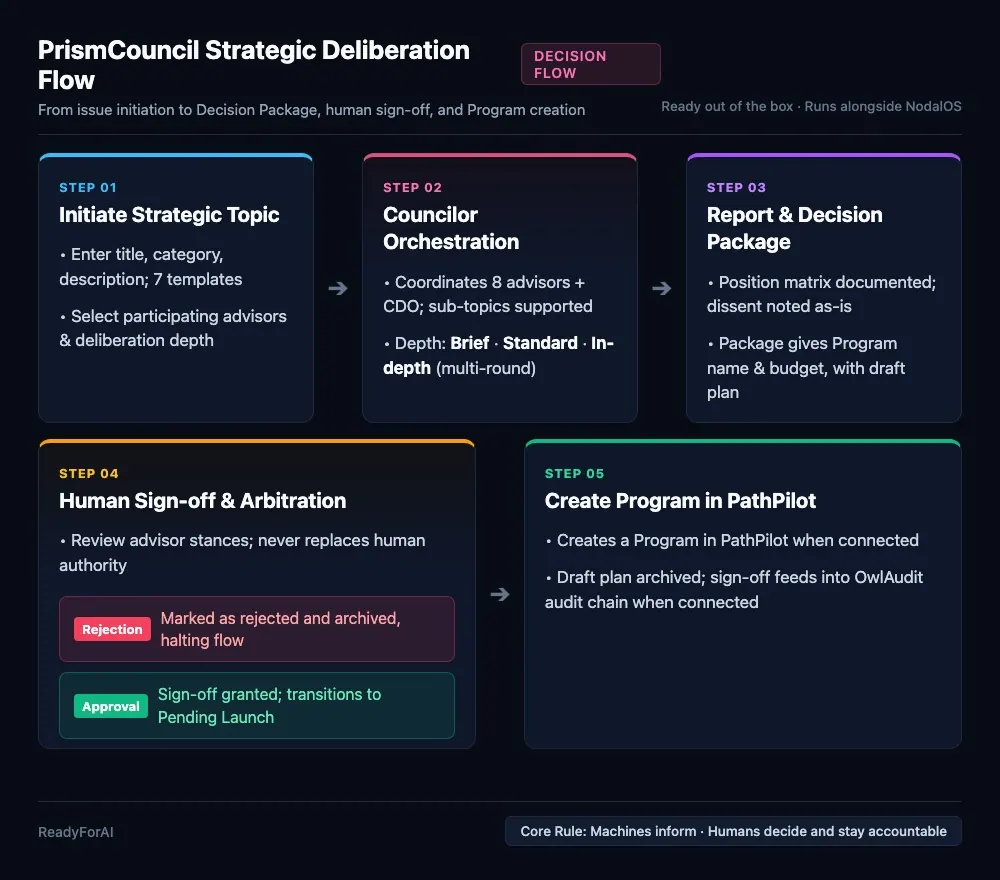
Positioned as the strategic decision layer of ReadyForAI's digital workforce infrastructure, PrismCouncil is ready to use out of the box and runs alongside NodalOS, accessible within the AULO council panel. It standardizes multi-agent deliberation into an enterprise-ready capability:
1. 8 Built-in Advisors + Dedicated CDO: Comprehensive Scrutiny Without Blind Spots
Without manual prompt crafting, PrismCouncil provides immediate access to essential enterprise domains:
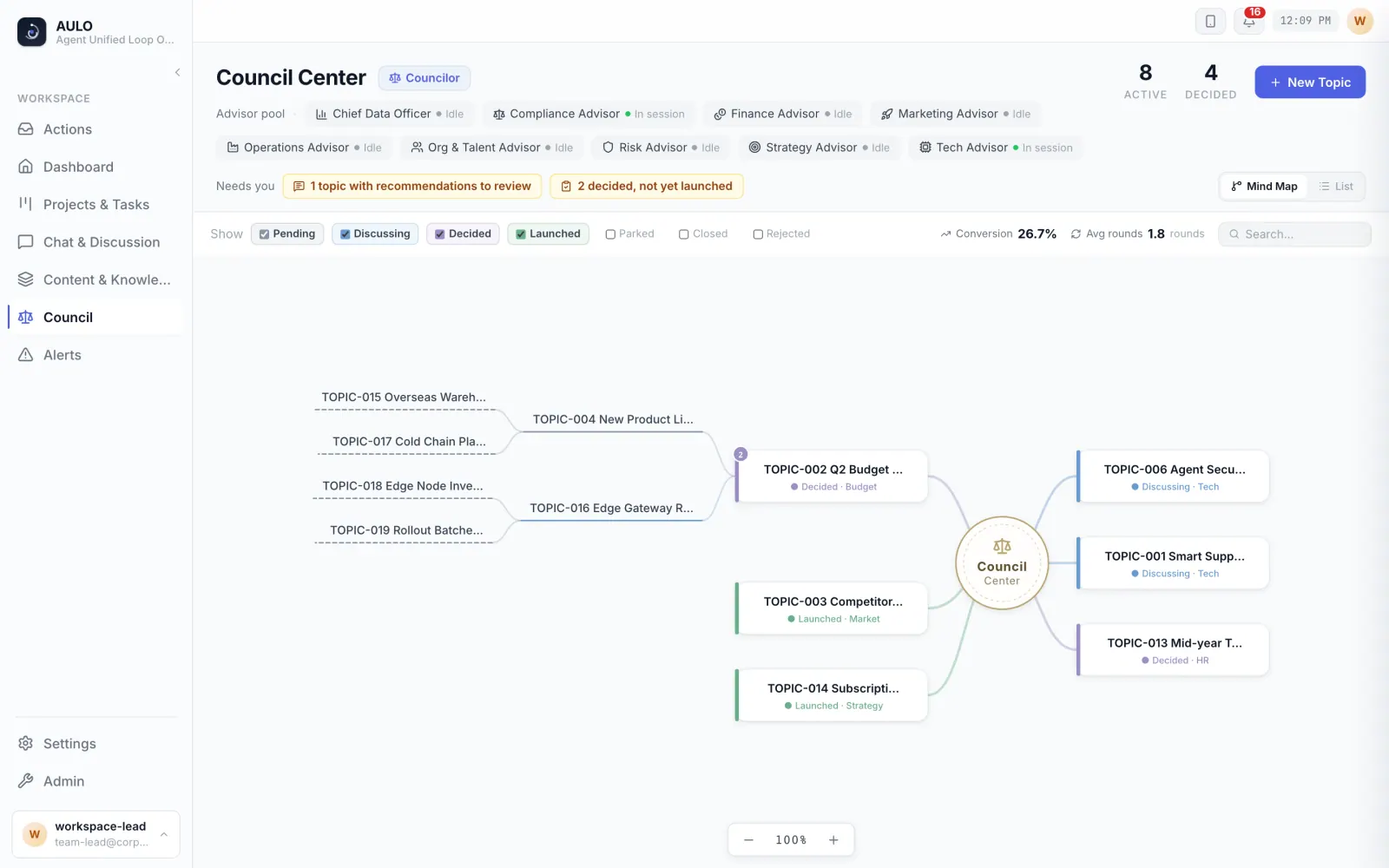
- 8 Built-in Professional Advisors: Covering Strategy, Technology, Finance, Risk, Compliance, Marketing, Operations, and Organization & Talent;
- Resident Chief Data Officer (CDO): Operates as an objective data role rather than a perspective advisor, supplying data baselines, range estimates, and reference charts;
- Adversarial Tension: Incorporates structural counterbalances (such as Marketing vs. Risk, Technology vs. Finance), where adversarial pairings adapt dynamically based on the participating roster, orchestrated by the Councilor to maintain substantive debate;
- Multi-Model Support: Administrators can configure different foundation models for different advisors, with every stated position recording the specific underlying model;
- Solo and Nested Sub-Topics: The Councilor dynamically alternates between solo deep dives (single advisor deep analysis) and group deliberations based on topic weight, supporting up to two tiers of sub-topics.
2. Synthesizing Beyond Noise: The Structured Decision Package
Deliberations in PrismCouncil do not sprawl into endless transcripts; they converge intentionally toward actionable deliverables:
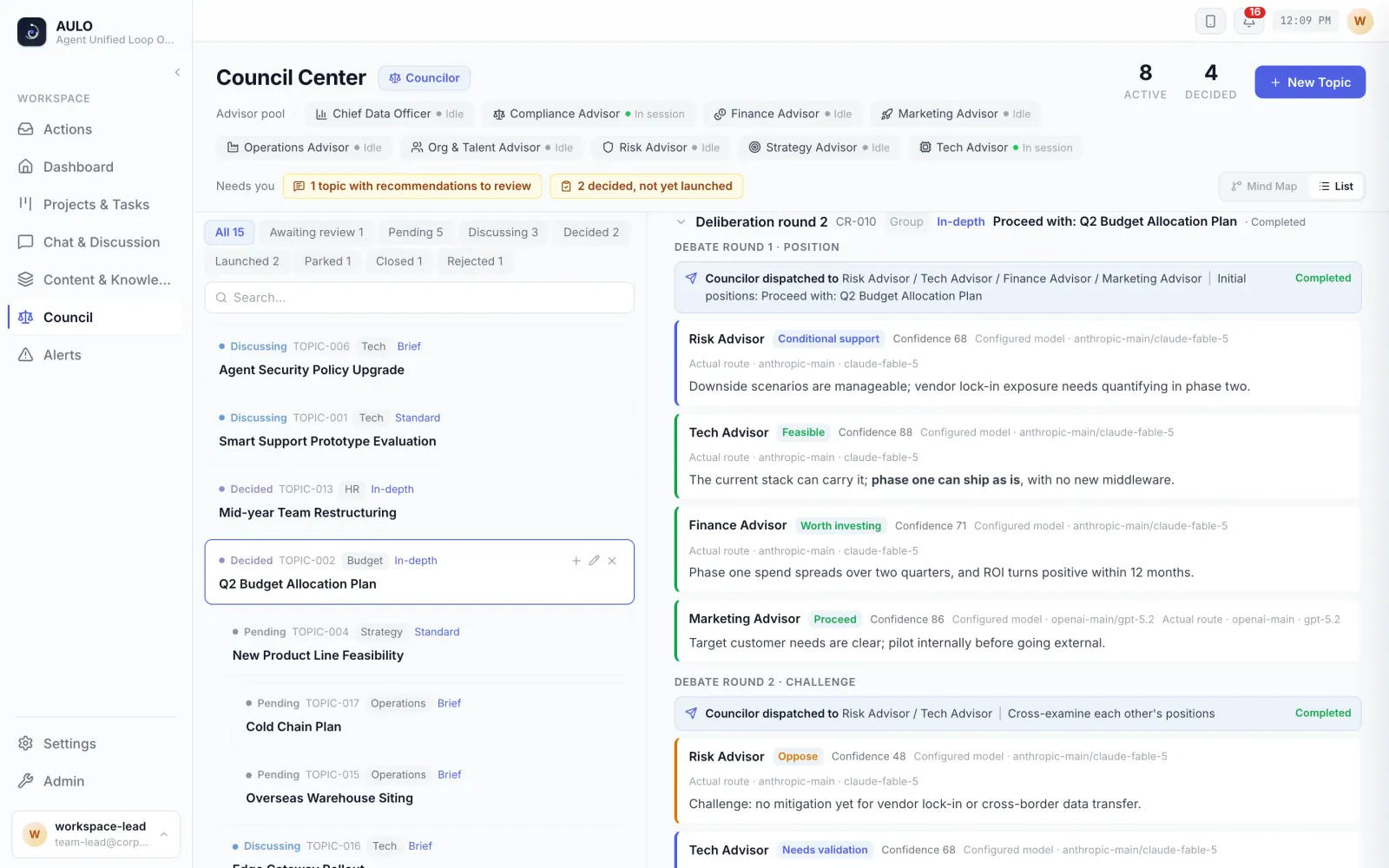
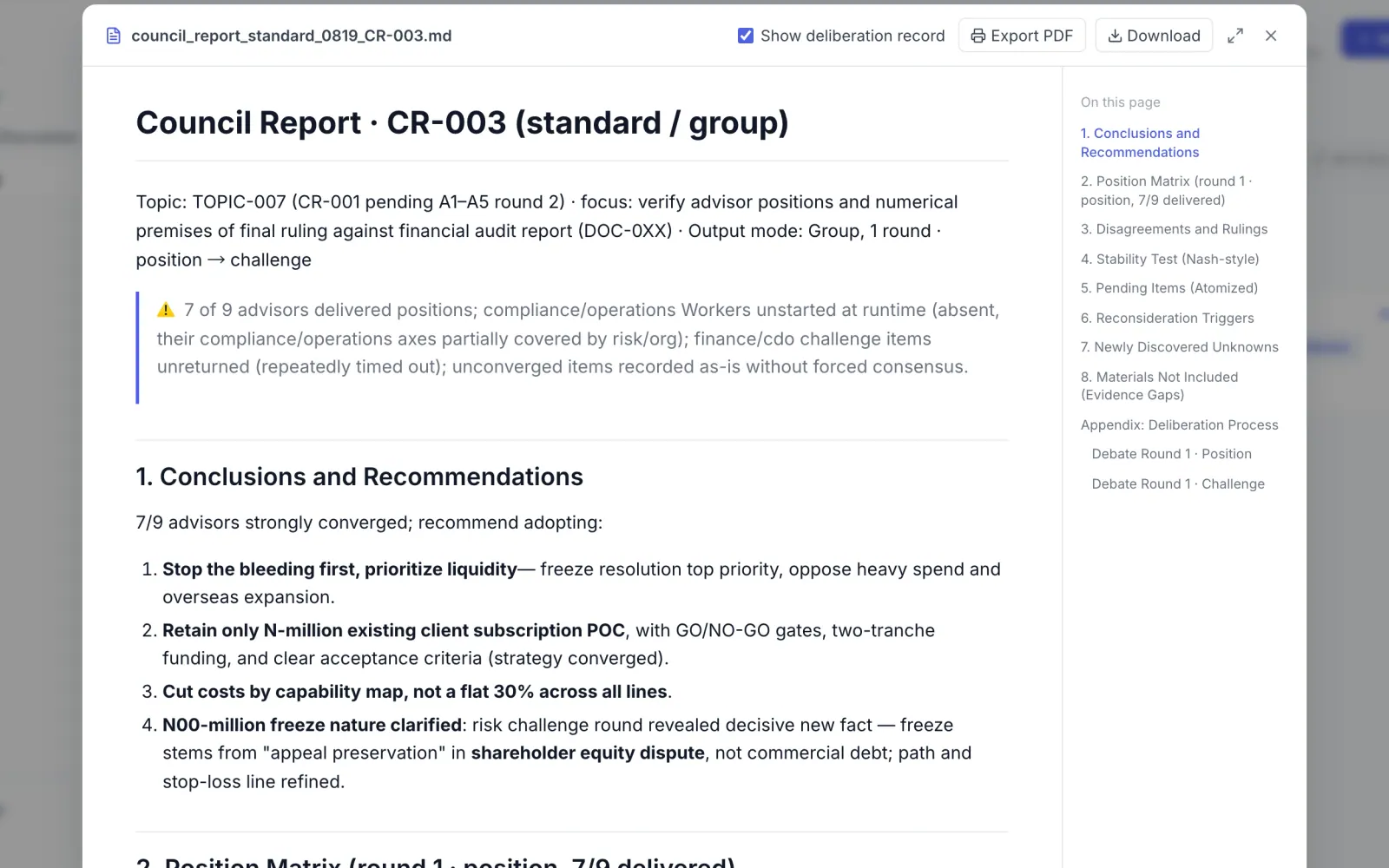
- Section-by-Section Council Report: Synthesizes position matrices, disagreements, and rulings, explicitly documenting unconverged items and preserving round-by-round advisor stances for verification;
- Structured Decision Package: Crafted by the Councilor, specifying the Program name and budget (budget provided by executives, not estimated by the system), accompanied by a draft execution plan detailing work groups and a task outline.
3. Preserving Human Final Authority: From Deliberation to Program Launch
PrismCouncil enforces unambiguous governance boundaries:
- Absolute Human Final Authority: The system never replaces final human strategic and business authority; progression requires explicit human sign-off;
- Traceable Decision Provenance: Advisor stances remain logged in-service; human sign-off events feed into audit chains when connected to OwlAudit;
- Handoff to Execution: With PathPilot integration enabled, an approved Decision Package allows leaders to create a PathPilot Program, archiving the draft execution plan alongside.
4. Strict Session Isolation
Within the AULO council panel, executives see only the topics they personally initiate. Even system administrators are subject to the same isolation by permission design, ensuring confidential strategic planning and organizational assessments remain strictly compartmentalized.
5. Deliberation in Action: The AULO Council Workflow
Within the AULO unified workspace, strategic deliberation follows a disciplined, transparent lifecycle:
- Initiate Strategic Topic: Enter title, category, and description;
- Configure Deliberation Parameters:
- Select from 7 built-in issue templates with recommended rosters and default depths, or choose manual selection;
- Select deliberation depth (applied during group deliberations):
- Brief: Advisors state primary stances without cross-examination;
- Standard: Initial positions followed by one focused round of counter-argument;
- In-depth: Multi-round adversarial exchange, driving progressive consensus while formally noting minority dissent.
- Accompanying Councilor Drawer: The Councilor remains active in the right-side drawer to assimilate supplemental context and coordinate advisor contributions;
- Structured Mindmap Topology: Parent and child topics are visualized in the default mindmap view across 7 distinct states: Pending, Discussing, Decided, Launched, Parked, Closed, and Rejected;
- Review and Launch: The Councilor drafts the Decision Package → executives review round-by-round advisor arguments → sign-off → topic transitions to Pending Launch → confirm and click Launch Project to establish the execution foundation.
6. Conclusion
As generative AI matures across enterprise operations, its organizational value is transitioning from localized task automation toward systematic decision support.
Tobi Lütke's exploration underscores a clear trend: structured multi-agent deliberation helps leaders see options and risks more fully in complex environments.
ReadyForAI's mission is to transform this cutting-edge paradigm into secure, auditable, and reliable infrastructure. If your organization is evaluating AI governance readiness and strategic decision friction, explore our Governance Pain Diagnosis.
Move beyond fragmented prompts and unvetted memos. Turn high-stakes strategic deliberation into structured, accountable execution.