Moving Beyond "High-End Outsourcing": The Ultimate Role of the FDE Is a "Digital Organization Architect"
AI adoption requires restructuring enterprise institutions. FDEs must evolve into digital organization architects of a scalable digital workforce.
On this page (6)
- Introduction: The Industry's Greatest Cognitive Misalignment
- 01. Role Reshaping: From "Interface Firefighter" to "Digital Organization Architect"
- 02. Organizational Model: The New Atomic Unit of AI-Native Digital Organizations
- 03. How Should the Infrastructure for an AI-Native Organization Actually Be Built?
- 04. Deployment Walkthrough: The FDE's Practical Roadmap as a Digital Organization Architect
- Conclusion: Rebuilding the Skeletal Architecture of the Enterprise
Introduction: The Industry's Greatest Cognitive Misalignment
Real-world enterprise AI adoption is only just beginning, yet the tech industry and corporate enterprises are already trapped in a collective state of intertwined euphoria and anxiety. On one hand, everyone talks about FDEs (Forward Deployed Engineers), hailing them as the silver bullet to conquer AI's "last mile"; on the other hand, vendors aggressively churn out flashy, do-it-all solo Agents, proclaiming that "a single prompt can handle complex work for any employee."
Yet beneath the hype, anyone stepping onto the real front lines of enterprise production quickly encounters an embarrassing paradox:
Many enterprises have deployed cutting-edge Agents and even paid top dollar for tier-one FDE teams. Yet the enterprise as a whole has not sped up. Instead, meetings have multiplied, organizational friction has intensified, and coordination overhead has spiked. The moment the expensive FDE team packs up and leaves, the system rapidly decays into an untouchable, unmaintainable "digital monument."
Why has single-point technical brilliance resulted in organizational paralysis?
Because the single biggest common-sense error the industry is making in enterprise AI adoption today is attempting to "treat Agents as super-addons and force-fit them onto traditional organizational workflows."
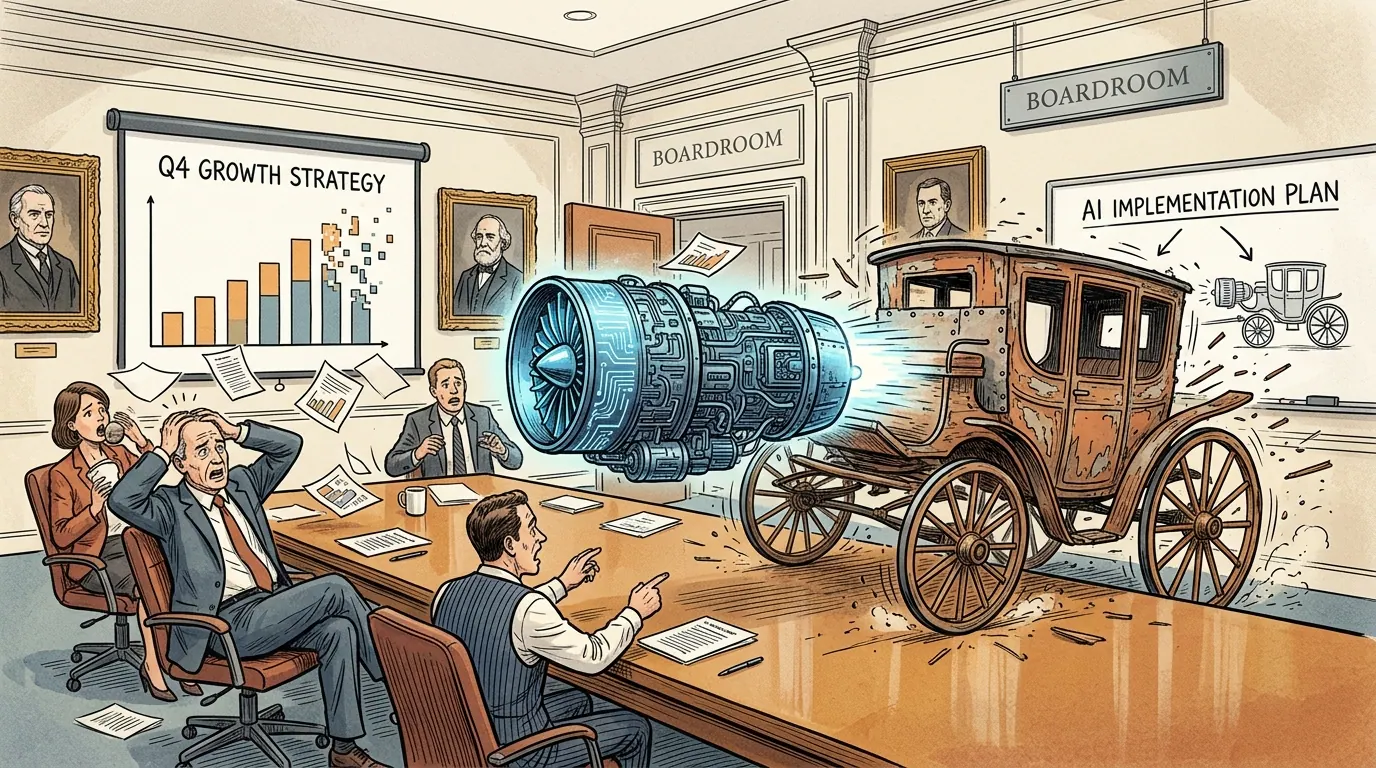
Existing corporate divisions of labor and operational workflows were designed over the last century exclusively for human-to-human collaboration: hierarchical reporting pyramids, cross-departmental approval routing, periodic progress updates, and management spans constrained by human biological limits. Splicing high-concurrency, rapid-output, probabilistic AI agents directly as patches onto antiquated process nodes is the exact equivalent of bolting a supersonic jet turbine onto a wooden horse-drawn carriage—aside from violent vibration and structural disintegration, there can be no other outcome.
In the AI era, the true mission of an FDE is emphatically NOT parachuting into customer sites to "install a few Agents, write some glue code, and hook up APIs." The ultimate calling of the FDE must be that of a "Digital Organization Architect."
Their core mandate is not patching legacy workflows, but landing a brand-new, AI-Native organizational structure purpose-built for the digital workforce inside the enterprise. And whether this organizational structure can actually run does not hinge on how dexterous an individual FDE's personal coding chops are—it depends entirely on how the underlying digital infrastructure supporting this new organization is engineered and stood up.
01. Role Reshaping: From "Interface Firefighter" to "Digital Organization Architect"
To understand the paradigm shift in delivery, we must first draw a clean boundary between traditional delivery and the new generation of FDE:
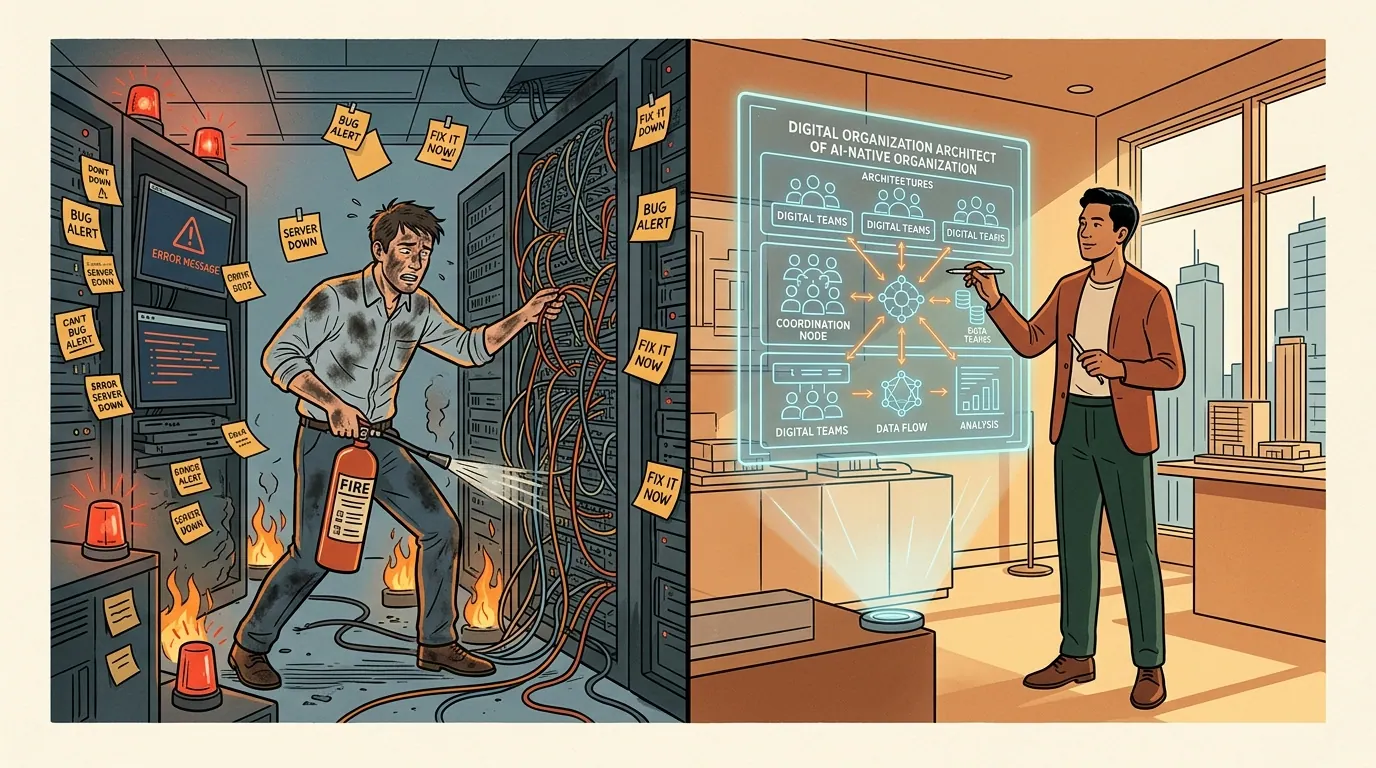
1. The Dead End of Traditional Delivery: Creating "Human Routers"
Traditional software delivery and pre-sales engineering mindsets always ask: "What does your current approval chain look like? At which step do you need AI to generate documents?"
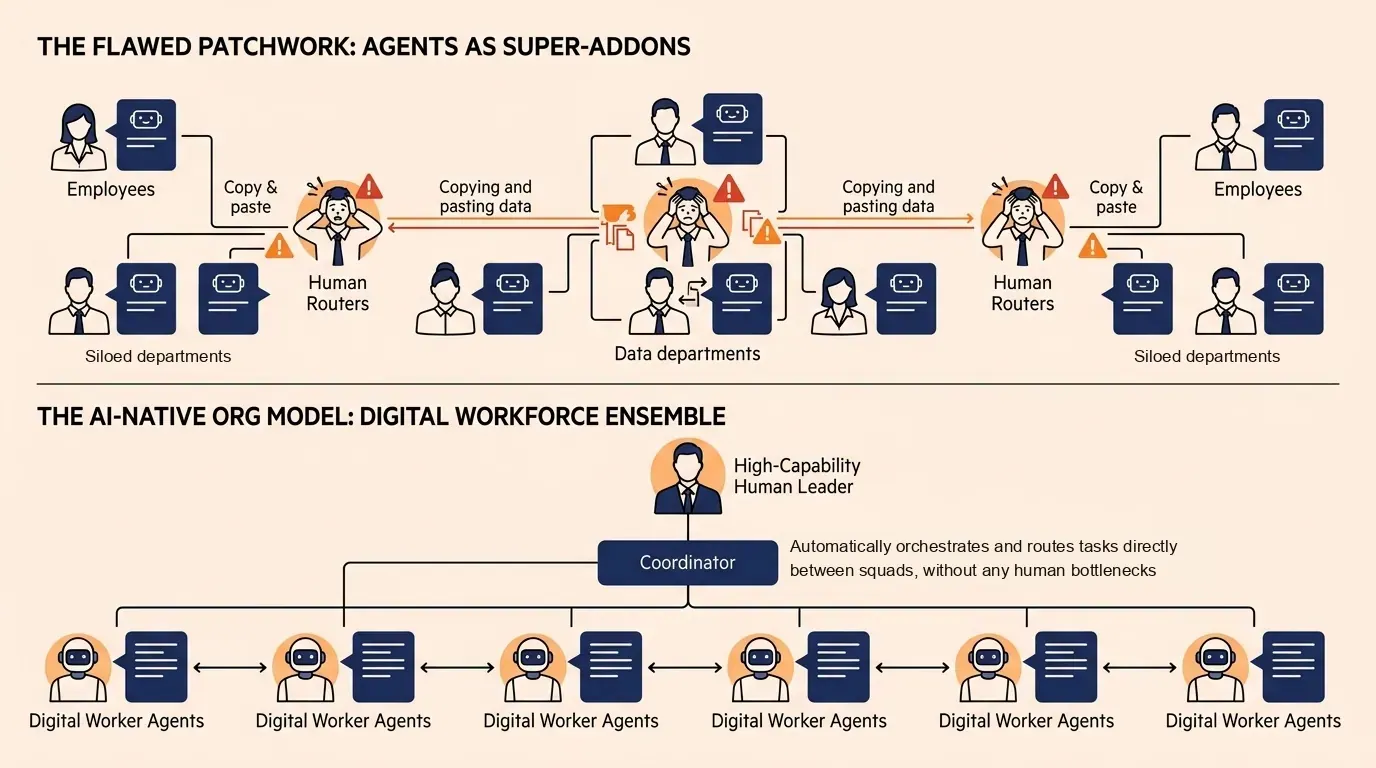
This mindset inevitably outputs isolated "Super-Copilots." The result is predictably broken:
- Employee A uses an Agent to generate a 40-page proposal in minutes and fires it off to Employee B;
- Employee B, overwhelmed by the data deluge, has their own Agent churn out 10 rebuttal points and hurls them at Employee C;
- Cross-functional alignment, accountability verification, and task handovers remain 100% bottlenecked inside the human mind.
Human employees are not emancipated; they are reduced to frantic "human routers" and physical relays between disconnected AI nodes. When FDEs merely cater to legacy workflows with custom patches, they themselves devolve into the highest-paid human switchboards on the premises.
2. The Breakthrough of the Digital Organization Architect: Institutionalizing the Digital Workforce
A competent FDE must recognize: When intelligent agents enter the enterprise, they do not arrive as a new category of tools; they arrive as an entirely new form of labor—a Digital Workforce.
The large-scale arrival of any new workforce paradigm fundamentally demands an entirely new set of production relations and organizational institutions. Just as the Industrial Revolution introduced not only steam engines, but also modern factory assembly lines, standardized shifts, and labor safety codes.
As a "Digital Organization Architect," an FDE's core mission on-site is threefold:
- Target Business & Confirm Accountable Leads: Centered on the selected business, identify or cultivate business owners who can define goals, make trade-offs, accept deliverables, and own accountability, validating their capabilities in the initial delivery;
- Restructure Atomic Units: Flatten traditional bureaucratic pyramids to establish agile operational units centered on "Business Owner + Digital Management Hub + Specialized Digital Workers";
- Anchor in Institutions and Infrastructure: Rather than building fragile code castles on shifting sands, firmly stand up an enterprise digital infrastructure complete with identity, coordination, memory, risk guardrails, and control surfaces.
02. Organizational Model: The New Atomic Unit of AI-Native Digital Organizations
What should this new organizational structure actually look like? It must fundamentally break through the biological constraints of "Span of Control" found in classical management theory.
Historically, a brilliant business director could only directly manage 7 to 10 subordinates because routine administrative overhead—status updates, syncs, task tracking, and information compression—maxed out their cognitive bandwidth. To oversee hundreds of people, companies were forced to stack layers of VPs, directors, managers, supervisors, and team leads, resulting in severe signal distortion as information traversed the pyramid.
In an AI-Native organizational structure, the core operational cell evolves into a Three-Tier Collaborative Model:
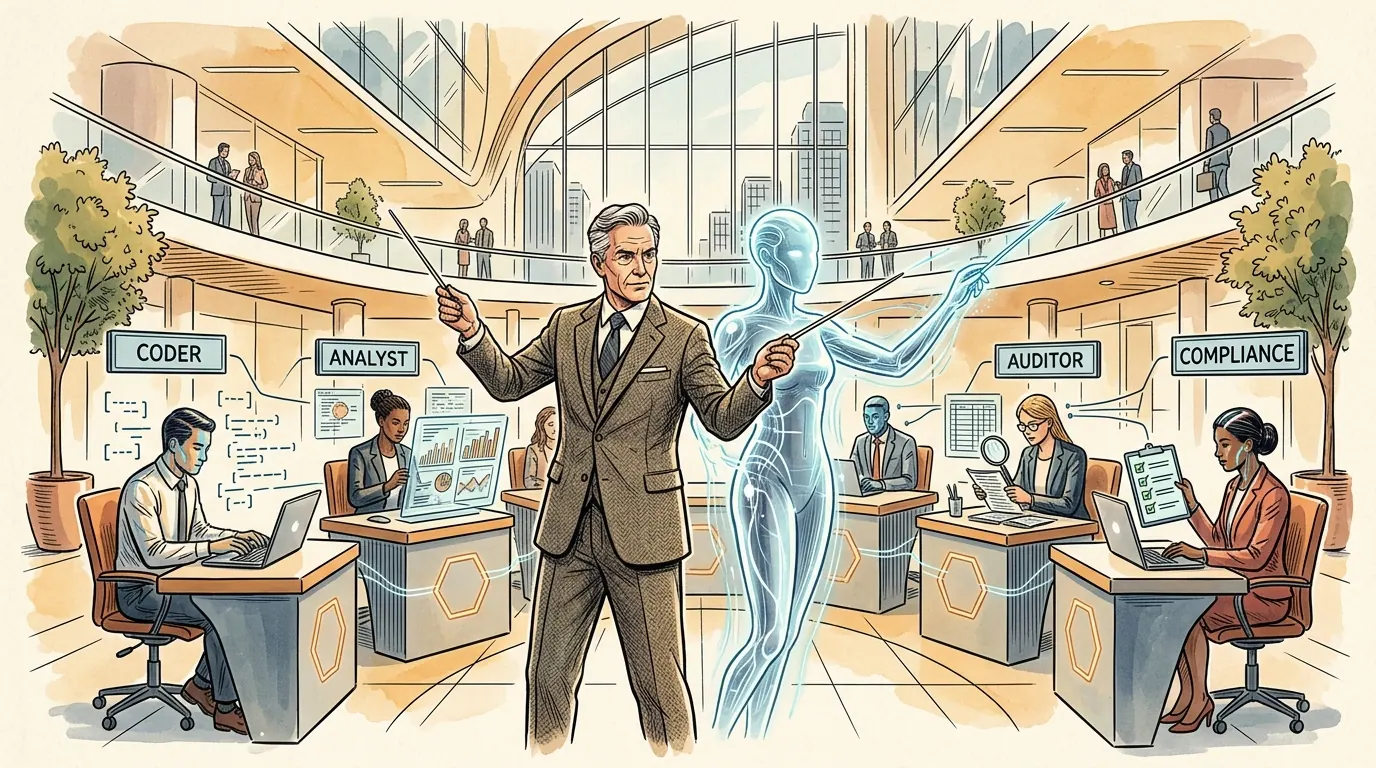
1. Human Ownership Layer: From Overseer to Strategic Decision-Maker and Ultimate Anchor
- Role: The business domain expert, technical director, or commercial leader who holds ultimate accountability for business outcomes.
- Function: Humans step back from low-level data hauling and administrative chasing to concentrate on defining strategic intent, setting value boundaries, cultivating client trust, and making high-stakes commercial tradeoffs and executive calls when critical forks arise.
2. Digital Management Layer (Coordinator): From Tool to Digital Management Partner
- Role: A digital management hub dedicated to a specific human leader—the critical operational glue of the architecture.
- Function:
- Maintains the Plan Ledger: Deconstructs the human leader's high-level intent into execution paths, timelines, and dependency graphs;
- Autonomous Collaborative Dispatch: Automatically routes context and transfers verified artifacts directly between underlying specialized Agents, completely severing reliance on "human relays" at the protocol level;
- Watchdogs and Anomaly Escalation: Continuously senses execution stalls, deadlocks, and logical conflicts across lower tiers, surfacing tightly structured, high-stakes decisions and risks directly to the human leader.
3. Specialized Digital Workforce Layer: Vertical Execution Squadrons
- Role: No longer generic, jack-of-all-trades chat dialogs, but highly specialized digital workers with rigorously defined job descriptions (e.g., Code Building Agent, Compliance Audit Agent, RFP Decomposition Agent, Data Cleansing Agent).
- Function: Execute rigorous, heavy-duty workloads at high concurrency and quality within standardized protocols, equipped with dedicated execution lifecycles and tool permissions.
03. How Should the Infrastructure for an AI-Native Organization Actually Be Built?
An organizational structure cannot exist as a mere chart on paper. In the physical world, any operating enterprise requires office towers, physical security turnstiles, network backbones, HR codes of conduct, operational workflows, and executive dashboards.
By the exact same token, to enable this new hybrid organization of humans and digital workers to run in production, FDEs must stand up a complete "Digital Workforce Runtime & Governance Infrastructure" inside the enterprise.
This methodology is built on four progressively stacked architectural pillars:
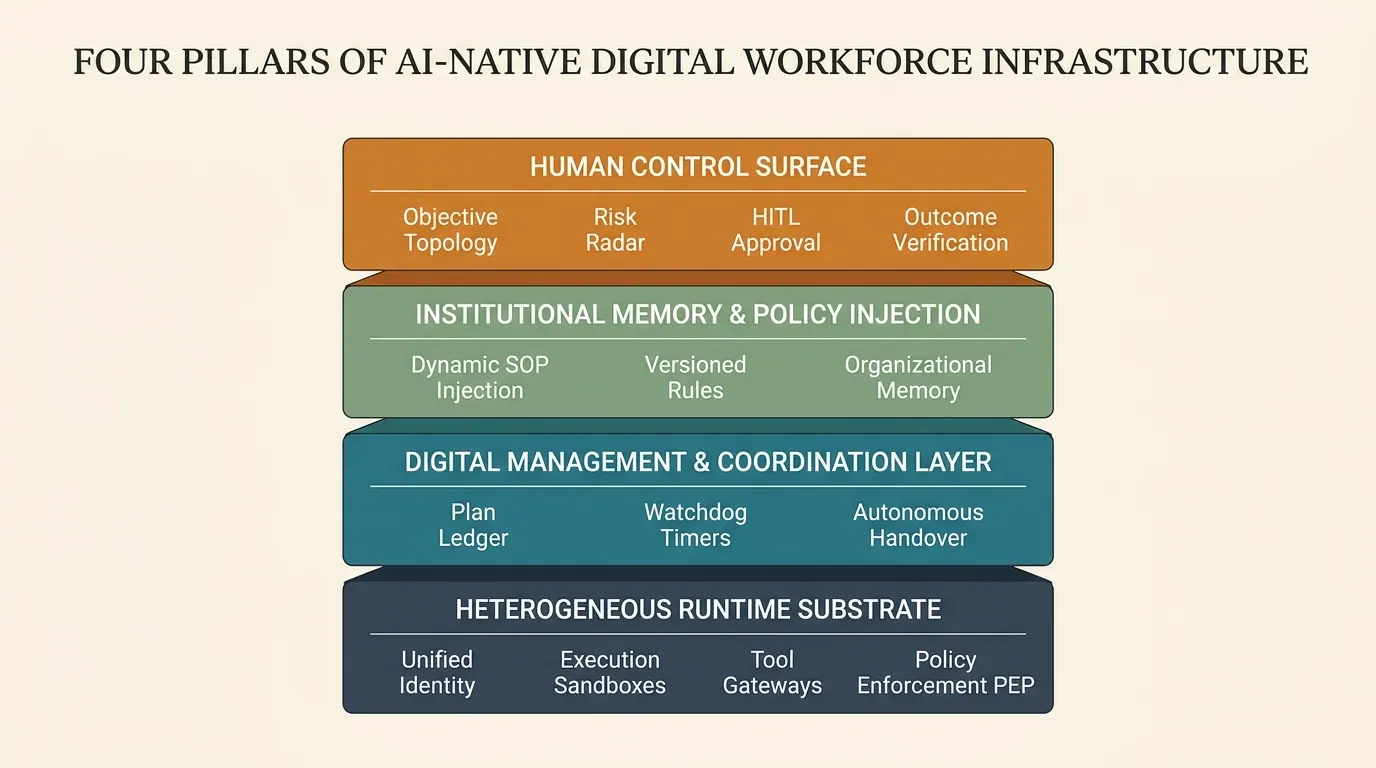
Pillar 1: Heterogeneous Agent Runtime Substrate
— Equivalent to the New Organization's "Digital Office Tower, IT Backbone, and Physical Access Control"
Many delivery teams attempt to impose a single tech giant's walled-garden ecosystem upon arrival, which inevitably crashes against the messy reality of enterprise IT. Corporate technology stacks are permanently heterogeneous: engineering runs specialized coding agents, data science uses open-source frameworks, business teams call third-party APIs, and risk modeling runs on private local models.
Infrastructure Standard: Do not force uniform tech stacks; enforce uniform enterprise boundaries and execution baselines.
- Unified Digital Identity & Workspace Sandboxes: Every Agent entering the enterprise must be provisioned with an immutable digital identity and operate within an isolated virtual sandbox, strictly bounding its network reach and preventing privilege escalation.
- Standardized Tool & System Gateways (Tool & MCP Access Layer): Complex internal ERPs, CRMs, code repositories, and databases must be wrapped into secure, governed tool interfaces via open standards (such as MCP). Direct, raw connections from Agents to production databases are strictly prohibited.
- Hard Policy Enforcement Points (PEP): The physical firewall of organizational discipline. Regardless of hallucinations in an LLM's reasoning chain, any high-risk action—database writes, wire transfers, contract dispatch—must pass through hard runtime gateway inspection and authentication before execution.
- State Checkpointing & Resumption: Enterprise workloads often span hours or days. The runtime substrate must provide process checkpointing, ensuring tasks seamlessly resume even during network drops or infrastructure reboots.
Pillar 2: Digital Management Layer
— Equivalent to the New Organization's "Digital Middle Management & Orchestration Dispatch"
An organization lacking middle-tier coordination will drown its executive leadership in operational trivia. This layer equips business owners with a tireless digital management partner.
Infrastructure Standard: Eliminate human relays; achieve autonomous closed-loop agent collaboration.
- Plan Ledger Engine: Persists high-level objectives into dynamic dependency graphs, tracking real-time ownership, prerequisite milestones, token spend, and latency budgets.
- Machine-to-Machine Autonomous Handovers: Establishes standardized communication and artifact transport buses for all managed Agents. When Agent A finishes an analysis, the output format is validated and routed straight to Agent B as structured input, completely eliminating "human copy-paste relays."
- Watchdog & Circuit Breakers (Watchdog & Durable Timer): Enforces timeouts on infinite loops and divergent execution. When conflicting logic arises between Agents, the coordination layer freezes the task and preserves state telemetry.
- Structured Escalation Pipeline: Extracts core points of friction from raw execution logs, synthesizing them into structured business choices (complete with context, evidence trails, and risk projections) for human executive review.
Pillar 3: Institutional Memory & Dynamic Policy Injection
— Equivalent to the New Organization's "HR Regulations, SOP Training, and Corporate Knowledge Repository"
If a digital organization's rules rely on engineers manually pasting prompt fragments into chat boxes, that enterprise possesses zero durable digital assets. Models will be upgraded; frameworks will be swapped; only the enterprise's institutions, policies, and accumulated wisdom must endure across technology cycles.
Infrastructure Standard: Dynamic, version-controlled, permission-bounded policy distribution.
- Cross-Session Institutional Memory: Unlike transient conversational context, institutional memory archives fundamental enterprise baselines: "What is our absolute bottom-line tolerance for bad debt?", "What major compliance pitfalls were discovered during the last audit?", "What is the proven execution pattern for this client tier?"
- Dynamic Compilation and Injection of SOPs: Enterprise policies, operational standard operating procedures, and compliance red lines must carry semantic versioning and role-based permissions. When a digital worker wakes up to process an incoming ticket, the system dynamically injects corresponding SOP rules into its runtime context based on role tags and situational scope.
- Digital Worker Capability Profiling: Continuously logs each specialized Agent's real-world delivery track record—cost per task, error frequency, latency, and reliability—building a living "digital talent profile" to inform resource allocation and model upgrades.
Pillar 4: Human Control Surface for Accountability and Governance
— Equivalent to the New Organization's "Executive Cockpit and Boardroom Decision Interface"
If business executives are left staring at opaque terminal logs or endless chat dialogs, they will never develop genuine trust in the system.
Infrastructure Standard: Shift from conversational chat windows ("Chat") to a definitive management cockpit ("Control Surface").
- Global Objective & Task Topologies: Clear visual mapping of all business domains, project milestones, and associated digital worker squadrons under a leader's command.
- Risk & Anomaly Radar: Surfaces real operational blockers, performance drift, and budget overruns instead of generating false reports of harmony.
- Human-in-the-Loop (HITL) Override Controls: One-click approvals, policy rejections, and runtime overrides at critical intervention gates, allowing human leaders to exercise ultimate authority with minimal cognitive overhead.
- Artifact Acceptance & Verification Auditing: Structured deliverable review panels accompanied by immutable audit trails, ensuring every decision is verifiable and compliant.
Within ReadyForAI's product suite, these four infrastructure pillars are realized through dedicated components. The underlying runtime relies on NodalOS to govern heterogeneous agent form factors with inter-agent communication and policy controls, while PathPilot orchestrates task dispatch, tracking, escalation, and budget guardrails. Organizational memory and rule injection are handled by LarkScout compiling enterprise knowledge into traceable assets, with HarnessServer delivering role-specific skills, SOPs, and context into agent workspaces. Finally, AULO unifies human-agent collaboration by bringing to-dos, consoles, projects, and alerts onto a single workbench, supported by OwlAudit to enforce policy-based human approvals and traceable audit trails on high-risk operations.
04. Deployment Walkthrough: The FDE's Practical Roadmap as a Digital Organization Architect
Armed with this infrastructural methodology, an FDE's engagement path inside an enterprise undergoes a fundamental transformation from manual craft to rigorous engineering:
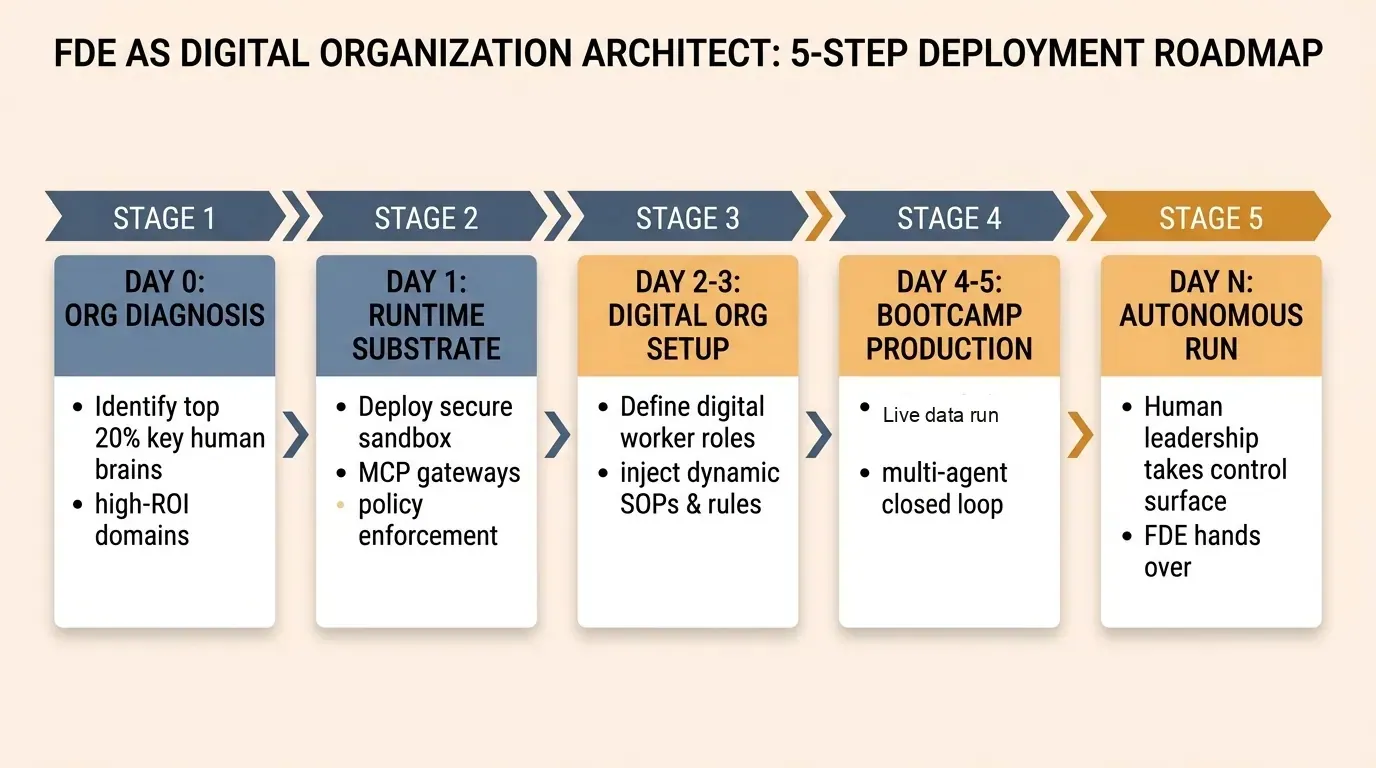
- Stage 1 (Day 0: Organizational Diagnosis & Lead Confirmation): Select high-ROI, knowledge-dense business domains for transformation, and confirm the accountable business owners responsible for delivery;
- Stage 2 (Day 1: Deploy Runtime Substrate & Policy Gateways): Connect into enterprise infrastructure, provision secure sandboxes, configure MCP gateways, and arm hard policy enforcement points;
- Stage 3 (Days 2–3: Digital Org Setup & Dynamic SOP Injection): Define specialized digital worker roles, bind dynamic SOP rules, and construct the Digital Management Coordinator;
- Stage 4 (Days 4–5: Bootcamp Live-Data Production Run): Ingest real customer business scenarios, orchestrate multi-agent closed-loop workflows on actual data, and calibrate the human control surface;
- Stage 5 (Day N: Handover of the Self-Sustaining Digital Org): Human leadership assumes full command of the control surface, the FDE executes an orderly handover, and the system continues running with autonomous operational resilience.
This roadmap unlocks decisive commercial and engineering advantages:
- Escaping the Outsourcing Trap: Because core security, routing, and lifecycle management are carried by standardized infrastructure, FDEs never waste time rebuilding wheels;
- Radical Time-to-Value: Utilizing mature methodology and pre-built infrastructure, enterprises witness multiplicative productivity gains within days;
- Living Digital Assets: Following the FDE's departure, the client is left not with fragile bespoke scripts, but with a self-sustaining digital organization capable of seamlessly absorbing new models and scaling autonomously.
Conclusion: Rebuilding the Skeletal Architecture of the Enterprise
The commercial world stands at an epochal inflection point. For the past thirty years, enterprise digital transformation was fundamentally about using software to "record business data generated by human labor." For the next thirty years, enterprise AI adoption will be about directly using software to "organize, govern, and orchestrate autonomous digital labor."
This transformation can never be accomplished by slapping a few AI band-aids onto the surface of obsolete organizational processes.
The true greatness of an FDE does not lie in crafting clever prompts, nor in staying up all night patching broken API endpoints. It lies in stepping into the role of a "Digital Organization Architect"—leveraging rigorous digital infrastructure to help enterprises break free from outdated bureaucratic inertia and stand up an AI-Native organization built to thrive in the modern age.
Models will be updated daily; algorithms will evolve every quarter;
But the organizational architecture, institutional infrastructure, and collaborative networks woven into the marrow of the enterprise are the indestructible fortress that allows it to navigate technological cycles and lead the future.
Next step: Explore the complete toolchain for digital organizational architecture in Products, or Book a demo. Further reading: Don't Mistake Super-Copilots for a Digital Workforce, Build Your Own Control Plane: When Models Expire in Six Months, What Are Enterprises Actually Buying?.