Don't Mistake Super-Copilots for a Digital Workforce
Big tech is selling all-in-one Agents as enterprise AI. Individual output jumps; the organization stalls. This article unpacks the Human Router trap and the digital-fleet architecture enterprises actually need.
Recently, major tech giants launched an unusually dense offensive in the enterprise AI market:
- Tencent aggressively rolled out WorkBuddy, pitching deep integration into local OS environments and office suites, claiming multi-agent parallel execution and end-to-end task closure;
- Alibaba consolidated multiple internal technologies to launch QwenWork (千问办公), bridging DingTalk and enterprise data assets, promising that any employee can "deliver complex workflows with a single prompt";
- ByteDance restructured its teams, merging Feishu and Doubao to introduce Doubao Workplace (豆包工作), spotlighting desktop OS control, cross-software automation, long-running cloud execution, and specialized "AI coworker squads."
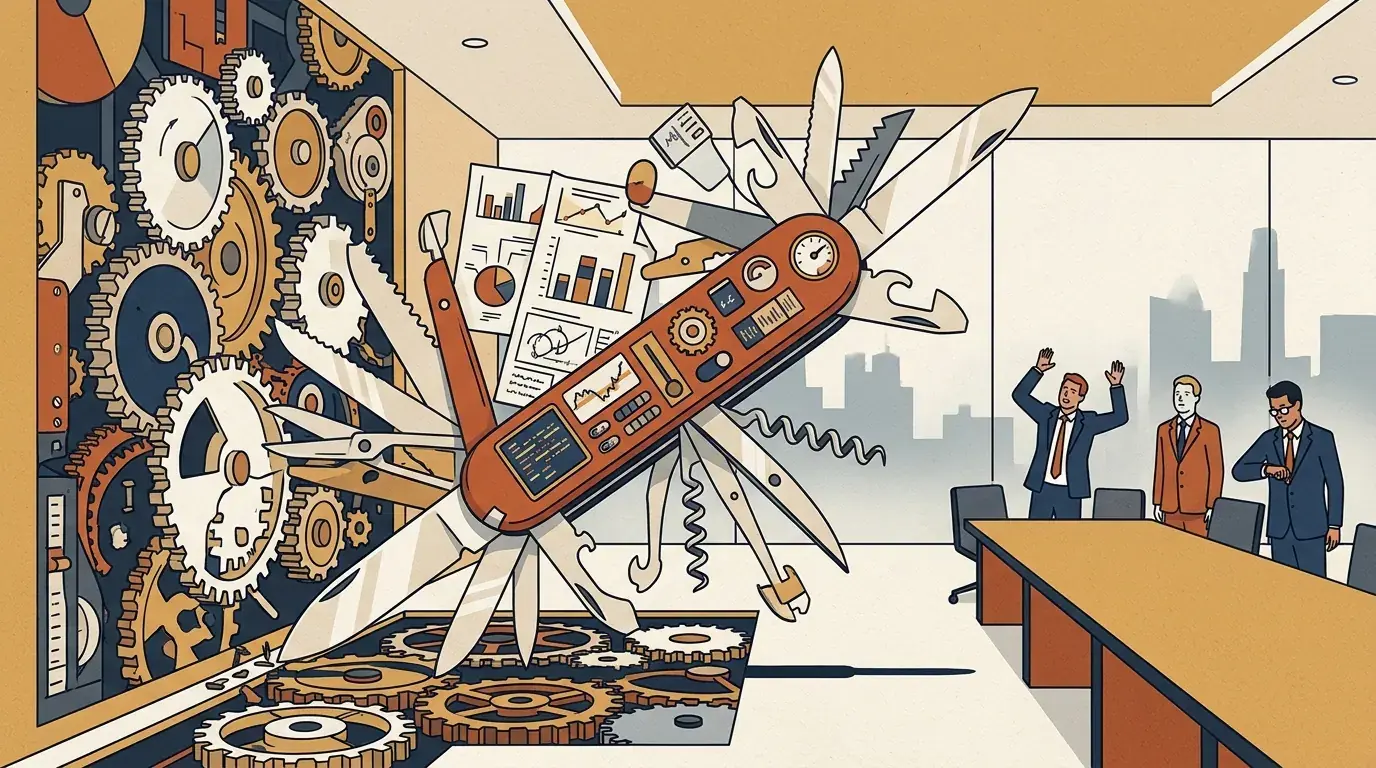
Almost overnight, the tech and corporate worlds seemed to reach an intoxicating consensus: The future of enterprise digital transformation is simply handing every employee an all-powerful, do-it-all "Super-Agent."
In every product keynote, the pitch is undeniably seductive: an AI autonomously breaks down tasks, scours the web, queries the corporate knowledge base, fills out approval forms, and outputs a stunning, polished executive presentation.
Let's be unequivocally clear: The individual productivity leap demonstrated by these super-agents is 100% real. Whether writing scripts, extracting data, refactoring documents, or automating cross-app clicks, the execution speed of a solo human operator has undeniably multiplied.
Yet beneath this glittering spectacle, a brutal, counter-intuitive reality is quietly playing out across enterprise after enterprise:
When every individual employee gains a "Super-Agent" that outputs work 10x faster, the enterprise as a whole does not accelerate. Instead, there are more meetings, more friction, more misalignment, and the organization sinks into an unprecedented swamp of information overload and coordination paralysis.
Why has a radical surge in single-point efficiency resulted in organizational gridlock?
Because what big tech is currently peddling as "enterprise Agent adoption" is fundamentally a category error. Model vendors are applying the solo tooling mindset of a "Super-Copilot" to solve deeply complex enterprise organizational and coordination problems.
This is not the end-state of enterprise AI. It is an expensive detour that is leading corporate digital transformation straight down a blind alley.
01. The Fatal Chokepoint: Single-Point Efficiency Surges, So Why Is the "Human Router" Paralyzing Enterprises?
The first industry myth we must dismantle is the illusion of "collaboration."
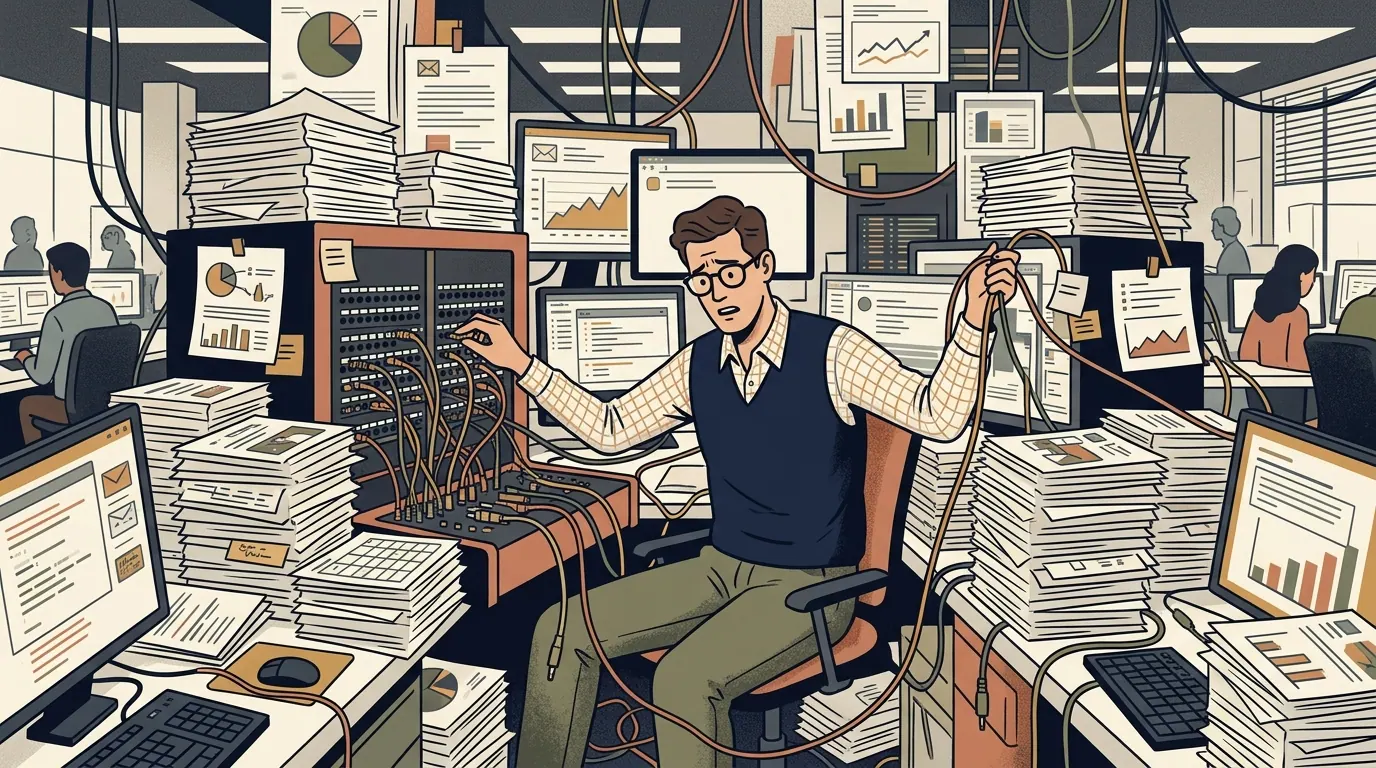
Regardless of how slick their desktop automations look, every all-in-one agent on the market today shares a fatal architectural trait: They are isolated islands that require a human being as their interactive host.
These agents can trigger tools, click through software, and read chat transcripts. But they cannot directly collaborate, autonomously align, or hand off state machine tasks across the broader enterprise.
This creates an absurd, choking operational loop:
- Upstream Employee A uses their Super-Agent to analyze industry data in 3 minutes, generating a dense, 40-page strategic memo, and dumps it into the project group chat;
- Midstream Employee B, overwhelmed by the sheer volume of text, opens their own Super-Agent, generates a 10-page critique and compliance risk list in 2 minutes, and throws it back into the channel;
- Downstream Employee C, bombarded by this rapid-fire avalanche of AI-generated deliverables and counter-arguments, has no choice but to fire up their agent just to summarize, reconcile, and compare the options...
Do you see what has happened?
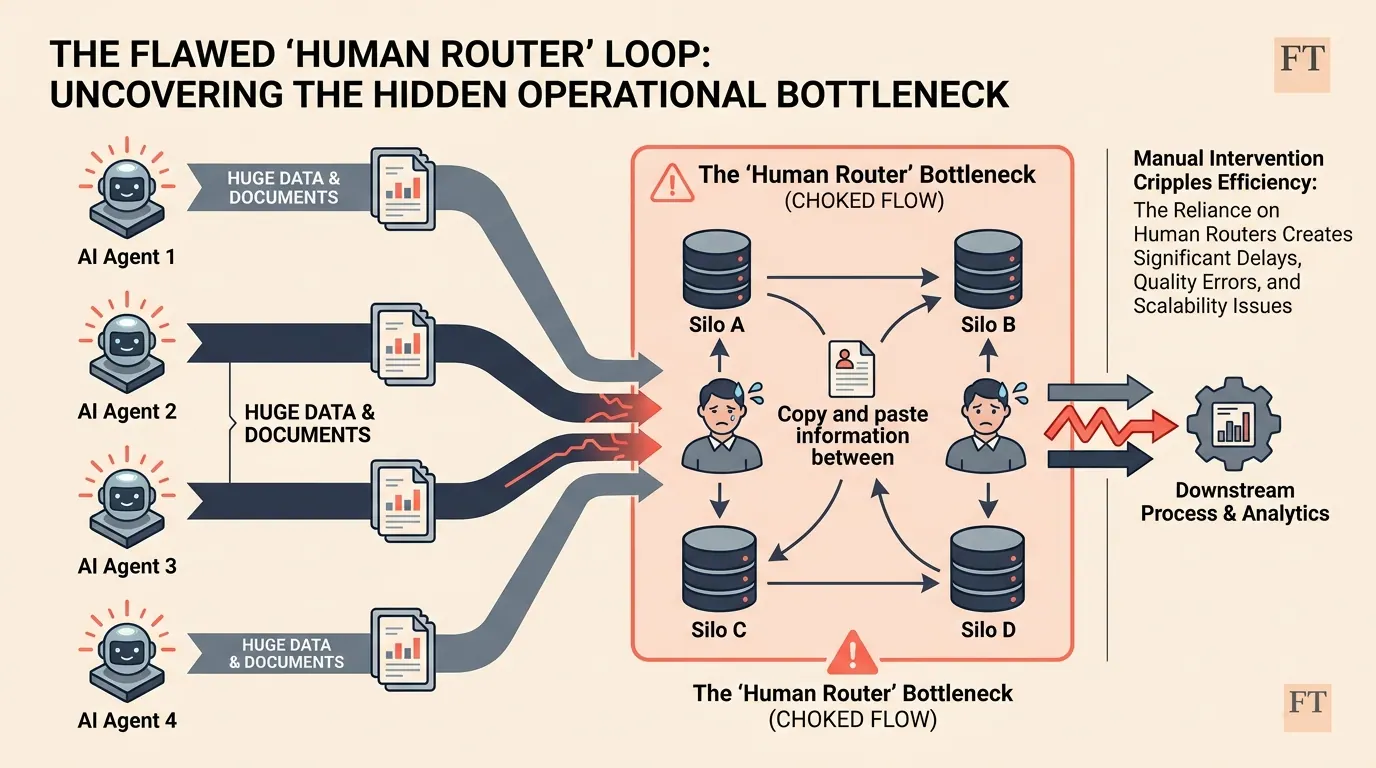
The marginal cost of producing complex content and executing digital tasks has dropped to near zero. Yet the cross-functional alignment, accountability verification, context handoffs, and state synchronization remain 100% dependent on human brains, human chat channels, and human meetings.
In this loop, human employees have not been liberated. Instead, they have been reduced to fragile, low-bandwidth "Human Routers" (biological relays) frantically shuttling data between disconnected AI silos.
Employees spend their days doing mindless glue work: copying output from System A's Agent, skimming it, pasting it as a prompt into System B's Agent, and calling another meeting to verify whether the hallucinated numbers are actually accurate.
The extreme optimization of local efficiency has triggered an organizational coordination meltdown.
If an engineering design only accelerates the rotation of individual gears while ignoring how those gears mesh together, spinning the gears 10x faster will only cause the entire machine to shake itself apart in a cloud of friction and heat.
02. Ecosystem Lock-in & The Accountability Vacuum: Two Fatal Flaws of Big Tech's All-in-One Agents
Beyond trapping human workers as biological routers, big tech's Super-Agent playbook hits two insurmountable brick walls in the real enterprise world.
Flaw 1: "Walled Garden Monopolies" vs. "The Reality of Heterogeneous Enterprise Tech Assets"
The underlying motivation behind big tech's agent products is obvious:
- Tencent pushes WorkBuddy to cement the primacy of WeChat Work (WeCom) and its proprietary Hunyuan models;
- Alibaba pushes QwenWork to build deep moats around DingTalk and Alibaba Cloud;
- ByteDance pushes Doubao Workplace to permanently weld Feishu, Coze, and the Doubao model family onto your desktop.
They are selling enterprises a seductive illusion: "Migrate your entire operational stack into our garden, adopt our foundation model, and your company will instantly transform into an AI-native powerhouse."
Yet real enterprises are never monolithic greenhouses.
In any mid-to-large enterprise:
- The Engineering Team will inevitably rely on best-in-class coding agents (like Claude Code, Codex, or OpenCode);
- Business Analysts are building domain-specific workflows on open-source frameworks (like LangGraph or Dify);
- Risk and Financial Audit Teams require proprietary, on-premise fine-tuned models running inside private infrastructure;
- Core Business Systems harbor dozens of proprietary, in-house agents built across varying SDKs and APIs.
"Heterogeneity" is not a temporary transition phase; it is the permanent reality of the enterprise.
Foundation models evolve every quarter, and agent frameworks emerge and die constantly. Demanding that an enterprise tie its entire digital workforce to a single vendor's closed product suite or proprietary model is not only technically naive—it creates catastrophic vendor lock-in and insurmountable technical debt.
Enterprises do not need another "all-in-one vendor client." What they desperately need is an enterprise-grade infrastructure that unifies, orchestrates, and governs heterogeneous agents in a private environment, regardless of their underlying model or framework.
Flaw 2: Runaway Feature Bloat vs. The Vacuum of Governance, Boundaries, and Accountability
Big tech keynotes obsess over vanity metrics: Our Agent can operate 50 desktop apps! We support 200 pre-packaged skills!
Yet step into the trenches of a core business unit and speak with a business director or compliance officer, and you will hear the exact same hesitation: "We dare not let this loose in production."
Why?
- When an autonomous agent modifies live customer data, triggers an unvetted procurement workflow, or submits a contract redline—if a disaster occurs, who owns the ultimate business accountability?
- Which actions can execute autonomously, and which strictly require Human-in-the-Loop (HITL) approval? Are these boundaries hard-coded into systemic security gateways, or are they naively whispered to the LLM via disposable system prompts?
- How are enterprise SOPs, legal red lines, and institutional lessons learned injected into agents systematically, rather than relying on employees to re-type instructions into chat boxes daily?
- When an agent enters an infinite loop or encounters unexpected edge cases, who acts as the operational "watchdog" to fuse, quarantine, and escalate the failure?
Big tech has poured billions into selling "powerful limbs," yet has failed to provide the "nervous reflex system, safety brakes, and immutable audit chains" necessary to govern them.
Without systemic boundaries, governance gates, and accountability loops, unbridled "autonomy" in a serious enterprise is not productivity—it is catastrophic systemic risk.
03. Why One Agent per Employee Is Not Enough: Aligning Busyness, Evaluation, and Real Value
Distributing Super-Agents across an enterprise on a per-seat basis is a common rollout strategy today. Individual material generation speeds up, but inside many organizations, a significant misalignment already exists between busyness, performance evaluations, and ultimate business value. Many employees spend their days overwhelmed by endless chat threads, status reports, and sync meetings, yet much of that energy is consumed by data hauling, cross-team alignment, and manual handoffs. Meanwhile, conventional evaluation frameworks often track activity metrics—counting document volume, meeting frequencies, and logged hours—rather than validated delivery outcomes.

When AI reduces the marginal cost of drafting memos, generating slides, and churning out proposals to near zero, this misalignment is not resolved—it is amplified by existing institutional incentives:
- If performance evaluation continues to reward raw activity volume, low-cost summaries, briefs, and derivative discussions multiply exponentially. Employees produce faster while spending even more time reading and reacting to each other's outputs. The organization becomes visibly busier yet further removed from genuine business outcomes, escalating the "Human Router" dilemma described earlier.
- Accountable business owners remain trapped in conventional communication and coordination overhead. A business leader directly managing 7 to 10 people quickly hits cognitive limits. To drive complex initiatives, organizations layer in managerial tiers and endless alignment loops, diluting valuable focus on routine administration, status chasing, and handoff friction.
The true opportunity of enterprise AI is not fueling activity-based churn, but realigning the relationship between busyness, performance evaluation, and ultimate business value—anchoring incentives and resources directly to real delivery, and liberating people from repetitive shuttling and relay work.
This does not mean other roles should not use AI—as detailed in Section 05, front-office personnel are similarly equipped with dedicated digital copilots deeply embedded in the collaborative network; the focus of this section is on who must define goals and accept deliverables for specialized digital workforce teams.
Therefore, enterprise adoption of a digital workforce must focus squarely on concrete business outcomes:
Centered on specific business initiatives, identify or cultivate business owners who can define goals, make trade-offs, accept deliverables, and own accountability, validate their capabilities through real-world delivery, and equip them with governed, specialized digital workforce teams.
This business owner role is defined by business context and operational responsibility, not a static status label. As business priorities change, different people can step into this role across different domains. Anyone in the organization can grow into a business owner by taking accountability for goals and acceptance criteria. The benchmark for evaluating them is always actual delivery, not job titles, busyness, or the volume of materials produced.
Breaking through the management span of control so that accountable business owners can directly orchestrate specialized digital teams is the underlying rationale behind the "Business Owner + Digital Coordination Layer + Specialized Digital Workforce Fleet" architecture.
04. Organizational Redesign: From "Super Soloists" to a "Digital Fleet Architecture"
If handing every employee an isolated Super-Agent is the wrong path, what is the true paradigm for enterprise AI adoption?

The future atomic unit of an enterprise is not an isolated individual staring into a chat prompt. It is:
【Business Owner + Digital Coordination Layer + Specialized Digital Workforce Fleet】
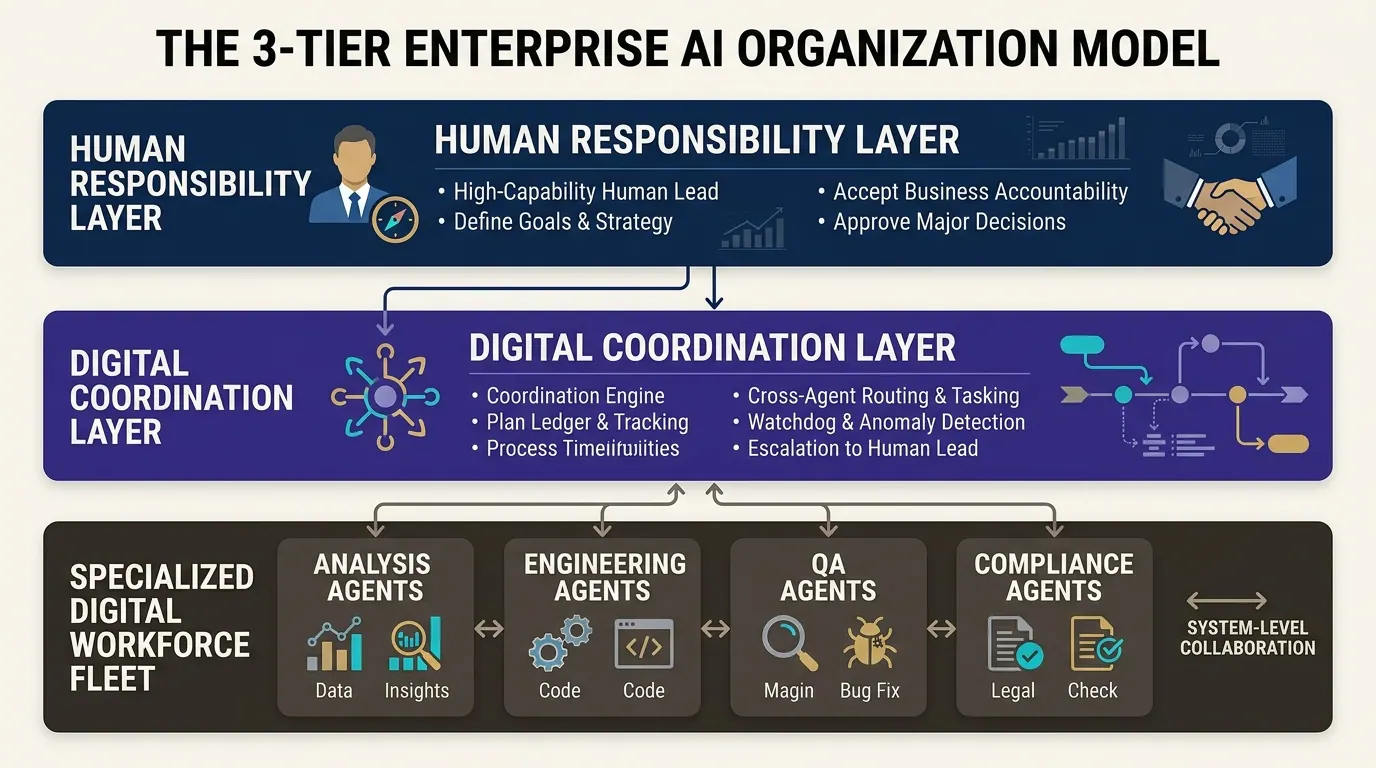
In this architecture, responsibilities are cleanly decoupled and restructured:
1. The Human Lead: Returning from "Human Router" to Ultimate Decision-Maker
Humans are completely relieved of low-level data shuttling and multi-task micromanagement. The human lead focuses exclusively on defining strategic intent, making high-stakes commercial trade-offs, nurturing human trust and client relationships, and anchoring ultimate business accountability.
2. The Digital Coordination Layer: The Operational Partner
This is not another generic LLM prompt; it is a resilient management orchestration engine built to maintain state over long operational cycles.
- It serves the human leader directly, maintaining an active Plan Ledger;
- It continuously tracks real-time execution facts, resource locks, and blocking risks across worker agents;
- It directly handles context routing and automated task handoffs between worker agents, completely eliminating the "Human Router" bottleneck;
- When deviations occur, compliance red lines are touched, or major trade-offs arise, it compresses the context into high-density briefings and escalates to the human lead for a final decision.
3. Specialized Digital Workforce Fleet: Vertical, Disciplined Executors
These are not generic, jack-of-all-trades chatbots. They are specialized digital workers (engineering, test automation, legal compliance, RFP analysis, financial modeling, etc.) that communicate over standard protocols and execute tasks strictly according to organizational SOPs.
05. Front-Office vs. Back-Office: Two Distinct Human-AI Collaboration Paradigms
Under this organizational redesign, enterprises will not apply AI uniformly. The workforce naturally bifurcates into two distinct human-machine configurations:
Front-Office Roles (Sales, Customer Success, Strategic Advisory): Human-AI Symbiosis, Trust at the Forefront
Where deep interpersonal trust, negotiation, and emotional intelligence are paramount, human professionals must remain firmly at the frontline.
However, frontline professionals will be backed by a dedicated digital assistant wired into the enterprise coordination mesh.
- Rather than a rigid script-bot, this assistant extracts CRM signals from daily interactions, automates meeting preparation, executes post-meeting follow-ups, and logs records;
- When complex industry solutions or cross-domain deliverables are required, the assistant requests the backend Coordination Layer, which mobilizes specialized backend agents to produce deliverables that the frontline human can inspect and deliver to clients.
Back-Office Roles (R&D, DevOps, Data Analytics, RFP Bidding, Solution Delivery): One Person as a Fleet
In knowledge-intensive, delivery-focused back-office domains, organizations will undergo radical flattening:
A single seasoned domain architect, empowered by a Digital Coordination Layer, can directly command a fleet of 10 to 50 specialized digital workers, achieving end-to-end delivery that previously required an entire multi-tiered department.
The human defines high-quality problem statements and acceptance criteria; the digital fleet handles high-concurrency execution, validation, and artifact generation.
06. The Ultimate Battle: Don't Unify Agent Tech; Unify Enterprise Governance & Institutional Memory
Once we recognize that "enterprise AI is fundamentally an organizational redesign problem," executive leadership must confront a foundational truth:

Foundation models are transient; agent frameworks are transient; but enterprise governance, roles, and institutional memory are permanent.
The best foundation model today will be surpassed next year; the open-source agent framework your team embraces this quarter may be obsolete by the next.
If an enterprise's AI assets are hard-coded into proprietary prompts or tied to a single vendor's closed environment, every technological generational leap will shatter the company's digital investments.
An enduring digital workforce infrastructure must rest upon three foundational pillars:
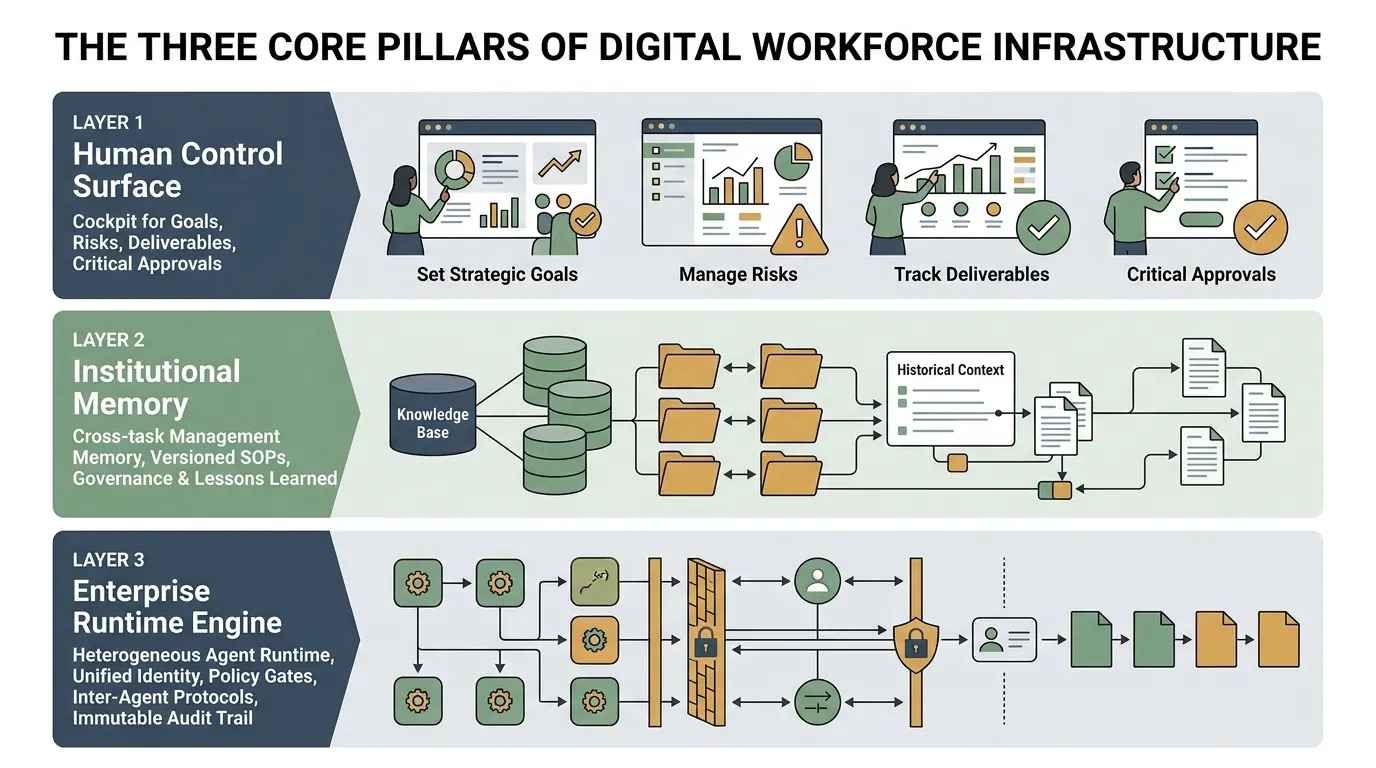
Institutional Memory, Not Disposable Session Memory
- Enterprise SOPs, compliance rules, security constraints, and hard-earned project lessons cannot simply be stuffed into ephemeral prompts.
- There must be an institutional engine that dynamically injects versioned, permissioned rules into agents based on role and context. Crucially, as digital workers solve real-world problems, new operational insights must automatically flow back into institutional memory. Even if the underlying models are swapped tomorrow, the company's organizational rules and operational wisdom remain intact.
An Enterprise Runtime Engine for Heterogeneous Agents
- Whether an agent is custom-coded in Python, built on an open-source SDK, or called via a proprietary vendor CLI, once it enters the enterprise perimeter, it must adhere to unified identity, isolated runtime sandboxes, policy execution gates, standard inter-agent communication protocols, and immutable audit trails.
- This does not constrain AI capability; it provides the essential "rule of law and traffic infrastructure" for digital labor to scale safely.
From Raw Chat Boxes to the Human Control Surface
- Real executives and managers should not spend their days typing prompts into 50 disjointed chat windows.
- The human interface must be a unified operational cockpit: What are our strategic goals? What is the status of my digital fleet? What are the critical blocking risks? Which high-risk operations require my immediate authorization? Which deliverables are ready for sign-off?
07. Conclusion: A Watershed Moment for Organizational Leverage
Enterprise AI has arrived at a defining crossroads.
One path is the "Super-Soloist" playbook aggressively peddled by big tech: stuffing increasingly bloated desktop agents onto personal laptops, treating human employees as biological "Human Routers," and driving organizational coordination deeper into chaos beneath flashy keynote demos.
The other path is the "Digital Workforce & Organizational Redesign" paradigm: recognizing the value of individual tools, but refusing to fall into the solo-tool trap; building an enduring foundation of coordination, institutional memory, and governance above heterogeneous tech reality; and empowering accountable business owners to command scalable digital fleets that achieve unprecedented business velocity.
Buying your employees shinier AI Swiss Army knives will never change the fate of your enterprise.
Only organizations bold enough to redesign their organizational units—and establish the runtime infrastructure for a true digital workforce—will secure their ticket to the next decade.